
 Search Articles


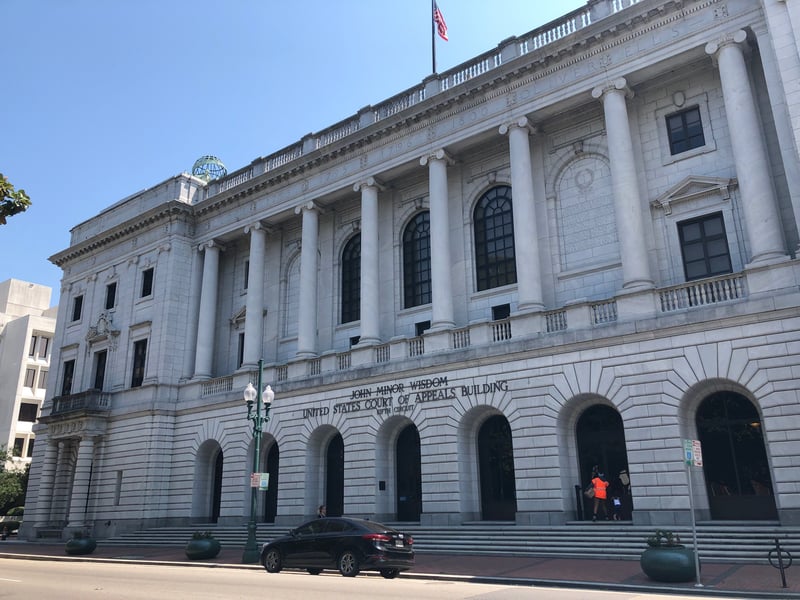
WASHINGTON (CN) — The Supreme Court repudiated the Fifth Circuit more than any other court this term, but legal experts say the appeals court still served as an important pipeline of cases advancing conservative legal causes.
Whether it was glossing over the complexities of evidence, slaying a straw man or pushing the federal judiciary down an uncharted path, the Supreme Court found errors in the Fifth Circuit’s rulings this term.
In a pointed criticism from Justice Elena Kagan, the appeals court was singled out for requiring directions to correctly review social media laws from Texas and Florida, with the Barack Obama appointee noting “that need is especially stark for the Fifth Circuit.”
“Certainly, it wasn’t a term that was especially positive for the Fifth Circuit Court of Appeals,” Adam Winkler, a professor at UCLA School of Law, said in an interview. “They had some victories, but they got shot down in a bunch of cases.”
The eight cases where the Fifth Circuit was rebuffed elicited more consensus and less ideological divisions along the bench, with half of the rejected rulings being unanimous. In an 8-1 decision reversing the Fifth Circuit on a major Second Amendment case, the majority only lost Justice Clarence Thomas.
Even as the justices split 7-2 and 6-3 when reversing cases involving the administrative state and the First Amendment, the majority included justices from both ideological wings of the bench.
Court watchers provided one explanation for the Fifth Circuit’s uneven ratio of losses.
“The Fifth Circuit’s view of a lot of things seems to be, to me as an outside observer, that they’re very happy to be a forum for parties nationwide who want to challenge the federal government,” Alison LaCroix, a professor of law and history at the University of Chicago, said in an interview.
Eight out of the 11 appeals at the Supreme Court from the Fifth Circuit this term involved challenges to the federal government. In a challenge to federal agency funding, the appeals court would have defunded a watchdog agency. The Fifth Circuit also ruled to strictly limit how the Biden administration shares information with social media platforms, throw out federal gun prohibitions on domestic abuser firearm ownership and curtail access to an abortion drug nationwide.
“The Fifth Circuit has been willing to be that kind of marketplace or litigation domain in which those arguments are being aired,” LaCroix said.
All of the rulings that affirmed the Fifth Circuit this term involved federal policies, with only one falling in the government’s favor. The Supreme Court upheld rulings dictating requirements to deport noncitizens, discarding a federal ban on bump stocks and overhauling federal agency law enforcement.
“The Fifth Circuit is clearly pushing the boundaries of the law and it is winning in some of these cases,” Winkler said. “And I guess if they’re going to be a maverick court, really pushing the law, even if they only win half of those cases, it’s pretty good success for the conservative legal movement. They will have succeeded in pushing the law in a distinctly conservative direction.”
Unlike the more unanimous reversals, the justices were more likely to split on ideological lines when upholding rulings from the Fifth Circuit, with the conservative supermajority prevailing.
While few in number — only three out of 11 appeals — the Fifth Circuit wins carried a heavy punch. In one of the most controversial rulings of the bunch, the Supreme Court approved the appeals court’s shake-up of agency adjudication, deflating the authority of in-house administrative law judges.
That particular opinion resulted in a scathing dissent from the liberal wing, with Justice Sonia Sotomayor characterizing the decision as a judicial hubris, marking a massive sea change further dismantling the administrative state.
Legal experts say the Supreme Court isn’t merely a bystander in the Fifth Circuit’s endorsement of novel jurisprudence.
“In a manner of speaking, the Fifth Circuit is pushing the Supreme Court to adopt a more radical jurisprudence but another way of looking at it is the Fifth Circuit is just responding to the calls that the Supreme Court has been sending to the lower courts and conservative litigants,” Thomas Wolf, director of democracy initiatives at the Brennan Center, said in a phone call.
Legal experts said the Supreme Court could signal an aversion to these rulings. Aside from rejecting the Fifth Circuit’s findings, the justices could issue more summary reversals, refusing to even entertain the cases. The court could issue narrower rulings, indicating a distaste for big shifts in the law.
But court watchers more often see the justices encourage these ideas in their writings.
“What’s been going on is that justices who want to change the law or move it in a particular direction will take a case that’s sort of related to the issue that they want to address and then they’ll put suggestions in,” Kermit Roosevelt, a law professor at the University of Pennsylvania Carey Law School, said in an interview.
Thomas is often cited for using this tactic, sprinkling in once unconventional ideas in dissents and concurrences that are now considered mainstream, featuring in majority opinions.
Some court watchers believe that even when the Fifth Circuit is repudiated, not all is lost because of the exposure the novel views are getting, potentially making them more palatable over time.
“Is the Supreme Court striking down the Fifth Circuit and should we see that as the Fifth Circuit being rejected or scolded by the Supreme Court?” LaCroix said. “Is that not what’s happening? Or even if that is a scolding from the Supreme Court, maybe that doesn’t matter if the purpose is to air the novel argument and kind of get people used to the idea. I think all of those things may be true in some ways.”
 Follow @KelseyReichmann
 Follow @kelseyreichmann.bsky.social
Subscribe to our free newsletters
Our weekly newsletter Closing Arguments offers the latest about ongoing trials, major litigation and rulings in courthouses around the U.S. and the world, while the monthly Under the Lights dishes the legal dirt from Hollywood, sports, Big Tech and the arts.