
 Search Articles


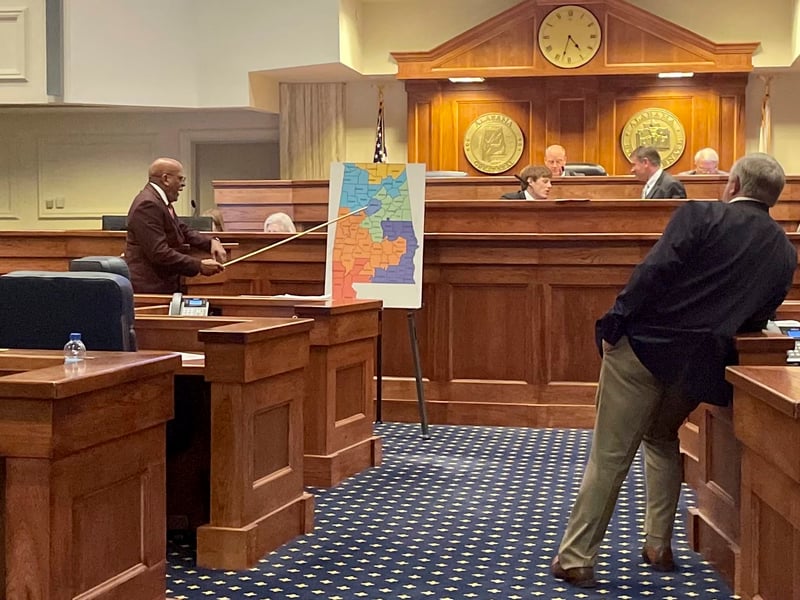
(CN) — After parties in Alabama’s ongoing redistricting fight met in a Birmingham courtroom again late July, the federal panel of judges who heard their arguments rejected the voting rights advocates’ request to “bail-in” the state to federal preclearance requirements under Section 3 of the Voting Rights Act.
In a per curiam order, the panel determined there was a lack of need for intrusive federal relief because the state’s active congressional district plan was drawn by a special master and approved by the court. It is already in place for the 2026, 2028, and 2030 elections.
The special master plan, which was created by court order after the Republican supermajority in the legislature refused to add a second Black-majority district, fully addresses constitutional violations, the court found.
“So long as the Legislature does not pass any legislation that would violate the injunctive relief we have entered, and the Secretary abides by our injunctions, we can discern no compelling reason to tread into such intrusive waters,” the panel said.
The U.S. Department of Justice has filed a brief indicating it wasn’t interested in monitoring Alabama’s redistricting process.
The court did not let the state completely off the hook in its Thursday ruling. The panel also said the court would retain jurisdiction to enforce the remedial plan, prevent backsliding and address any future violations without the need for Section 3’s “extraordinary measure.”
Yet they also stressed respect for state sovereignty, noting that the Constitution entrusts states with redistricting, adding preclearance would be a significant federal overreach unless absolutely necessary.
The panel noted that legislators agreed not to redraw the map before 2030, and said “we will not, in an unrestrained attempt to resolve any hypothetical issue that may arise far down the road, assign to our court the exceedingly intrusive task of supervising Alabama’s congressional elections for the next fifteen years.”
The court also suggested that Section 3 preclearance typically requires more than a single violation — such as a pattern of “pervasive, flagrant, rampant, and widespread” voting discrimination. Although U.S. District Judge Terry F. Moorer, a Donald Trump appointee, emphasized the state’s long, well-documented history of racial discrimination in the July hearing, the panel ultimately determined the plaintiffs only proved violations in a single redistricting cycle.
The panel also included U.S. Circuit Judge Stanley Marcus, Bill Clinton appointee, and U.S. District Judge Anna Manasco, also a Trump appointee.
The case dates back to the 2020 Census, which revealed a Black population of 26% and the need for a second Black majority congressional district in Alabama. But repeatedly until 2023, Republican state legislators approved noncompliant maps, until the group of voters who became plaintiffs convinced the court to strip the legislature of its responsibility.
The resulting special master plan forced two white incumbent congressmen to run against each other in District 1 — U.S. Representative Barry Moore won — while U.S. Representative Shomari Figures, who is Black, was elected to District 2. Previously, U.S. Representative Terri Sewell was the state’s lone Black member of Congress.
In a scathing order from May, the panel determined the state intentionally diluted the voting power of Black residents, characterizing the legislature’s act as “intentional racial discrimination.”
“Try as we might, we cannot understand the 2023 plan as anything other than an intentional effort to dilute Black Alabamians’ voting strength and evade the unambiguous requirements of court orders standing in the way,” they wrote.
On Friday, representatives of the parties did not immediately return requests for comment.
 Follow @gabetynes
Subscribe to our free newsletters
Our weekly newsletter Closing Arguments offers the latest about ongoing trials, major litigation and rulings in courthouses around the U.S. and the world, while the monthly Under the Lights dishes the legal dirt from Hollywood, sports, Big Tech and the arts.