
 Search Articles


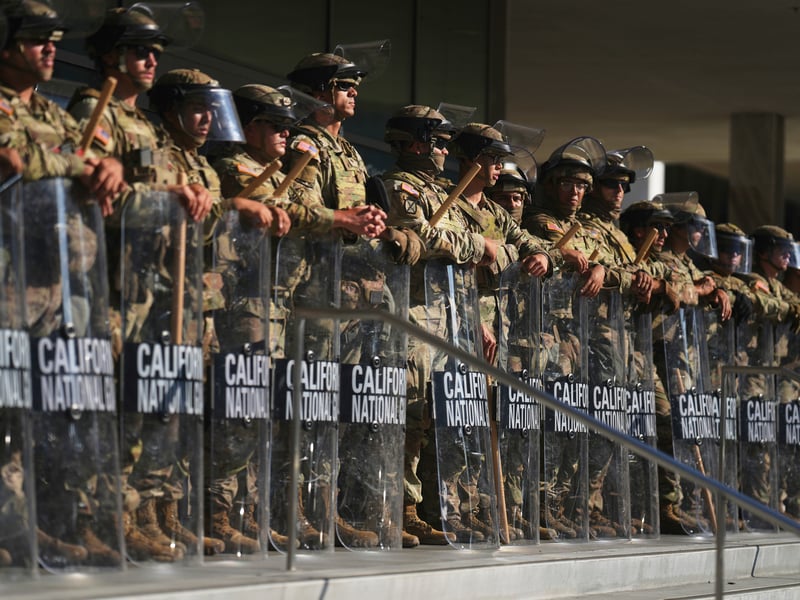
PASADENA (CN) — The Trump administration asked a Ninth Circuit panel Wednesday to lift a lower court block on federalizing the California National Guard in Los Angeles, arguing that the court “improperly second-guessed the president’s judgment.”
“The district court in this case entered an extraordinary and at the time unprecedented order enjoining the president from calling up the National Guard, a step the president had taken to protect federal personnel and property from violent riots in Los Angeles seeking to thwart enforcement of federal immigration law,” Deputy Assistant Attorney General Eric McArthur told the panel.
Trump deployed thousands of guard members and Marines to Los Angeles in June, citing “numerous incidents of violence and disorder” that followed the immigration sweeps by Immigration and Customs Enforcement (ICE) in Los Angeles, calling the protests “a form of rebellion."
California sued the Trump administration two days after deployment began. Soon after, U.S. District Judge Charles Breyer issued a temporary injunction returning control of the National Guard to Newsom. The federal government appealed, and the Ninth Circuit stayed the injunction, ruling that the president has broad discretion to deploy the Guard if his ability to execute federal law is “significantly impeded.”
A few days later, the appeals court extended the emergency pause, finding that Trump was within his authority to deploy the state National Guard. However, the panel noted it disagreed with the federal government’s argument that Trump’s deployment decision was “unreviewable.”
In July, a Ninth Circuit judge requested a vote to rehear the case. However, a majority of the voting judges decided against this, according to a decision released Wednesday evening.
Several judges dissented, including Senior U.S. Circuit Judge Marsha S. Berzon, a Clinton appointee, who wrote in an opinion for 11 other circuit judges that the panel’s decision to grant the government’s request for a stay was written in “exigent circumstances with fairly perfunctory briefing and no knowledge as to what was coming next.”
Berzon also called out the judges who voted against the en banc rehearing, writing, “I continue to think that the president’s disregard for this country’s deep-seated commitment to the principle that armed forces must not be used as civil law enforcers except where there is no alternative should have been headed off now, not later.”
U.S. Circuit Judge Ronald Gould, another Clinton appointee, separately wrote that the case “warranted a more extensive consideration” and that the court “should have imposed real limits on the statutory presidential power at issue here.”
In Wednesday’s hearing, McArthur reiterated the government’s position that the president has unreviewable discretion to send the National Guard and determine how long they are deployed.
“When the president has made a determination that one of the enumerated exigencies exists, that decision is vested in his sole and exclusive discretion and is conclusive on all other persons, including the courts,” he said.
The panel — consisting of U.S. Circuit Judge Mark J. Bennett and U.S. Circuit Judge Eric D. Miller, both Trump appointees, and U.S. Circuit Judge Jennifer Sung, a Joe Biden appointee — seemed skeptical of the government’s argument that there was no time limit on how long troops could be deployed and lobbed hypotheticals, including whether a militia called up by President George Washington could stay called up forever without any judicial review.
“Would it be your view that no matter how much conditions on the ground changed, there would be no ability of the district court to review, say, in a month, six months, a year, five years, whether the conditions still support that the president was unable, with the regular forces to execute faithfully the laws of the United States?” Bennett asked.
McArthur said yes.
“I just don’t see a basis in the text of the statute for a court to be making that determination,” he said. “The court would have to, in essence, make up its own standard about when the National Guardsmen have to be released from service, because there’s nothing in the statute, unlike the prior versions, that speaks to that question.”
The panel also pushed back on the government’s argument that Trump has the authority to deploy federal troops under Title 10, Section 12406 of the U.S. Code, which allows federal use of state National Guard troops during a “danger of rebellion.”
“Why is a couple of hundred people engaging in disorderly conduct and throwing things at a building over the course of two days of comparable severity to an invasion or rebellion?” Miller asked.
McArthur described the events that unfolded in early June as “laying siege” on federal buildings and “hours of nonstop fighting.” He said officers were not able to carry out the immigration enforcement operation they had previously planned.
“Violence is being used to thwart enforcement of federal law; this is well beyond the sort of everyday resistance that you see to federal law enforcement,” he said.
In contrast, California emphasized just how much had changed since Trump first ordered the National Guard to LA, expanding the deployments of federalized troops until February 2026 and promising to send troops to other cities included in the Ninth Circuit.
“The evolving circumstances over the past four months only highlight the importance of a judicial check in this area,” California Solicitor General Samuel Harbourt said.
Harbourt emphasized the reduced number of troops as a reason that there is no longer the same “pressing need” the government claimed in June would support the appeals court continuing the stay.
He added that while the majority of 4,100 guard members and Marines sent to LA have been sent home, around 300 remain called up. Of those remaining, around 200 have been sent out of state to Portland and Chicago, with only around 85 remaining in Los Angeles.
Harbourt argued the government did not need to deploy federal troops where there were civilian law enforcement options available.
“There are alternative civilian law enforcement measures generally available in the face of exigent circumstances, and there’s no explanation in the record, none as to why those measures were unavailable or infeasible,” he said.
The panel also questioned Harbourt about where Section 12406, which allows the president to federalize the National Guard when “the president is unable with the regular forces to execute the laws of the United States,” fits with the Posse Comitatus Act (PCA), which bars federal troops from engaging in local law enforcement.
“I’m having a hard time seeing how the exception in 12406, ‘to execute the laws,’ wouldn’t count as an exception under the PCA,” Bennett asked.
Harbourt said while the statute authorizes the federalization of troops, it does not authorize the “specific types of law enforcement activities that would fall within the Posse Comitatus Act.”
In September, Breyer, a Bill Clinton appointee, ruled that Trump’s deployment violated the Posse Comitatus Act. The government quickly appealed the ruling.
California has also threatened to “immediately” sue Trump if he sends federalized National Guard troops into San Francisco, an idea he has spoken about publicly multiple times.
“San Francisco may be the president’s latest target, but California is no stranger to the president’s political games and unconstitutional tactics. We’re ready to go to court immediately if the president follows through on this latest illegal plan,” California Attorney General Rob Bonta said in a press release.
However, San Francisco Mayor Daniel Lurie said Thursday that Trump had called off plans to deploy federal agents to his city for immigration enforcement.
The Trump administration also faces legal challenges to its use of National Guard troops in Portland and Chicago.
Neither party responded to requests for comment by press time.
 Follow @mhattridge_
Subscribe to our free newsletters
Our weekly newsletter Closing Arguments offers the latest about ongoing trials, major litigation and rulings in courthouses around the U.S. and the world, while the monthly Under the Lights dishes the legal dirt from Hollywood, sports, Big Tech and the arts.