Search Articles


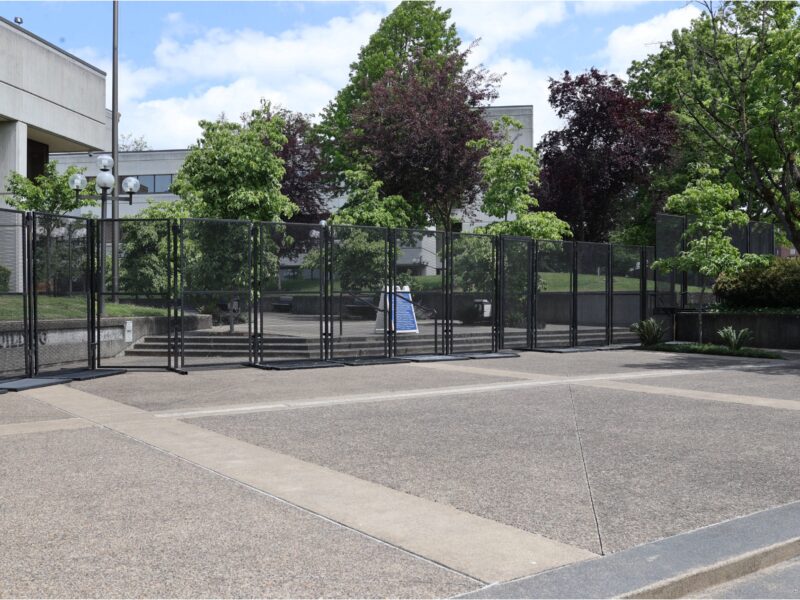
EUGENE, Ore. (CN) — The federal government has less than 24 hours to remove a fence it erected around an Oregon federal building — blocking off a plaza that has long been the site of public protests and demonstrations.
“Rather than ordering a mandatory injunctive remedy to move the fence, and given defendant’s incapacity to provide certain timelines even now, the only thing this court can and should do is order a return to the status quo — the removal of the existing perimeter fence,” U.S. District Judge Mustafa Kasubhai wrote in his order.
The General Services Administration has until 7 a.m. Thursday to fully remove the fence.
On Wednesday, the Ninth Circuit denied the General Services Administration’s bid to extend the appeals court’s block on Kasubhai’s previous order to remove the fence.
The appeals court will consider the merits during a hearing next Wednesday and said the denial “should not be construed to prevent the government from implementing other appropriate safety measures for the protection of personnel and property."
Six plaintiffs with a history of participating in protests at the Eugene Federal Building sued the General Services Administration at the beginning of June, accusing the agency of violating their First Amendment rights by blocking off access to a plaza traditionally used as a public meeting ground.
The federal government installed fencing around the perimeter of the building in late April. The building houses U.S. Customs and Immigration Enforcement and other federal agencies. The move was publicly announced in February by Eugene Police Chief Chris Skinner in response to protests that occurred in the plaza and courtyard in late January.
The General Services Administration told the city the fence was temporary and expected to be in place for approximately two years to protect the building and employees and to facilitate repairs to damage caused by the January protests. The agency also said it would provide a designated area for protesters to gather on a lower plaza.
Kasubhai, a Joe Biden appointee, initially ordered the government to do just that on June 22, writing that the case involved the “effective elimination of a long-established public forum in which the people have spoken freely for 50 years.”
“This case is a reminder that our government can be short-sighted when focusing on protecting certain immediate interests,” Kasubhai wrote in his June 26 written opinion, giving the government a chance to implement alternative fencing on its own timeline.
However, the Ninth Circuit temporarily paused the order on Tuesday and asked Kasubhai to “consider and clarify what alternative measures the appellant is authorized to employ.”
But Kasubhai stuck with his original decision in his own Tuesday ruling. He gave the government until Thursday morning to remove the fence, finding that it failed to provide any meaningful details about timing and process for moving the perimeter fence in a way that would open access to the plaza.
“Defendant did not express any serious interest in undertaking the authorized alternative,” Kasubhai wrote. “Further, the court did not have confidence that defendant and its counsel would use any additional time to consider implementing the authorized alternative to further resolution.”
At a Tuesday afternoon hearing to discuss the Ninth Circuit’s first pause, Kasubhai questioned the government’s lack of action during the time while his fence removal order was in place. There were roughly 12 hours between the expiration of the Ninth Circuit’s stay and when the lower court reconvened, during which time the government did not perform any fence removal work, Kasubhai noted.
The result of that hearing, which lasted over three hours and involved the testimony of two government witnesses, “confirms to the court the necessity of focusing the prohibitory injunctive relief on the removal of the fence rather than the implementation of the court’s authorized alternative fencing,” Kasubhai determined.
Specifically, Kasubhai noted the federal defendant seemed “disinterested in a solution other than a formal decision on the merits.”
Part of the rush to remove the fence is so the plaza can be publicly accessible for the Fourth of July holiday. The General Services Administration posited that reconfiguring the fence to the court-approved alternative would take between 30-40 days.
The fence cost around $270,000 to install, and the federal defendant estimated it will cost another $100,000 to implement the alternative fence perimeter, as it requires additional panels.
The General Services Administration website once stated the plaza played a “significant civil role in the early 1970s and during the Vietnam War. The plaza was and remains a favored venue as a stage for protests against the government’s policies.”
That passage has since been removed from the website.
Neither party responded to a request for comment before press time. A further status conference on the fence removal is set for Thursday morning.
Subscribe to our free newsletters
Our weekly newsletter Closing Arguments offers the latest about ongoing trials, major litigation and rulings in courthouses around the U.S. and the world, while the monthly Under the Lights dishes the legal dirt from Hollywood, sports, Big Tech and the arts.
Additional Reads
 Political discrimination in Puerto Rico? July 1, 2026