
 Search Articles


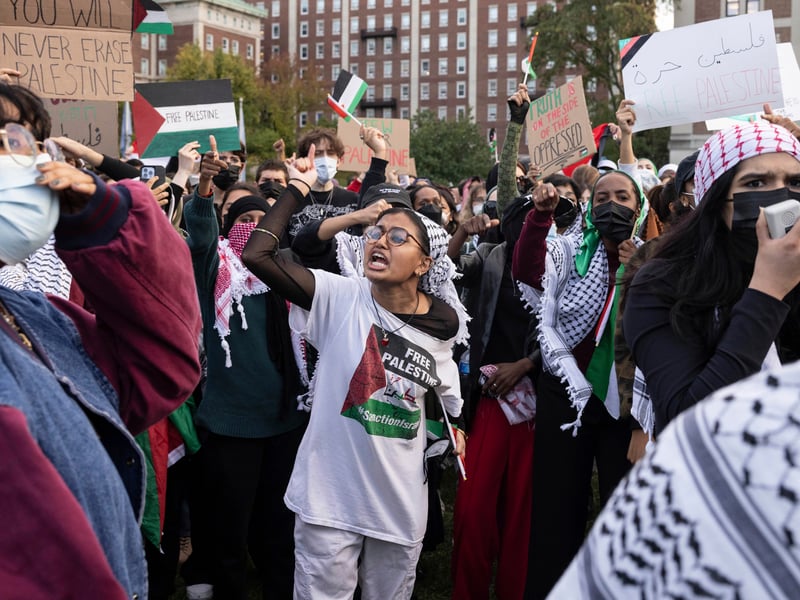
(CN) — President Donald Trump’s White House is on trial for its recent attempts to arrest and deport pro-Palestinian demonstrators at college campuses around the country.
Collegiate scholars testified against the government on Monday at the trial’s opening, where they claimed that their First Amendment rights have been chilled after seeing the arrests of students like Mahmoud Khalil and Rumeysa Ozturk — both of whom were targeted for deportation for their pro-Palestinian activism and have since been released from federal immigration custody.
One witness, Brown University international studies professor Nadje Al-Ali, said that the practice reminded her of stories from her Iraqi family.
“I know about dictatorship and repression, and my relatives in Iraq lived with that fear of being picked up from the street,” she testified. “It really reminded me of that.”
Al-Ali criticized the Trump administration for conflating pro-Palestinian speech with antisemitism and worried that her advocacy for Palestinian rights could affect her ability to get in and out of the United States as a German citizen with a green card.
She said those fears peaked in March when she got word of Khalil’s arrest in New York City while she was abroad visiting her ill mother.
“What’s going to happen when I get back?” she recalled thinking, adding that she retained an immigration lawyer to track her as she traveled back to the United States from Germany.
Khalil, Ozturk and other students were arrested by federal immigration officers after Secretary of State Marco Rubio deemed them threats to the nation’s foreign policy. Courts have since rejected Khalil’s and Ozturk’s detentions on that ground and ordered them to be released.
Trump said in March that Khalil’s arrest was the “first of many to come,” causing Al-Ali to rethink a planned research trip to Beirut, Lebanon, and Baghdad, Iraq, where she was planning to study gender-based violence in the region.
“Following the arrest and the detention and the threat of deportation of several students … I felt that it was too risky for me to do research in the Middle East,” she said.
The government’s actions against students like Khalil also made Al-Ali question whether she should attend a “No Kings Day” protest against Trump and his policies in Providence, Rhode Island.
“I would have liked to participate … but I was worried that my identity would be captured as part of the protest and that I would be risking increasing my vulnerability in terms of being targeted,” Al-Ali said, explaining why she didn’t attend the June demonstration.
Fellow scholar Megan Hyska, a philosophy professor at Northwestern University, echoed that sentiment when testifying Monday that she was afraid to make public statements denouncing the Israeli government for its bombing campaign in the Gaza Strip.
“I was fearful of deportation on the basis of high profile public speech that expressed dissent with the Trump administration or its policies,” Hyska said.
The trial stems from a lawsuit filed in March by higher education groups against Trump and several leading members of his administration, including Rubio.
In their complaint, filed in federal court in Massachusetts, the groups claim that the government’s targeting of pro-Palestinian students has “created a climate of repression and fear on university campuses.”
“It is terrorizing students and faculty for their exercise of First Amendment rights in the past, intimidating them from exercising those rights now, and silencing political viewpoints that the government disfavors,” the groups argue.
At the bench trial, the plaintiffs are looking to prove that the Trump administration is trampling on the constitutional rights of scholars by preventing them from engaging in advocacy or research on these scrutinized topics.
The government insists that it hasn’t chilled free speech whatsoever. U.S. District Judge William Young, a Ronald Reagan appointee in Boston’s federal court, is overseeing the proceedings and will decide the issues at hand. He previously ruled against the Trump administration’s broad cuts to National Institutes of Health funding, accusing the government of “palpable” discrimination in its targeting of diversity, equity and inclusion initiatives.
 Follow @Uebey
 Follow @uebey.bsky.social
Subscribe to our free newsletters
Our weekly newsletter Closing Arguments offers the latest about ongoing trials, major litigation and rulings in courthouses around the U.S. and the world, while the monthly Under the Lights dishes the legal dirt from Hollywood, sports, Big Tech and the arts.