
 Search Articles


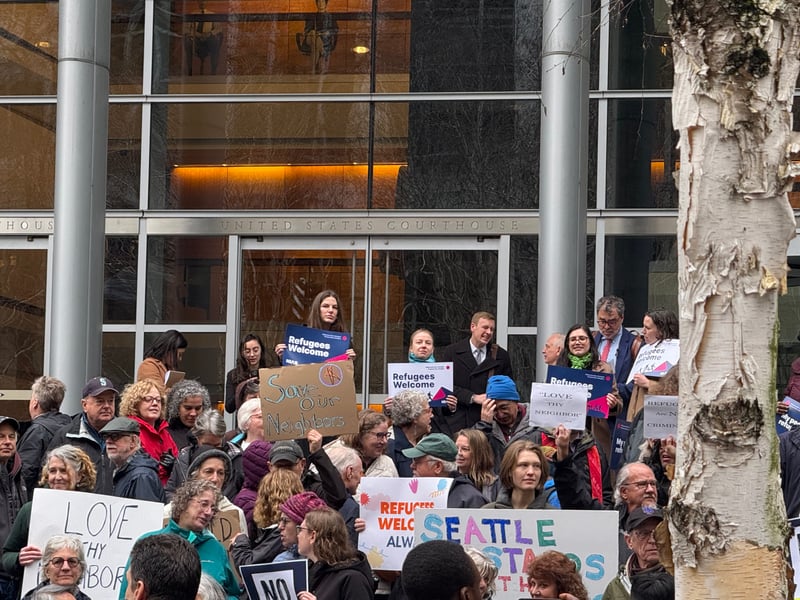
SEATTLE (CN) — As its bid to suspend the U.S. Refugee Admissions Program faces a legal challenge, the federal government offered a drastically low estimate of how many refugees it must admit to comply with a court order.
That figure is 160 people who have been identified as falling within the protections of a preliminary injunction as defined by the Ninth Circuit Court of Appeals, Justice Department attorney David Kim said during a Thursday morning status conference.
It’s an estimate that is around 10,000 people lower than that offered by the plaintiffs — three refugee aid organizations and nine individual refugees — and one that U.S. District Judge Jamal Whitehead wasn’t convinced was accurate to the language within the appeals court’s order.
“We have this fundamental disagreement about what this Ninth Circuit order states,” the Biden appointee remarked. “I just don’t see the limitation you’re trying to foist upon it.”
It’s not the first time the court has clashed with the government’s reading of the higher court’s order in this case.
After Whitehead issued a preliminary injunction preventing the government from fully suspending refugee admissions through President Donald Trump’s executive order, titled “Realigning the United States Refugee Admissions Program," the Ninth Circuit issued a brief order staying the order except as it applied to people conditionally approved for refugee status before Jan. 20.
The Ninth Circuit didn’t define “conditional approval,” which led to conflicting interpretations about who is protected under the injunction. The appeals court then clarified that its previous order only pertained to individuals who met three conditions on or before Jan. 20: had an approved refugee application, were cleared for travel to the United States and had “arranged and confirmable travel plans to the United States.”
It’s the “arranged and confirmable” condition that led the government to reduce its estimate to only include people who had plans to travel within the two weeks following Jan. 20. However, the two-week limitation the government read into the order perplexed Whitehead.
“You’re reading terms into the Ninth Circuit clarification order that simply were not there,” Whitehead said.
Kim argued that applying the narrow window to the order was an “entirely reasonable” interpretation. Someone like Pacito, one of the individual plaintiffs, would be eligible under the reading since his travel was scheduled for Jan. 22.
If the two-week limitation were lifted to include all individuals who had met the conditions and had travel plans arranged and confirmed, even for later dates, the number would come closer to around 12,000 people, the government acknowledged.
“If you were to go beyond a two-week window, the number jumps drastically, beyond exponential,” Kim said.
In its clarification order on the partial stay, the Ninth Circuit said both parties had misinterpreted the carveout for refugees who were nearly set to travel to the U.S. before Trump issued the executive order. The appeals court noted found the government’s estimate of up to 130,000 people was incorrect, as well as the plaintiff’s claim that tens of thousands of refugees had been approved for travel by the government ahead of the order.
Admitting 12,000 refugees would be a significant hurdle for the government, Kim said. Deepa Alagesan, attorney with the International Refugee Assistance Project, noted that the process wouldn’t be so difficult if the government resumed working with the resettlement partner organizations. But the government argued that it could manage admitting the 160 people it identified as excluded from the program suspension on its own.
When asked whether the government would comply with admitting 12,000 people if that is the number the court landed on, Kim admitted it would be at odds with the government’s interpretation and would likely have to seek further review.
Whitehead previously expressed a reluctance to be in a position again where further clarification from the Ninth Circuit would be necessary and indicated he would have a compliance framework released soon.
Subscribe to our free newsletters
Our weekly newsletter Closing Arguments offers the latest about ongoing trials, major litigation and rulings in courthouses around the U.S. and the world, while the monthly Under the Lights dishes the legal dirt from Hollywood, sports, Big Tech and the arts.