
 Search Articles


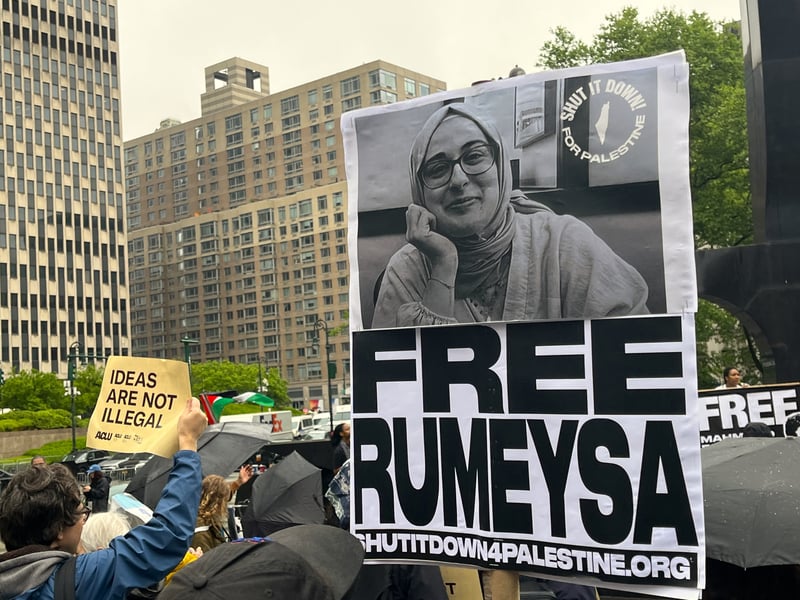
MANHATTAN (CN) — The Second Circuit on Wednesday ruled against the Trump administration’s efforts to keep a pro-Palestine Tufts University student at an ICE facility in Louisiana while she fights her deportation.
The three-judge panel issued a speedy 45-page ruling in favor of Rumeysa Ozturk, a Turkish doctoral student who was jailed in March by six masked plainclothes federal agents near her home in Somerville, Massachusetts. She claims that her arrest was in retaliation to an article she co-wrote in The Tufts Daily, in which she criticized the university’s response to pro-Palestine protests on campus.
Last week, a federal judge ordered Ozturk transferred from Louisiana to Vermont to fight her deportation there. But the government sought to keep her in Louisiana, and claimed that it would suffer irreparable harm and “irrecoverable costs” if it was forced to transfer her north.
The Second Circuit was unconvinced, noting in their Wednesday order that the government’s potential to be inconvenienced is outweighed by the possibility of Ozturk’s rights being violated.
“Faced with such a conflict between the government’s unspecific financial and administrative concerns on the one hand, and the risk of substantial harm to Ozturk on the other, we have little difficulty concluding ‘that the balance of hardships tips decidedly’ in her favor,” the judges wrote in a per curiam order.
Ozturk is one of numerous international college students to be targeted via deportation by the Trump administration for criticizing Israel’s bombing campaign in Gaza. Like several of the others, Ozturk’s student visa was quietly revoked just days before her arrest.
“Ozturk was not informed that DHS and ICE were considering seeking her visa revocation, nor that such a determination was made,” the judges acknowledged in their ruling.
Shortly after her arrest on March 25, Ozturk quickly filed a habeas corpus petition challenging her detention. The judges wrote that her lawyers, “unaware of her location and unable to contact their client,” filed the petition in Massachusetts — Ozturk’s last known location — despite the fact that she had already been moved to Vermont and then Louisiana.
The federal court in Massachusetts, finding it lacked standing, transferred the case to Vermont. But the government ascertained that Ozturk needs to file an entirely new petition in Louisiana, where she is currently held.
“The government now argues that this transfer was improper. The government is wrong,” the judges wrote.
It’s a similar situation to that of Mahmoud Khalil, the Palestinian Columbia University student who is also jailed in Louisiana awaiting deportation proceedings for being an outspoken critic of Israel’s war in Gaza.
In Ozturk’s case, the Second Circuit found this venue uncertainty is the Trump administration’s fault for discreetly moving Ozturk from jurisdiction to jurisdiction without letting her contact her attorneys.
“Any confusion about where habeas jurisdiction resides arises from the government’s conduct during the twenty-four hours following Ozturk’s arrest,” the judges ruled.
The government has one week to transfer Ozturk to Vermont so she can appear for her habeas case and fight her deportation. She has a bail hearing on Friday, and a hearing on the merits of her habeas petition on May 22.
“No one should be arrested and locked up for their political views,” Ozturk’s attorney Esha Bhandari of the American Civil Liberties Union said in a statement. “Every day that Rumeysa Ozturk remains in detention is a day too long. We’re grateful the court refused the government’s attempt to keep her isolated from her community and her legal counsel as she pursues her case for release.”
U.S. Circuit Judge Barrington Parker, a George W. Bush appointee, U.S. Circuit Judge Susan Carney, a Barack Obama appointee, and U.S. Circuit Judge Alison Nathan, a Joe Biden appointee, made up the panel. They reached their ruling roughly 24 hours after hearing oral arguments on Tuesday.
At those arguments, Parker pressed the government about the circumstances behind Ozturk’s detention. He probed Deputy Assistant U.S. Attorney General Drew Ensign on whether Ozturk’s speech was constitutionally protected.
“Your honor, we have not taken a position on that,” Ensign replied.
“Help my thinking along, take a position,” Parker demanded.
“Your honor, I don’t have the authority to take a position on that right now,” Ensign said.
The same judicial panel also heard arguments Tuesday in the case of another pro-Palestinian student Mohsen Mahdawi, a Columbia University attendee who was jailed for his activism, then subsequently released by a federal judge in Vermont.
The government contested that order, too. But at the time of writing, the Second Circuit has not yet ruled in Mahdawi’s case.
 Follow @Uebey
 Follow @uebey.bsky.social
Subscribe to our free newsletters
Our weekly newsletter Closing Arguments offers the latest about ongoing trials, major litigation and rulings in courthouses around the U.S. and the world, while the monthly Under the Lights dishes the legal dirt from Hollywood, sports, Big Tech and the arts.