
 Search Articles


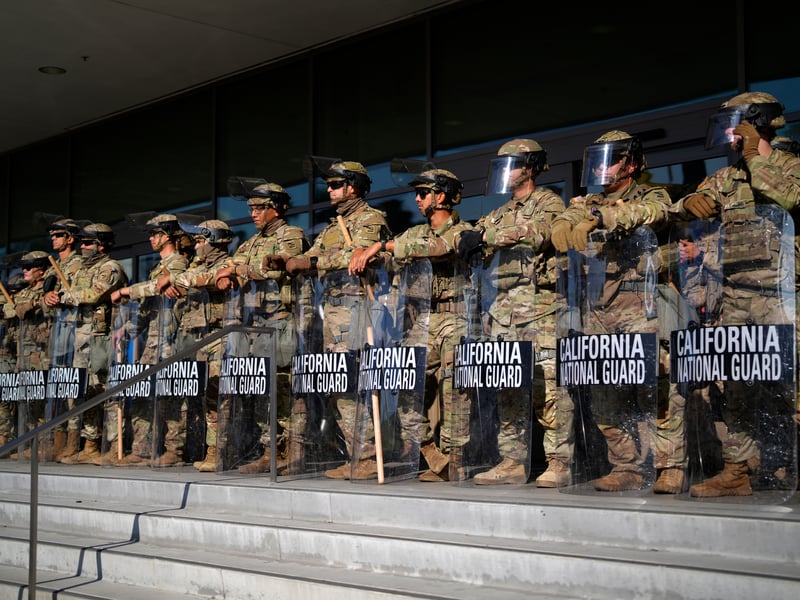
SAN FRANCISCO (CN) — The federal government insisted Tuesday in its closing arguments that President Donald Trump was within his authority to send federal troops into Los Angeles earlier this summer during immigration protests across the city.
The three-day bench trial focuses on the Posse Comitatus Act, a federal law that blocks federal troops from participating in regular civilian law enforcement except when authorized by the Constitution or an act of Congress.
The Department of Justice relied on memorandums issued by Secretary of Defense Pete Hegseth and military training documents to build its case that the Marines and National Guard deployed in Los Angeles did not illegally participate in any law enforcement actions.
During the second day of the trial, U.S. District Judge Charles R. Breyer, a Bill Clinton appointee, heard from the defense’s sole witness, Major General Scott M. Sherman, the commander of Task Force 51, the U.S. Army force deployed to LA in response to protests against U.S. Immigration and Customs Enforcement raids.
Sherman said the task force was sent to LA to “temporarily protect Immigration and Customs Enforcement and other federal government personnel and protect federal property where protests against those actions are happening.”
He said Trump’s labeling the protests “rebellion” triggered a “constitutional exception” that allowed federal troops to partake in four acts otherwise restricted by the Posse Comitatus Act: security patrols, traffic control, crowd control and riot control.
“If there was some impediment of federal employees executing federal laws, is it your understanding the military can provide the services that are outlined in the red portion of the prohibition?” Breyer asked, referring to those four acts.
“Yes, as long as it’s in line with protecting federal personnel,” Sherman responded. “They were strictly there for the protection of federal law enforcement."
When asked about specific operations federal troops took part in — such as “Operation Excalibur,” which took place at MacArthur Park in the Westlake neighborhood of Los Angeles — Sherman said that federal soldiers remained behind state law enforcement agents unless there was a direct threat.
“Is there any limitation to use of the military in an operation which is being conducted by a federal agent? I’m trying to figure out where the limits are,” Breyer said.
Justice Department attorney Eric Hamilton responded that nothing in the Posse Comitatus Act requires pre-assessment and that the president’s memorandum, and memos from the secretary of defense, are enough authorization.
Breyer also asked if there was any determination made as to whether local law enforcement was adequate to address security concerns.
“You bring in the Marines, but maybe it’s entirely possible that the SWAT teams of the LAPD, or the National Guard under the control of the Governor of California, all of whom who have been trained in riot control, traffic stops, that these people have the ability to protect the federal employees in the execution of their job,” he said.
Hamilton responded that local law enforcement response was not sufficient.
In its closing arguments, California rebutted the federal government’s claim that there are exceptions under the Posse Comitatus Act, arguing the president and secretary of defense don’t have the power to create an exception.
“Neither can create an exception to the Posse Comitatus Act, only Congress and the Constitution can do that,” California Deputy Attorney General Megan Strong said.
Strong said the federal government meets all three tests required to prove a violation of the Posse Comitatus Act: direct, active use of military personnel to execute the law, military conduct pervaded the conduct of law enforcement, and military personnel subjected citizens to regulatory, prescriptive, and compulsory power.
She added that each of these incidents on its own is a violation — however, combined, they have a cumulative effect and show how Trump is “deadset on occupying Southern California, intimidating civilians, and using the military to both expedite his agenda and deter any opposition to it.”
Strong also referenced recent comments made by Trump on mobilizing the National Guard in Washington, D.C., and floated the idea of doing the same in other cities, including Oakland and Baltimore.
“To defendants, LA is just the beginning,” she said.
Despite the parties’ closing arguments, only the evidentiary phase of the trial has ended. Trial will continue Wednesday to determine if Breyer can indeed rule on the case.
Representatives for either party did not immediately respond to requests for comment.
Newsom sued Trump in federal court on June 9 — just days after the LA protests began and as many as 4,000 California National Guard troops and 700 Marines were mobilized — arguing that Trump’s deployment of the troops violates the 10th Amendment and the Administrative Procedure Act by exceeding his constitutional authority.
Breyer initially issued a temporary restraining order on June 12 restoring Newsom’s control of the state National Guard, but a Ninth Circuit panel quickly blocked that order the same day with an emergency stay.
Although the panel ultimately disagreed with Trump’s argument that his deployment decision was “unreviewable,” it still determined that the president was within his authority to send in the state National Guard.
In a later court order, Breyer said that the Ninth Circuit’s recent decision will not prevent him from deciding if another preliminary injunction is warranted, as long as he doesn’t interfere with the higher court’s findings on appeal.
“The Ninth Circuit has left it to this court to determine whether defendants’ conduct exceeds their authority under the Posse Comitatus Act … and the court will do so,” Breyer wrote.
This case was filed in the Northern District of California and heard at the Phillip Burton Federal Courthouse in San Francisco.
 Follow @mhattridge_
Subscribe to our free newsletters
Our weekly newsletter Closing Arguments offers the latest about ongoing trials, major litigation and rulings in courthouses around the U.S. and the world, while the monthly Under the Lights dishes the legal dirt from Hollywood, sports, Big Tech and the arts.