
 Search Articles


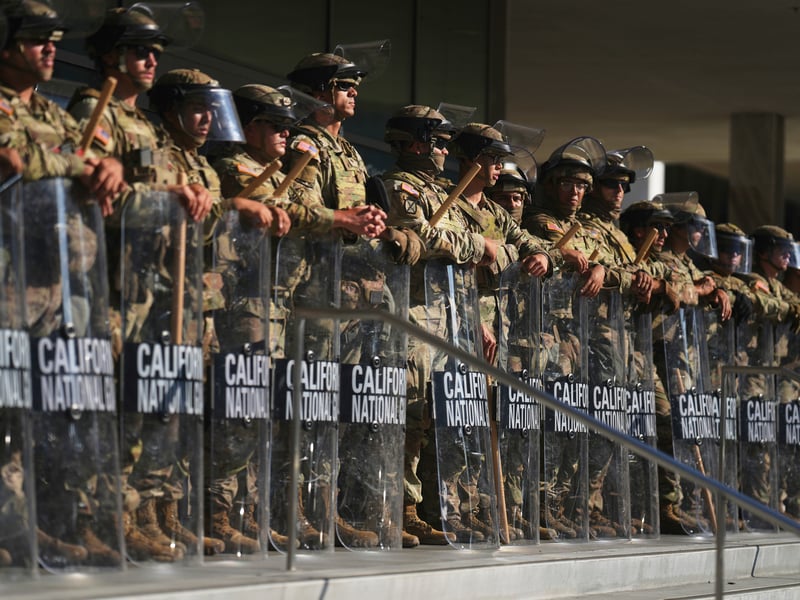
SAN FRANCISCO (CN) — The Trump administration told a federal judge Friday that the president has “exclusive decision-making authority” to extend the federalization of state National Guard troops, and that a decision is judicially unreviewable.
“Is it your view that the president can keep troops federalized indefinitely without judicial review?” U.S. District Judge Charles Breyer, a Bill Clinton appointee, asked.
“We read these statutes to foreclose judicial review at all stages,” Deputy Assistant Attorney General Eric Hamilton said.
Trump deployed thousands of guard members and Marines to Los Angeles in June, citing “numerous incidents of violence and disorder” that followed the immigration sweeps by U.S. Immigration and Customs Enforcement in Los Angeles, calling the protests “a form of rebellion."
California sued the Trump administration two days after deployment began. Soon after, Breyer issued a temporary injunction returning control of the National Guard to California Governor Gavin Newsom. The federal government appealed, and the Ninth Circuit stayed the injunction, ruling that the president has broad discretion to deploy the Guard if his ability to execute federal law is “significantly impeded.”
A few days later, the appeals court extended the emergency pause, finding that Trump was within his authority to deploy the state National Guard. However, the panel noted it disagreed with the federal government’s argument that Trump’s deployment decision was “unreviewable.”
In August, Breyer ruled that Trump’s deployment of National Guard troops was illegal. However, the judge stayed the case in October, saying he was “skeptical” of the federal court’s jurisdiction to consider California’s motion challenging the government’s order extending the presence of the National Guard in Los Angeles. Upon appeal, the Ninth Circuit found that the federal court had jurisdiction over the plaintiff’s challenges.
At Friday’s hearing, Breyer focused the majority of his questions on the federal government, asking what statutory authority exists to extend the federalization of the National Guard and if federalized troops are permitted to remain indefinitely.
Hamilton argued that the president had the sole authority to dictate how long National Guard troops are going to serve, citing a federal statute that states that when federalizing the National Guard, the president may “specify in the call the period of the service,” and that “members and units called shall serve inside or outside the territory of the United States during the term specified, unless sooner relieved by the President.”
Breyer pushed back, saying that the “words themselves don’t say the president can extend the term.”
“The consequence of your position is that as long as the president believes in his discretion that there is a situation that would justify federalization of the National Guard, it can last forever, or at least the duration of the president’s belief. If he believes it, game over, match done, end of the inquiry,” Breyer said.
Hamilton noted that the government was in the process of demobilizing 200 out of the 300 troops mobilized to Los Angeles, arguing that the 100 remaining troops were still needed in Los Angeles because they “help facilitate protection of the federal government from attack,” specifically protecting Department of Homeland Security personnel carrying out immigration enforcement.
He reiterated the government’s June position that Los Angeles is “under danger of rebellion,” citing the violence at anti-ICE protests this summer and an incident earlier this week involving a man throwing a Molotov cocktail into a federal building in downtown Los Angeles.
“How does that square with your calling down the National Guard?" Breyer asked. “You federalized the National Guard; did they stop the Molotov cocktails? If they didn’t stop it, because obviously they didn’t, the argument you need the National Guard there to stop it rings a bit hollow.”
The judge further pressed the government’s rebellion claim, asking Hamilton if every violent protest is a rebellion.
“Well, no, but this one was," Hamilton said.
“I understand that there are illegal, dangerous acts of violence. But, are illegal, dangerous acts of violence co-definitional with rebellion?” Breyer inquired, adding, “You want me to accept the definition that if it’s an act of violence during a protest against administration policy, that is a rebellion?”
“A violent, organized effort against administration priorities, that tracts with rebellion,” Hamilton responded. “In December now, we are in a different situation than when this case was filed.”
“My point precisely,” Breyer said.
On rebuttal, California Deputy Attorney General Meghan Strong argued that there is “no evidence of any ongoing inability to execute the laws,” adding that the Molotov cocktail incident was isolated and handled quickly by federal officers, not the National Guard. She noted that the Department of Justice’s own press release on the event did not list the National Guard as an agency that responded to the issue.
Strong also said that the record includes attestations from the Los Angeles Police Department and California Highway Patrol stating that they are “monitoring and responding to any situation in LA,” but there has been nothing to respond to.
Breyer did not indicate when he would issue a ruling, only that it would be soon.
A representative for the Department of Justice declined to comment.
At a press conference after the hearing, California Attorney General Rob Bonta called the government’s argument that judges can’t review the deployment of the National Guard “remarkable.”
“This president believes that if he’s able to deploy the National Guard, he can then deploy the National Guard in whatever number, to whatever place, for any amount of time, forevermore thereafter and he simply cannot. So the argument violates the law, and it also defies common sense,” he said.
Bonta also said the federal government’s claim of a rebellion in Los Angeles is “untethered from the facts.”
“It’s not a surprise that that position was taken by the federal government, but it’s always shocking, their manipulation of the words,” he said.
 Follow @mhattridge_
Subscribe to our free newsletters
Our weekly newsletter Closing Arguments offers the latest about ongoing trials, major litigation and rulings in courthouses around the U.S. and the world, while the monthly Under the Lights dishes the legal dirt from Hollywood, sports, Big Tech and the arts.