
 Search Articles


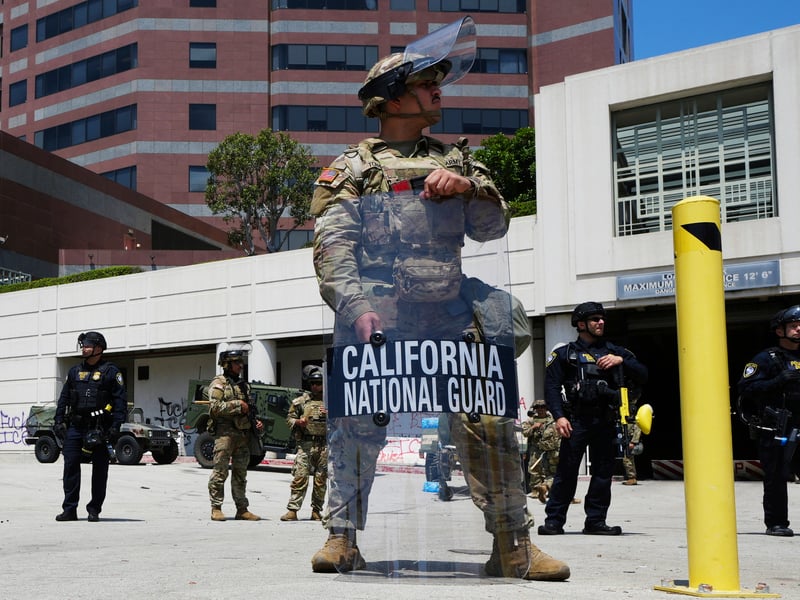
(CN) — The Trump administration asked the Ninth Circuit Court of Appeals on Monday to stay a federal injunction restricting Immigration and Customs Enforcement agents from using certain tactics during its immigration sweeps in Southern California, including the targeting of people based on their ethnicity, accent, language or location.
Beginning last month, federal agents began raiding Home Depots, where immigrants often stand around waiting for work as day laborers; car washes, where many immigrants are employed; bus stops; and other locations, rounding up anyone they suspected of being in the country without legal permission.
Several people with legal immigration status — citizens and those with temporary legal status, like green card holders — were caught up in the dragnet and detained. The operations triggered widespread protests throughout the Los Angeles area and beyond.
Earlier this month, five SoCal residents and three advocacy groups sued the Trump administration over what they called “unlawful stop and arrest practices” and “illegal conditions of confinement.” Soon after, a federal judge issued two temporary restraining orders, one ordering the government to let detainees have access to counsel and the other halting generalized sweeps based on the notion that many Spanish-speaking Hispanic people are known to congregate or work in a certain area.
The Trump administration filed an emergency appeal, asking the court to temporarily pause the injunction pending a more thorough appeal, arguing that it would inflict “irreparable harm” and put immigration enforcement in a “straitjacket.”
During Monday’s oral arguments, held over Zoom, the three judges on the panel — all appointed by Democratic presidents — appeared skeptical about the government’s position and grilled Deputy Assistant Attorney General Yaakov Roth for nearly an hour.
“No one suggested you cannot consider these factors at all,” said U.S. Circuit Judge Jennifer Sung, a Joe Biden appointee. But, she added, “using these factors alone form a broad profile,” which is a violation of the Fourth Amendment.
U.S. Circuit Judge Ronald Gould, a Bill Clinton appointee who has multiple sclerosis and can speak only with great difficulty, asked Roth again and again whether or not each ICE field office in Southern California has been ordered to arrest or detain 3,000 people every day, as the plaintiffs in the case contend.
“I’m just trying to understand what would motivate the officers who did the roundup of aliens here to grab such a large number of people so quickly and without marshaling reasonable suspicion to detain,” Gould said. “Am I right that ICE set that target?”
“I don’t know,” Roth said — not for the last time. “I believe that comes from a newspaper article that the plaintiffs cited.”
Roth insisted the raids were not an instance of ethnic profiling, saying, “Officers are instructed to find reasonable suspicion before they arrest.” But, he added: “I don’t think we have any real information in the record of any particular stop. We don’t know basis for these stops.”
“It seems to me the record establishes that the government is picking locations based on past experience showing that illegal aliens have used these locations or have found work at these locations,” Sung said. “Parking lots, bus stops, car washes.”
The question then, she said, was whether or not that is “a general profile sufficient to support a reasonable suspicion to justify” a legal stop or whether that was a violation of the Fourth Amendment, similar to a police officer racially profiling a driver.
“Those locations are selected for encounters,” Roth said, meaning that ICE agents sought out people for questioning, which might or might not lead to a detention or arrest. “People came and asked questions.”
The encounters, he said, were “consensual,” and the detentions were based on “reasonable suspicion.”
Mohammad Tajsar, a staff attorney at the ACLU representing the plaintiffs, argued that when dozens of ICE agents show up with masks and guns and start questioning people, perhaps blocking their path, it’s never a “consensual encounter.”
When asked if the injunction wasn’t too broad, Tajsar said it might only apply to Southern California, where a large number of Hispanic, Spanish-speaking people who stand outside Home Depots or work at car washes are here legally.
“In this region, these factors cannot possibly weed out those who have documented and undocumented legal status,” Tajsar said. “That is all that [temporary restraining order] is enjoining — the use of four factors in this region where this operation is taking place.” Nothing in the restraining order, he added, “stops the government from doing ordinary investigations.”
Toward the end of the arguments, Gould threw Tajsar a softball, asking, “In the annals of U.S. law, has there ever been a government agency that sought a target for 3,000 persons to be removed per day?”
“I don’t know the answer to that question,” Tajsar said, perhaps reluctant to take the bait. “It would seem to be quite unusual.”
He added: “There is an extraordinary amount of fear. Cities have canceled Fourth of July celebrations. People are afraid of getting on the bus.”
The judges took the argument under submission and suggested that a ruling would be issued on an expedited basis. Gould also asked Roth to tell the court whether ICE has, in fact, directed its field offices to arrest or detain 3,000 people every day. Roth agreed.
The panel was rounded out by U.S. Circuit Judge Marsha Berzon, also a Clinton appointee.
 Follow @hillelaron
Subscribe to our free newsletters
Our weekly newsletter Closing Arguments offers the latest about ongoing trials, major litigation and rulings in courthouses around the U.S. and the world, while the monthly Under the Lights dishes the legal dirt from Hollywood, sports, Big Tech and the arts.