
 Search Articles


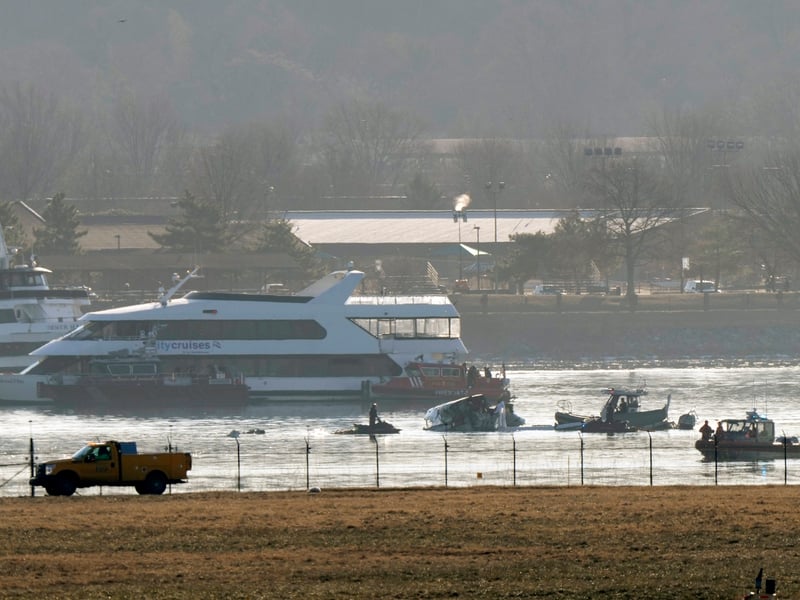
WASHINGTON (CN) — The family of one victim from the fatal plane collision over the Potomac River on Jan. 29 filed a wrongful death suit Wednesday against American Airlines and the federal government for failing to address concerns regarding the busy airspace surrounding Reagan National Airport.
Rachel Crafton, whose husband Casey Crafton was among the 67 killed when American Eagle Flight 5342 collided with a U.S. Army Blackhawk helicopter, brought the 115-page suit in the U.S. District Court for the District of Columbia.
“Defendants knew, or should have known, that AE 5342 was transiting one of the busiest airspaces in the United States, and they knew, or should have known, that the airport approaches presented certain safety risks, specifically including the possibility of a mid-air collision,” Crafton wrote. “This knowledge includes, but is not limited to, the fact that there have been a substantial number of ‘near miss’ events in an around Washington, D.C.’s Reagan National Airport (DCA) which were required to be analyzed to ensure that a mid-air collision does not occur.”
The lawsuit comes amid an ongoing National Transportation Safety Board investigation of the collision, which has thus far revealed that years of repeated concerns regarding the busy airspace around Reagan went unaddressed and were exacerbated by reduced air traffic control staffing.
A two-day hearing in August indicated that broad failures by the Army and the Federal Aviation Administration created an environment the night of the crash where mistakes by an overworked air traffic controller and the helicopter crew resulted in the collision.
Due to concerns around the busy airspace, Crafton said, the airline should have exercised “extreme vigilance” when arriving at Reagan, but had “utterly failed in their responsibilities to the traveling public.”
Specifically, Crafton asserts the flight crew of either aircraft failed to spot and avoid the other; the airline failed to implement policies to mitigate the risks around Reagan; the airline “abused the arrival rate system” at Reagan to force more arrivals per hour; the helicopter crew failed to stay at or below the mandatory altitude; and the Federal Aviation Administration air traffic controllers failed to separate the aircraft in airspace and issue safety alerts when they became too close.
Crafton is requesting a jury trial, where any damage amount will be determined.
According to the NTSB’s probe, the air traffic controller guiding both aircraft on Jan. 29 was managing 21 other flights in the 10 minutes before the collision while working two positions at once, managing both helicopter and jet traffic.
The controller, who has not been identified, approved the Army crew’s request to fly down the Potomac River and informed them of the incoming American flight, but declined to instruct the helicopter to wait near Hains Point as was standard practice.
FAA official Nick Fuller testified that the controller should have warned the airplane’s pilots that the helicopter was approaching from the north and that their paths were “likely to merge.”
In his interview, the controller said by the time he realized there could be a collision, it was too late to warn either flight crew.
The probe further revealed that control tower staff at Reagan had pushed for eliminating or moving the helicopter route where the crash occurred, which passed just below the landing path for the runway the American Airlines flight had used.
Clark Allen, the operations manager at the tower on Jan. 29, testified that the proposal to eliminate the route or move it eastward over Interstate 295 was canceled for being “too political” thanks in part to Reagan’s regular use by members of Congress.
Other concerns regarding the Army helicopter’s equipment, including an inaccurate barometric altimeter responsible for providing altitude readings, an ineffective locator system providing real-time location data and the use of night vision goggles mid-flight, were also raise as part of the NTSB probe.
In an emailed statement, American Airlines said it has provided support to the families of passengers and crew members since the collision and vowed to defend itself against any legal action “claiming the airline caused or contributed to this incident. The company emphasized its support for the ongoing National Transportation Safety Board’s investigation and pointed to the Army’s conduct.
“Aviation safety requires multiple layers of compliance with detailed procedures, restrictions and operational standards across the full range of pilots and air traffic controllers,” the company said. “As the recent NTSB investigative hearing showed, Flight 5342 was on a routine approach to DCA when the Army helicopter — that was above the published helicopter route altitude — collided with it.”
 Follow @Ryan_Knappy
Subscribe to our free newsletters
Our weekly newsletter Closing Arguments offers the latest about ongoing trials, major litigation and rulings in courthouses around the U.S. and the world, while the monthly Under the Lights dishes the legal dirt from Hollywood, sports, Big Tech and the arts.