
 Search Articles


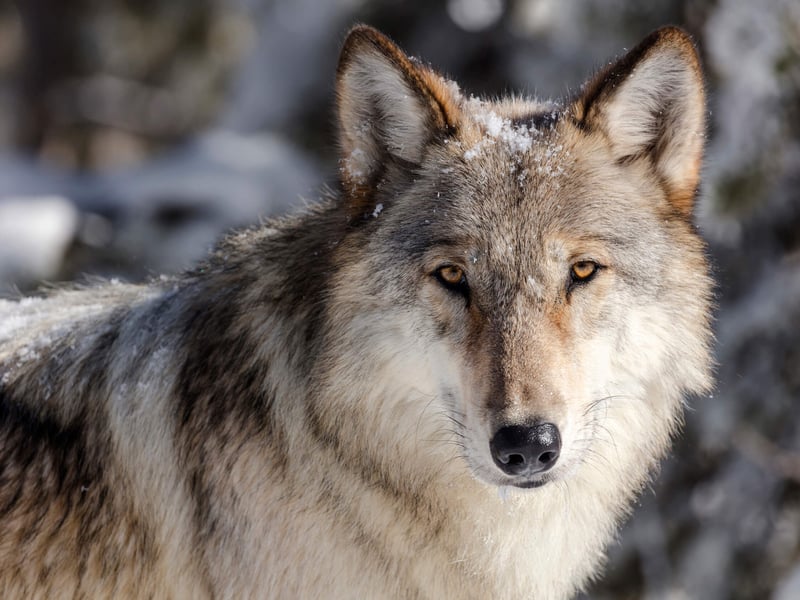
(CN) — Multiple conservation groups urged a Montana federal judge on Wednesday to overturn the U.S. Fish and Wildlife Service’s refusal to restore endangered species protections for gray wolves in the Western United States, arguing the agency ignored science and misapplied the law.
“Again and again over the past two decades, further wolf recovery has depended on the court stepping in to reverse the service’s unlawful listing decisions,” said Margaret Robinson, attorney with Humane World for Animals.
In 2009, the U.S. Fish and Wildlife Service removed the Northern Rocky Mountain’s gray wolf population from the Endangered Species Act’s list of threatened and endangered wildlife.
The Center for Biological Diversity, joined by Humane World for Animals, Humane World Action Fund and the Sierra Club, sued the U.S. Fish and Wildlife Service in 2024 over its denial of their petition to restore the federal protections. The court consolidated the case with two similar lawsuits from Western Watershed Project and Animal Wellness Action, both seeking federal protections for gray wolves.
The service denied two 2021 petitions to restore protections for gray wolves in the Northern Rockies, covering Idaho, Wyoming, Montana, north-central Utah, and eastern Oregon and Washington.
Without federal protections, the gray wolves’ recovering population faces dire threats, argued Robinson.
The service “misinterpreted the [Endangered Species Act], dodged key scientific evidence and inadequately assessed the threats to the wolf in the western United States regarding the significant portion analysis,” Robinson said.
Robinson argued that the service ignored the species’ historical range and wrongly dismissed the southern Rockies as insignificant due to low wolf numbers. The conservation groups claim the Endangered Species Act requires the agency to assess all significant areas where the species is “no longer viable but once was."
The Fish and Wildlife Service argued that it is only required to consider the wolf’s current range, and pointed to the provision that defines endangered species as “any species which is in danger of extinction throughout all or a significant portion of its range.”
“To say a species is in danger in an area where it no longer exists, that is in its historical range where it has been extirpated, is inconsistent with common usage,” said Sara Warren, Justice Department attorney.
However, the conservation group argued that the service’s conclusion overlooked and disregarded key scientific studies, particularly in its adoption of population estimates.
“The population estimates that the service is using here in the states aren’t scientifically based,” said Matthew Bishop with the Western Environmental Law Center.
Within the West, there are 2,797 wolves, which Bishop argued is not sufficiently large to be viable in the long term.
Plus, the service failed to account for state regulation impacts in its species status assessment, Kate Schultz with the Center for a Humane Economy argued. The service also dismissed an Idaho population estimate because it was unpublished.
“This is not just internal inconsistency, but it is hypocritical because the service then relies wholly on the unpublished, unpeer-reviewed [Wildlife Genetics International] report for the genetic health of the larger population,” Schultz said.
The service relied on three states’ (Montana, Idaho and Wyoming) commitments to stop recreational wolf harvest before their wolf populations drop below 150 wolves to support its petition denial, which the conservation groups characterized as uncertain and unscientific.
Plus, Schultz argued that the states and services are overestimating the wolf population based on flawed methods.
“The fact that harvest numbers remain steady and reported wolf counts remain steady is like a canary in a coal mine,” Schultz said. “When the canary dies, the service here has just propped it up and said, ‘Oh, it’s still alive,’ pretending that it is not, in fact, a serious concern and a potential imminent threat.”
The service explained that the minimum threshold for wolf recovery is 30 breeding pairs and 30 wolves, and that Montana, Idaho and Wyoming all manage wolves above that minimum threshold. The three states and federal and tribal lands within managed 45 breeding pairs and 450 wolves, Warren said.
Then there’s the issue of hunting, as both Idaho and Montana authorized increased take, which the conservation groups accused the service of ignoring, but the service argued was not nearly as impactful as the groups claimed.
“Contrary to plaintiff’s suggestion, more permissive hunting is not unregulated hunting,” Warren said. “Even though these states allow hunting and, in some cases, baiting and trapping, wolf populations in those three states are above goal levels, and the states have committed to maintain their minimum levels.”
U.S. District Judge Donald Molloy, a Bill Clinton appointee, questioned how the service determines if the wolf population drops below the 150 that each state committed to managing.
“It varies by state,” Warren said.
“That’s not an answer,” Molloy responded.
Warren explained that in many cases, the states have to rely on estimates and modeling because the populations have grown too large for hand counting.
Warren argued that while the conservation groups may have run modeling differently, they cannot say the service didn’t consider the issue and make a rational decision based on its consideration of the evidence.
Molloy took the matter under advisement and said he would issue a decision as soon as he could.
Subscribe to our free newsletters
Our weekly newsletter Closing Arguments offers the latest about ongoing trials, major litigation and rulings in courthouses around the U.S. and the world, while the monthly Under the Lights dishes the legal dirt from Hollywood, sports, Big Tech and the arts.