
 Search Articles


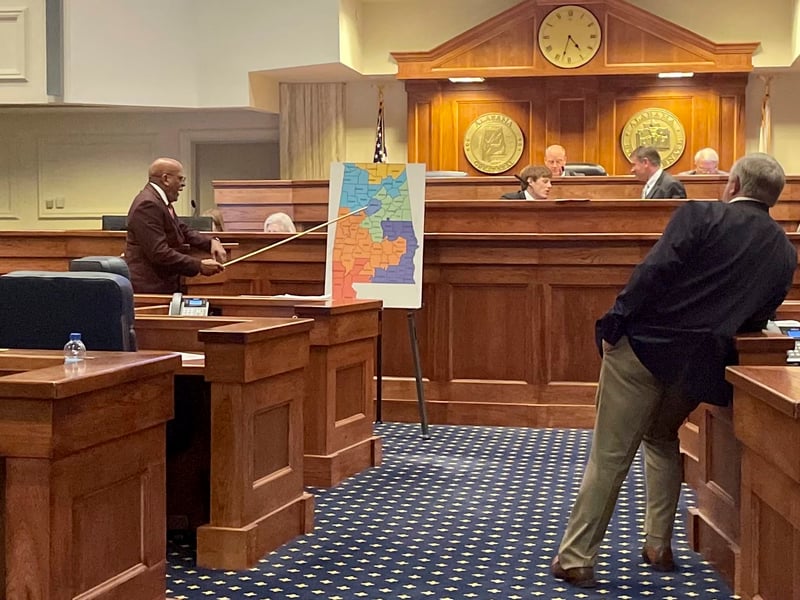
(CN) — A panel of Republican-appointed federal judges in Alabama admonished the state’s Republican-controlled Legislature in a lengthy judicial order Thursday, finding the state deliberately discriminated against Black voters in its congressional redistricting process between 2021 and 2023.
“Try as we might, we cannot understand the 2023 plan as anything other than an intentional effort to dilute Black Alabamians’ voting strength and evade the unambiguous requirements of court orders standing in the way,” the panel concluded in a 571-page per curiam order. “The Legislature deliberately enacted another plan that it concedes lacks the second Black-opportunity district we said was required. This amounted to intentional racial discrimination in violation of the Fourteenth Amendment’s Equal Protection guarantee.”
As part of the ruling, the courts ordered the state to continue using a previously ordered remedial plan, and scheduled further proceedings to consider placing the state under federal preclearance guidelines that were only lifted in 2020.
Voting rights advocates first challenged the 2021 plan in several separate federal lawsuits. That plan afforded the state’s Black voters with just one majority district out of seven total, when they represent more than one-quarter of the voting age population.
Later, a federal panel ruled the state’s maps violated Section 2 of the Voting Rights Act by cracking Black voters. The U.S. Supreme Court subsequently upheld the finding.
The courts forced lawmakers back to the table in 2023 to redraw the districts to include a second Black majority district, but the Republican leadership refused to comply.
On Thursday, the panel again concluded the lawmakers’ maps failed to comply with the Voting Rights Act. But for the first time, the panel ruled on the plaintiffs’ constitutional claim, finding the state Legislature intentionally discriminated against Black voters by deliberately enacting a plan it knew did not comply with prior court orders and Voting Rights Act standards.
The panel — comprised of U.S. Circuit Judge Stanley Marcus, a Bill Clinton appointee originally elevated to the federal bench by Ronald Reagan, and U.S. District Judges Anna Manasco and Terry Moorer, both Donald Trump appointees — cited legislative actions, public statements, and procedural irregularities.
The panel heard arguments in the case earlier in 2025 during an 11-day trial featuring 23 witnesses and more than 2,600 pages of evidence. It rejected claims from members of the Legislature that they were acting in good faith.
“It would be remarkable — indeed, unprecedented — for us to hold that a state legislature that purposefully ignored a federal court order acted in good faith. It would be shocking for us to hold that a state legislature that intentionally ignored a federal court order for the purpose of (again) diluting minority votes acted in good faith. And it would be unthinkable for us to hold that a state legislature that purposefully took calculated steps to make a court-required remedy impossible to provide, for the purpose of entrenching minority vote dilution, acted in good faith," the panel said.
“Although it is robust, the legal presumption of legislative good faith cannot give the Legislature a free pass for its purposeful attempt to rob Black Alabamians of an equal opportunity under the law to elect candidates of their choice,” the panel added.
In 2023, the same panel ordered the Alabama Secretary of State to enact a remedial plan created by a court-appointed special master and voters have since elected Democratic Congressman Shomari Figures in the newly redrawn First Congressional District.
The panel also attacked statements made by defendants indicating they would continue to refuse the court’s orders for political purposes.
“We are troubled by the state’s view that even if we enter judgment for the plaintiffs after a full trial, the state remains free to make the same checkmate move yet again — and again, and again, and again,” the panel wrote. “On the rare occasion that federal law directs federal courts to intrude in a process ordinarily reserved for state politics, there is nothing customary or appropriate about a state legislature’s deliberate decision to ignore, evade, and strategically frustrate requirements spelled out in a court order.”
A statement late Thursday from a spokesperson said the Alabama Attorney General’s Office was “still reviewing the order and that all options remain on the table.”
State Representative Chris Pringle, a Republican who chaired the reapportionment committee and testified at trial, wrote in a text message he would need time for attorneys to review the ruling before commenting.
In a statement on behalf of the National Redistricting Foundation, former U.S. Attorney General Eric Holder said Thursday the ruling was a win for democracy.
“Because of their tenacity and hard work, Black Alabamians will continue to vote on a fair congressional map that gives them their legally mandated voting power and allows them to elect a candidate of their choice in two districts,” Holder said.
As Attorney General, Holder was the defendant in the landmark Supreme Court case Shelby County vs. Holder , which resulted in the rollback of the Department of Justice preclearance requirement that Alabama and other southern states were subjected to between 1965 and 2013. Separate litigation kept Alabama under DOJ preclearance through 2020.
“The relentless efforts of some in Alabama to deny black state citizens the rights they deserve and force them to vote on a racially discriminatory map are truly shameful—but their failure is also instructive. The court has made clear that the anti-democracy forces attempting to reverse new, more fair Voting Rights Act-compliant maps in other states will not succeed in taking this nation backwards.”
 Follow @gabetynes
Subscribe to our free newsletters
Our weekly newsletter Closing Arguments offers the latest about ongoing trials, major litigation and rulings in courthouses around the U.S. and the world, while the monthly Under the Lights dishes the legal dirt from Hollywood, sports, Big Tech and the arts.