
 Search Articles


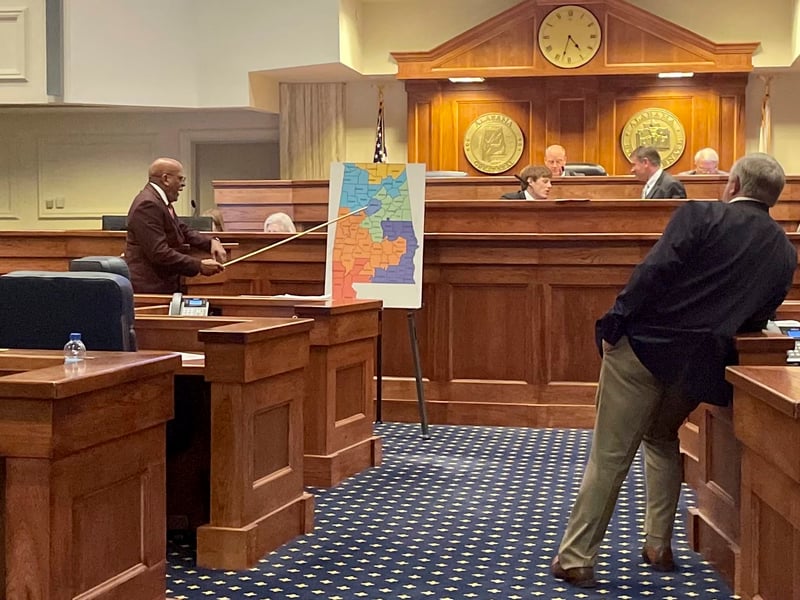
(CN) — The state of Alabama has been enjoined from using its latest congressional district map in statewide elections, with a three-judge panel of the Northern District of Alabama expressing that it was left “deeply troubled,” “disturbed” and “struck” by the Republican-controlled legislature’s refusal to create a second Black majority district.
The state’s 2023 congressional map was drawn during a week-long special session in July but openly defied instructions by both the panel of federal judges and the U.S. Supreme Court, which determined previous versions of the map diluted Black representation at the polls. According to the 2020 Census, the state is approximately 27% Black, yet the Legislature repeatedly ensured only one-seventh of its congressional districts were majority Black.
For its part, the state insisted it was in something of a Catch-22: although it was ordered to draw a second Black district, it was also prohibited from considering race to do so. Instead, by increasing the number of Black voters in a second district from 29% to 39%, Republican leaders suggested it provided Black voters an “opportunity” to elect a candidate of their choice.
In its 217-page order Tuesday, the panel concluded there is “no basis in federal law to accept a map the state admits falls short of this required remedy.” As a result, the courts have now stripped the state’s lawmakers of their responsibility to draw the maps and handed the job to a court-appointed special master and cartographer.
“We are not aware of any other case in which a state legislature — faced with a federal court order declaring that its electoral plan unlawfully dilutes minority votes and requiring a plan that provides an additional opportunity district — responded with a plan that the state concedes does not provide that district,” the panel wrote. “The law requires the creation of an additional district that affords Black Alabamians, like everyone else, a fair and reasonable opportunity to elect candidates of their choice. The 2023 Plan plainly fails to do so.”
The panel comprises two Trump appointees — U.S. District Judges Anna Manasco and Terry F. Moorer — as well as U.S. Senior Circuit Judge Stanley Marcus, a Clinton appointee. Because they granted relief on statutory grounds, primarily Section 2 of the Voting Rights Act, they reserved ruling on separate constitutional questions.
U.S. Representative Terri Sewell, the state’s lone Democratic and Black congressional representative, issued a statement Tuesday applauding the ruling, noting “the Voting Rights Act of 1965 is indeed alive and enforceable.”
“Today’s decision is yet another victory for Black voters in Alabama and for the promise of fair representation,” Sewell said. “By appointing a special master to fairly redraw Alabama’s congressional map, the court has rejected the state legislature’s latest attempt to dilute the voices and voting power of African Americans all across our state.”
In a tweet, Republican State Representative Nathaniel Ledbetter, a co-chair of the state committee on reapportionment, called the ruling “disappointing.”
“The Legislature worked together to meet the court’s vague requirements,” he insisted. “Above all, it’s frustrating that the court chooses to legislate when the Alabama Legislature knows our citizens, hometowns, and communities better than any federal judge.”
Republican U.S. Congressman Jerry Carl, whose coastal District 1 will likely be heavily altered by any map submitted by the special master, called the ruling the work of “activist judges.”
“South Alabama is a community of interest and needs a congressman who represents the entire region,” he tweeted Tuesday.
In a one-sentence statement, the Alabama Republican party suggested the legal battle isn’t over and it eventually intends to win.
“While we respect the court, we are disappointed in its decision, and we trust that the state will ultimately prevail in this litigation.”
Across the nation this week, other Republican-controlled states were facing pushback on similar redistricting attempts that Democratic opponents refer to as “voter suppression” bills.
Over the weekend in Florida, a judge struck down the state’s congressional map, ruling it violates the state constitution by diminishing the voting power of Black Floridians. The state has already appealed this decision and it will not take effect without further review.
Also on Tuesday, a trial began in Georgia over its congressional map. There are also consequential legal challenges in Ohio, South Carolina, Texas and Louisiana, among others.
Back in Alabama, the court previously appointed Richard Allen as a special master and David R. Ely as a cartographer. Attorney Michael Scodro of law firm Mayer Brown LLP has also been appointed to prepare and recommend remedial maps for the 2024 election.
In a separate order Tuesday, the panel instructed the special master to provide three proposed remedial maps and accompanying reports and recommendations by Sept. 25.
 Follow @gabetynes
Subscribe to our free newsletters
Our weekly newsletter Closing Arguments offers the latest about ongoing trials, major litigation and rulings in courthouses around the U.S. and the world, while the monthly Under the Lights dishes the legal dirt from Hollywood, sports, Big Tech and the arts.