
 Search Articles


Activists say some of Georgia’s controversial new voting restrictions and the criminal penalties associated with them violate the First Amendment.
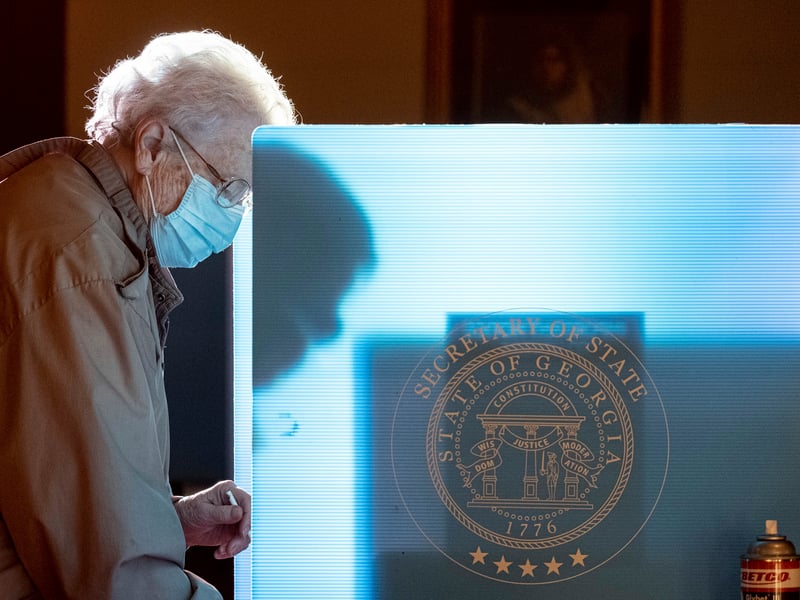
ATLANTA (CN) — With Georgia’s new voting law going into effect and early voting in two state House runoff elections already underway, election integrity activists asked a federal judge Thursday to block officials from enforcing certain portions of the law.
The state argued the legislation only reinforces protections that were already in place and is a necessary effort to bolster election security and voter confidence.
The wide-reaching Senate Bill 202, passed in March, has been denounced by Democrats and voting rights activists who’ve called it an “attempted infringement of First Amendment rights.”
The lawsuit at issue is just one of several challenging Georgia’s new election law, including one filed last week by the U.S. Department of Justice.
During Thursday’s hearing, the Coalition for Good Governance challenged only a few sections of the law, arguing that some parts criminalize free speech.
One of the sections makes it a felony to “intentionally observe” a voter in “a manner that would allow such person to see for whom or what the elector is voting.”
Because the statute is vague and doesn’t specify what manner of observation is forbidden, anyone who wants to watch how a local polling location is functioning or who glances at a screen while walking by could be charged with a felony, the Georgia First Amendment Foundation wrote in an amicus brief supporting the activists.
The state countered that the provision only targets “intentional” observation, not accidental, and said election officials are supposed to arrange polling booths in a way that gives the voter privacy.
Another section of SB 202 prohibits election observers from communicating “any information” they see while monitoring the processing to anyone other than “an election official who needs such information to carry out his or her official duties.”
The Georgia First Amendment Foundation called the statute a “gag rule,” arguing that it “impermissibly limits to whom information can be disclosed thereby undermining its purported goal of securing election integrity. It, in effect, requires the ‘observer’ to disclose possible wrongdoing solely to the very election official who may be involved in the observed misconduct.”
U.S. District Judge J. P. Boulee, a Donald Trump appointee, said during Thursday’s hearing that “any information” seemed overly broad to him and asked state attorney Bryan Tyson whether someone could escalate a concern if an election official declined to look into a matter.
“Not at this point,” Tyson said, adding the idea is to keep ballot counting a “closed process.”
If election officials are doing their jobs improperly, “you have the option of notifying other election officials, like the state election board or the secretary” or wait until after the election, Tyson said.
The new law also makes it a misdemeanor to photograph a ballot, a restriction that would ban routine press photographs or videos of election workers counting or recounting ballots, according to the voting rights activists.
The state noted that photography was already restricted at polling places in Georgia, but there was no penalty. Now there is.
The Coalition for Good Governance is also challenging the deadline to apply for an absentee ballot of 11 days prior to an election, arguing that voters who encounter unforeseen emergencies within the 11 days prior to an election and cannot vote in person will be disenfranchised.
The state rebuts that allowing absentee ballot requests up until the day before the election led to logistical problems and several other states have deadlines even longer than Georgia’s.
But, if the law were in place during the 2020 election, the coalition argued, it would have disenfranchised Republican Governor Brian Kemp, who was exposed to Covid-19 and could not vote in person. He applied for and received an absentee ballot just days before the November election.
“The governor’s situation is not a freakish occurrence,” coalition attorney Bruce Brown said in court. “People have emergencies come up all the time.”
Boulee did not immediately rule Thursday on the request to block election officials from enforcing the challenged provisions.
Follow Rosana Hughes on Twitter
 Follow @HughesRosana
Subscribe to our free newsletters
Our weekly newsletter Closing Arguments offers the latest about ongoing trials, major litigation and rulings in courthouses around the U.S. and the world, while the monthly Under the Lights dishes the legal dirt from Hollywood, sports, Big Tech and the arts.