
 Search Articles


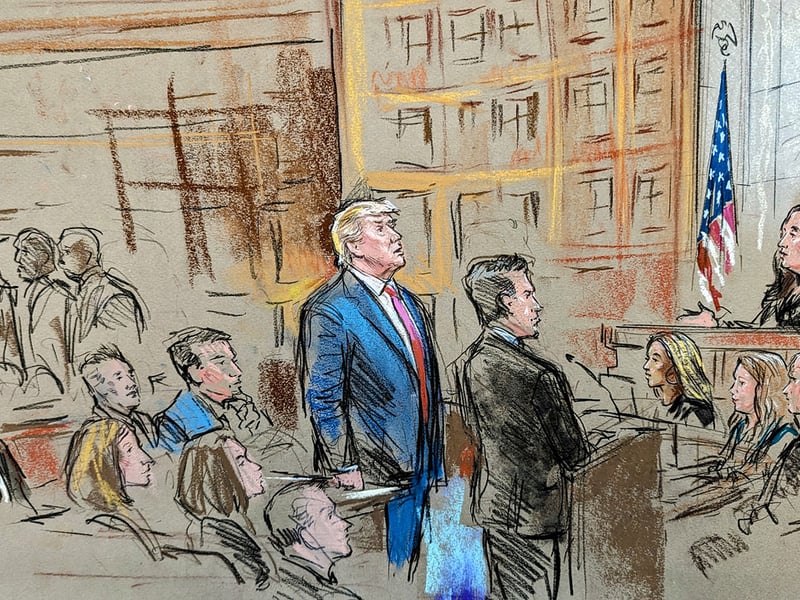
WASHINGTON (CN) — A federal judge unsealed special counsel Jack Smith’s major immunity brief in Donald Trump’s election interference case on Wednesday, making public what is likely to be Smith’s most extensive accounting of Trump’s conduct prior to the looming election.
The 165-page filing is part of Smith’s efforts to convince U.S. District Judge Tanya Chutkan that Trump can still be tried — if he does not win back the presidency on Nov. 5 — on his efforts to overturn his 2020 electoral defeat under the Supreme Court’s sweeping immunity decision this summer.
“The defendant asserts that he is immune from prosecution for his criminal scheme to overturn the 2020 presidential election because, he claims, it entailed official conduct. Not so,” Smith wrote. “Although the defendant was the incumbent president during the charged conspiracies, his scheme was fundamentally a private one.”
While portions of the motion are redacted — such certain names and information from sensitive materials like grand jury testimony — Smith details how, even before the 2020 election, Trump laid the groundwork with private and campaign advisors to simply declare himself the winner before all mail-in ballots could be counted.
The emphasis that Trump acted on the advice of private and campaign staffers is important, as Smith argued such conduct is clearly outside the scope of Trump’s duties as president and therefore liable to prosecution.
Immediately following the Nov. 3, 2020 election, Smith says Trump’s “private operatives” began creating chaos at polling places in states still counting votes, such as the TCF Center in Detroit, Michigan, where it appeared Trump was going to lose the state.
According to Smith, after a TCF Center official told a Trump operative, only referred to as “P5,” that a batch of votes heavily favoring Joe Biden were accurate, P5 responded, “find a reason it isn’t,” and instructed the official to “give me options to file litigation.”
When the official warned that such a move could lead to unrest like the 2000 Brooks Brothers Riot — a violent effort to stop the vote count in Florida after the 2000 presidential election — the Trump operative said “Make them riot” and “Do it!”
According to Smith, similar manufactured altercations occurred at tabulation centers across the country, including in Philadelphia, Pennsylvania, and in Maricopa County, Arizona, which Trump used to claim that his election observers were being wrongfully denied access and was proof of election fraud.
As early as Nov. 7, Smith said, Trump’s advisors told him that he was likely going to lose the election in a meeting that included his lead and deputy campaign managers, a senior campaign adviser and a White House staffer. Any chance of victory relied solely on wining the remaining vote counts, or litigation, in Arizona, Georgia and Wisconsin.
Less than a week later on Nov. 13, Trump’s campaign conceded its lawsuit in Arizona, which Smith said showed that even in his advisors’ own assessment, he had lost the election.
Trump then fired the advisors responsible for his legal election challenges, and placed a private attorney — referred to as co-conspirator 1, but has been publicly identified as Rudy Giuliani — willing to further his false claims that Trump was the true victor.
Then-Vice President Mike Pence also reportedly repeatedly told Trump that even he did not believe his claims of election fraud and tried to convince him to give up and acknowledge his lack of evidence. At a Nov. 16 lunch, Pence encouraged Trump to accept the election results and just run again in 2024, to which Trump responded “I don’t know, 2024 is so far off.”
Smith wrote that a key piece of evidence he would use at trial is a pattern in which Trump and his co-conspirators repeatedly changed the numbers of their fraud claims. He pointed to claims about non-citizens voting in Arizona, where the figure started at 36,000, then increased to 250,000, then dropped to 32,000, before returning to 36,000.
Such false claims were directly tied to Trump’s “Stop the Steal” speech outside the White House on Jan. 6, 2021, where he urged his supporters to march on the U.S. Capitol and halt the certification.
“When the defendant took the stage at the Ellipse rally to speak to the supporters who had gathered there at his urging, he knew that Pence had refused, once and for all, to use the defendant’s fraudulent electors’ certificates,” Smith wrote. “The defendant also knew that he had only one last way to prevent Biden’s certification as president: the large and angry crowd standing in front of him.”
Citing the U.S. Supreme Court’s recent immunity decision, Smith argued that while the justices found Trump’s communications with the Justice Department to further the scheme was immune conduct in his original indictment, the rest of the accusations should not be treated the same.
Smith asked Chutkan, a Barack Obama appointee, to side with his analysis that much of Trump’s conduct was private and determine that he “must stand trial for his private crimes as would any other citizen.”
Smith argued that none of Trump’s conduct nor any of the evidence he would use at trial should be protected by presidential immunity, but if anything could be deemed official, he could clear the presumption of immunity.
Trump has decried the filing as a “politically motivated manifesto” and clear election interference with just weeks remaining in the presidential campaign and has argued that moving forward with the criminal case threatens the office of the presidency itself.
He has pointed to the Supreme Court’s 6-3 decision that former presidents have at least the presumption of immunity for official acts taken in office as grounds to dismiss the four criminal charges outright.
However, Chutkan, has maintained that the high court’s decision instructs her to conduct a close analysis to separate Trump’s conduct into three buckets: core official actions, actions within the outer perimeter of his official duties and unofficial.
Smith in his major filing aims to give Chutkan the opportunity to make a single determination on which of Trump’s actions are official or unofficial acts, a move meant to give Trump just one decision he could appeal to the Supreme Court.
 Follow @Ryan_Knappy
Subscribe to our free newsletters
Our weekly newsletter Closing Arguments offers the latest about ongoing trials, major litigation and rulings in courthouses around the U.S. and the world, while the monthly Under the Lights dishes the legal dirt from Hollywood, sports, Big Tech and the arts.