
 Search Articles


(CN) — Whether or not a federal district court has jurisdiction over a lawsuit against the federal government for canceling National Institutes of Health grants was at the top of a judge’s to-do list during a hearing in the District Court of Massachusetts Thursday.
Senior U.S. District Judge William Young, appointed to the bench by Ronald Reagan in 1985, said there were significant concerns regarding his jurisdiction in the case following an order from the U.S. Supreme Court that determined a related case should be handled by the Court of Federal Claims.
Young said he’d take the jurisdiction issue under advisement and scheduled a case management conference for May 13.
“My impression is that the states have the better of it and that this court does have subject matter jurisdiction,” he said in court but added that the matter is complex and he has to take time to consider it.
“My mind is not made up,” Young added.
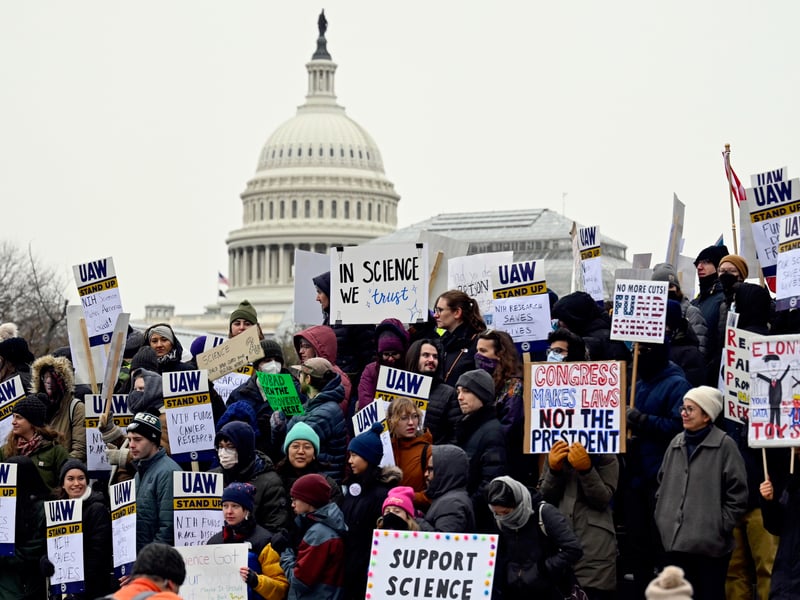
This case, among several others filed in recent months, seeks to stop the Trump administration’s unprecedented federal funding cuts.
In the 82-page lawsuit filed in April, 16 states say that the sudden, sweeping cuts jeopardize decades of progress toward eradicating widespread illnesses.
The states say the Trump administration has “engaged in a concerted and multi-pronged effort to disrupt NIH’s grants.” According to the states, the NIH has sent hundreds of letters to state research institutions announcing the termination of various grants since March because they “no longer effectuate agency priorities."
“Each boilerplate letter declares that the grant in question has been terminated because of some connection to ‘DEI,’ ‘transgender issues,’ ‘vaccine hesitancy,’ or another topic disfavored by the current administration,” they added.
The states say that the funding cuts will slow research into treatments for diseases like HIV, AIDS, Covid-19, Zika, Alzheimer’s and shingles. They name multiple defendants in their complaint, including Secretary of Health and Human Services leader Robert F. Kennedy Jr. and a number of NIH subagencies including the National Cancer Institute and the National Heart, Lung and Blood Institute.
The states note that Congress has already approved the terminated grants. They say NIH “has failed to acknowledge — let alone provide ‘good reasons for’ — any changes in agency policy supposedly justifying the terminations.”
The states are seeking a preliminary and permanent injunction that would bar the NIH from carrying out the funding cuts and find them unconstitutional.
Young called those claims breathtaking in Thursday’s hearing but grappled with what the Supreme Court has ruled in a related case.
In that case, Department of Education v. California , the Supreme Court declared that the Tucker Act, which allows for lawsuits against the federal government for monetary damages, gives exclusive jurisdiction to hear cases involving contracts with the U.S. that exceed $10,000 to the Court of Federal Claims — something the Department of Justice seeks to do with the Massachusetts case.
However, the states in the Massachusetts lawsuit made their arguments under the Administrative Procedure Act, challenging the government’s policies and bringing up constitutional claims.
Gerald Cedrone, who argued for the states from the Massachusetts Attorney General Office, said those claims fall squarely within the court’s jurisdiction.
Cedrone said the states are not seeking any sort of payout, so the Tucker Act would not apply.
“But you are as a practical matter,” Young replied, adding that the states are concerned that the congressionally appropriated money may not be spent because the federal government may delay those grants.
“Just because a case involves money, or just because a decision will implicate the payout of money down the line, it does not transform it into a contract claim,” Cedrone said.
However, according to Department of Justice attorney Thomas Port, the states in this case make a similar claim to the California case.
“Plaintiffs want the court to compel NIH to keep paying on now-terminated grant agreements by setting aside the termination of those agreements,” Port said in court Thursday.
Young said that if he decides he does have jurisdiction, he is likely to collapse the preliminary injunction motion with a trial.
“My feeling is that a large portion of this can be handled by summary judgment,” he said, but added that a trial would be needed to determine the rest of the claims.
The disagreement is over a contract, according to Port, and the state’s other arguments regarding unreasonable delay and equitable claims are moot because the states waited two months to file a lawsuit from the time the decision was made to cut funding, he said.
The multistate coalition is comprised of the Democratic attorneys general from Arizona, California, Colorado, Delaware, Hawaii, Maryland, Massachusetts, Minnesota, Nevada, New Jersey, New Mexico, New York, Oregon, Rhode Island, Washington and Wisconsin.
The NIH is the largest public funder of medical research in the world. According to Friday’s lawsuit, the organization’s $36 billion in federal awards spurred more than $94 billion in new economic activity that supported more than 400,000 jobs nationwide.
“Indeed, it is hard to find a medical breakthrough in recent years that has not been assisted — whether directly or indirectly — by NIH’s pioneering work,” the states say in the complaint.
Young has asked the states to provide a list of all grants impacted by the cuts and outline any alleged government wrongdoing. He has also asked the Justice Department to provide a definition of DEI.
“I understand the administration is against DEI,” Young said. “The substantive area here is health care for all Americans and so when you use that term, council, respectfully, I just don’t know what you mean.”
As it is used politically, the phrase often has a definition that shifts and broadens, depending on the point being made.
“I just don’t know what it means and there has to be some working definition,” Young said.
Subscribe to our free newsletters
Our weekly newsletter Closing Arguments offers the latest about ongoing trials, major litigation and rulings in courthouses around the U.S. and the world, while the monthly Under the Lights dishes the legal dirt from Hollywood, sports, Big Tech and the arts.