
 Search Articles


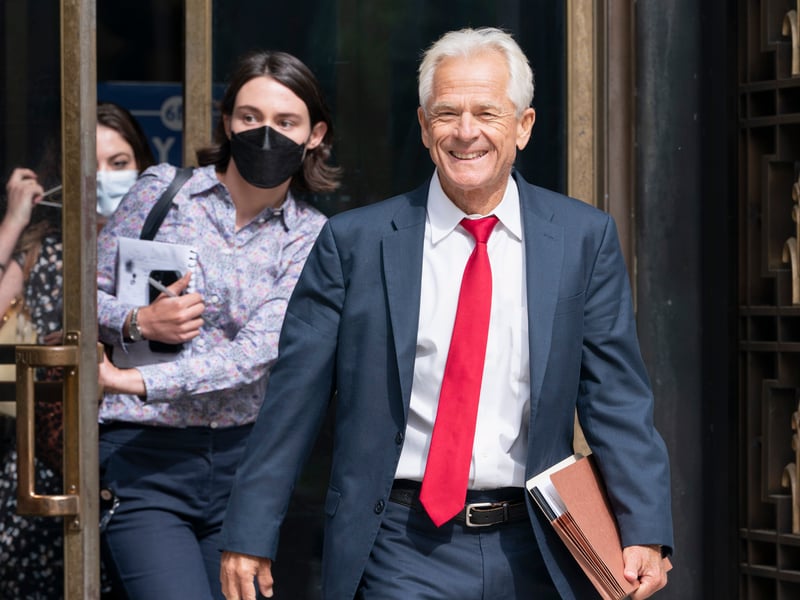
WASHINGTON (CN) — Finding no evidence that the government had violated his right to a speedy trial, a federal judge on Wednesday refused to nix charges against Peter Navarro over his refusal to testify before the special congressional committee investigating the Capitol riot.
The committee subpoenaed Navarro back in February 2022, given his position in the Trump administration as trade adviser, and requested testimony and documents related to efforts that occurred to delay the certification of the 2020 election results after Donald Trump lost to his Democratic rival Joe Biden.
Navarro by that time had already published a book, “In Trump Time,” where he described having worked closely with Steve Bannon in the weeks after the Nov. 3 election to claim voter fraud in six states where a majority of voters turned out for Biden. When Navarro nevertheless refused to comply with the subpoena, the committee was referred him for two criminal contempt of Congress charges.
Navarro has claimed that Trump’s assertions of executive privilege exempt him from testifying and he pleaded not guilty to the charges in June 2022.
In court on Wednesday, his lawyers failed to sway U.S. District Judge Amit Mehta that the government has exceeded the 70-day limit provided by the Speedy Trial Act.
While more than 70 days have elapsed since prosecutors first filed charges against Navarro, Mehta noted that the law provides that days can be excluded from the count to account for filings or motions by either party. In this case, he said, the defense had failed to account for a March filing by the prosecution.
Likewise any time between Wednesday and any future hearing or trial would be excluded, the judge said.
The judge called it “odd” Congress would make no effort to compel Navarro to provide testimony or allow him to make some response before indicting him.
Stanley Woodward Jr., an attorney for Navarro with Brand Woodward, argued that his client knew about qualified immunity but rather was unaware that he needed to explicitly communicate it to Congress as his reason for not testifying.
“Dr. Navarro shouldn’t have to take the chance to go to prison because he believed, even wrongly, that qualified immunity precluded him from appearing before Congress,” Woodward said.
Executive privilege has not been found to apply for various Trump aides, including Michael Flynn and Dan Scavino, who have been called before the U.S. House Select Committee on the January 6 Attack. Such privilege would have to come from the current president, and President Joe Biden has refused to provide it.
Mehta posed the question to Woodward about how the case should move forward, as a legal issue that he could then answer with a final ruling, or if it was fact-based and should be put to a jury.
Woodward, after a moment of hesitation, expressed his preference for a jury trial.
Mehta ended the hearing without resolving the question, instead setting up an evidentiary hearing in the coming weeks to allow the defense a chance to procure evidence that Navarro indeed knew he could invoke qualified immunity, such as directions from the former president.
Separate from the criminal contempt charges, Navarro faced a federal lawsuit that his refusal to turn over private emails related to his role as a presidential adviser after the 2020 election flouted the Presidential Records Act.
U.S. District Judge Coleen Kollar-Kotelly ordered Navarro in March to turn over up to 250 personal emails that he had withheld, rejecting the former trade adviser’s assertion that doing so would violate his right against self-incrimination in the contempt of Congress case.
 Follow @Ryan_Knappy
Subscribe to our free newsletters
Our weekly newsletter Closing Arguments offers the latest about ongoing trials, major litigation and rulings in courthouses around the U.S. and the world, while the monthly Under the Lights dishes the legal dirt from Hollywood, sports, Big Tech and the arts.