
 Search Articles


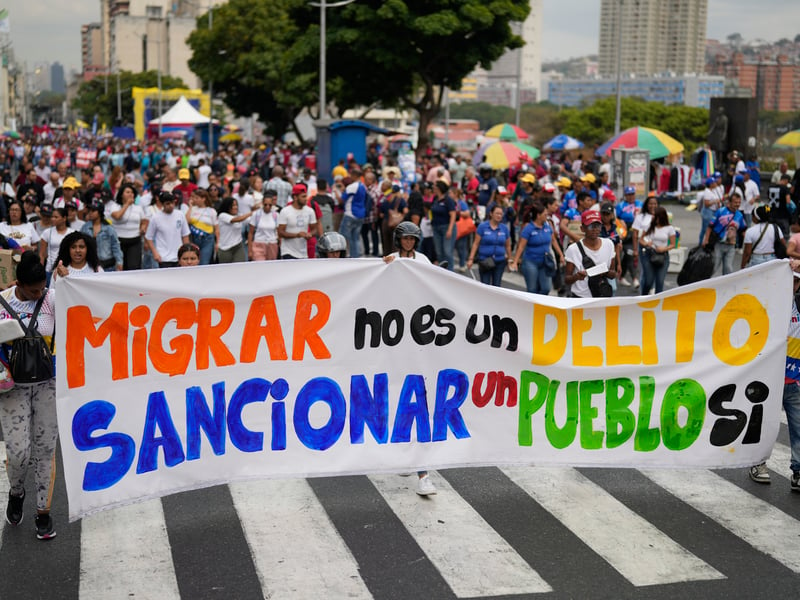
WASHINGTON (CN) — A federal judge ordered the Trump administration on Wednesday to facilitate habeas petitions for 238 Venezuelan migrants deported to an infamous mega-prison in El Salvador, finding their summary deportations violated their due process rights.
U.S. District Judge James Boasberg granted the migrants’ motion for a preliminary injunction and to certify a class of migrants detained at the Terrorism Confinement Center — known as CECOT — but declined to certify a class of migrants currently in U.S. detention.
The Barack Obama appointee wrote in his 69-page opinion that his ruling does not address the validity of President Donald Trump’s invocation of the Alien Enemies Act of 1978, nor his declaration that the migrants were all members of the Tren de Aragua gang.
“But — and this is the critical point — there is simply no way to know for sure, as the CECOT plaintiffs never had any opportunity to challenge the government’s say-so,” Boasberg said. “Defendants instead sprinted way planeloads of people before any such challenge could be made. And now, significant evidence has come to light indicating that many of those currently entombed in CECOT have no connection to the gang and thus languish in a foreign prison on flimsy, even frivolous, accusations.
According to a ProPublica investigation published Friday, the Trump administration knew the vast majority of the 238 deported migrants had no criminal record in the U.S. when it labeled them as terrorists and members of Tren de Aragua.
According to U.S. Department of Homeland Security data reviewed by ProPublica, only six of the immigrants were convicted of violent crimes: four for assault, one for kidnapping and one for a weapons offense. Further, the data shows the government was aware that 130 migrants were labeled as only violating immigration laws, which is a civil penalty.
The investigation — with The Texas Tribune and journalists from Venezuela — revealed that 20 migrants with arrest or conviction records from the U.S. and Latin America.
Of those, 11 were involved in violent crimes such as armed robbery, assault or murder, including one man the Chilean government asked be extradited from the U.S. to face kidnapping and drug charges there. Another four faced charges of illegal gun possession.
White House spokeswoman Abigail Jackson told Courthouse News in an emailed statement that Boasberg had “no authority to intervene with immigration or national security,” spaces reserved for the president and the executive branch.
“His current and previous attempts to prevent President Trump from deporting criminal illegal aliens poses a direct threat to the safety of the American people,” Jackson said. “Fortunately for the American people, Judge Boasberg does not have the last word.”
Boasberg wrote that the sudden transfer of the migrants from their detention center in Texas to a nearby airport was comparable to the mysterious arrest and prosecution of Josef, the main character in Franz Kafka’s “The Trial,” who receives only vague answers from his guards.
When the plaintiff migrants were transferred early on March 15, they similarly received no answers from officers at the El Valle Detention Facility.
“To where? That they were not told,” Boasberg wrote. “When asked, some guards reportedly laughed and said that they did not know; others told the detainees, incorrectly, that they were being transferred to another immigration facility or to Mexico or Venezuela.”
In April, Boasberg found probable cause that the Trump administration may be held in criminal contempt for flouting his court orders that the government return two deportation flights that took off on March 15 in the middle of an emergency hearing.
The ruling set up potential criminal contempt proceedings, starting with declarations from top immigration and White House officials and, if those are unsatisfactory, live testimony.
However, any such proceedings are currently on hold as an appeal of Boasberg’s probable cause finding is pending before the D.C. Circuit, which has already heard an appeal of Boasberg’s initial order blocking further Alien Enemies Act deportations.
A panel has yet to be assigned for the contempt appeal.
Boasberg blasted the Justice Department’s repeated position that it no longer had custody over the 238 detainees and any chance of release was up to the Salvadoran president Nayib Bukele, who mocked the idea of returning Kilmar Abrego Garcia as “preposterous.”
“Our legal tradition is wholly incompatible with the establishment of a network of overseas prisons, shielded from the Great Writ [of habeas corpus] by the facade of foreign control, to which the government routinely exports detainees without due process — a legal no man’s land,” Boasberg said. “Indeed, the Habeas Corpus Act of 1679 generally prohibited detention ‘beyond the seas’ to places where the writ did not run, and such abuses partly animated this nation’s War for Independence.”
 Follow @Ryan_Knappy
Subscribe to our free newsletters
Our weekly newsletter Closing Arguments offers the latest about ongoing trials, major litigation and rulings in courthouses around the U.S. and the world, while the monthly Under the Lights dishes the legal dirt from Hollywood, sports, Big Tech and the arts.