
 Search Articles


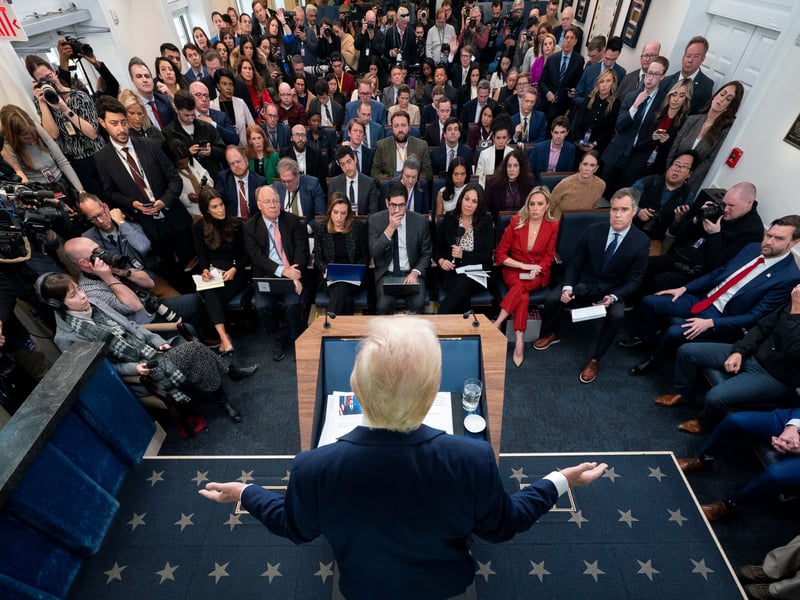
WASHINGTON (CN) — A federal judge opened the White House doors to The Associated Press’ reporters and photographers Tuesday, finding the Trump administration’s ban on the outlet violated the First Amendment.
U.S. District Judge Trevor McFadden, a Donald Trump appointee, subsequently stayed his decision until April 13, to provide the administration time to request an emergency stay from the D.C. Circuit and prepare to lift the ban if a stay is denied.
McFadden found the administration cannot exclude the AP from certain events in the White House due to its refusal to call the Gulf of Mexico “the Gulf of America” in its stories as Trump has demanded. He noted, however, his order does not mandate that all reporters get access to the president or prevent officials from being selective in granting interviews or answering questions.
“The court simply holds that under the First Amendment, if the government opens its doors to some journalists — be it to the Oval Office, the East Room, or elsewhere — it cannot then shut those doors to other journalists because of their viewpoints,” McFadden wrote. “The Constitution requires no less.”
McFadden noted the ban was clearly based on viewpoint discrimination, a textbook violation of the First Amendment, adding that the Trump administration had been “brazen” in stating the ban was because of the outlet “refuse[d] to adhere to what the president believes” regarding the Gulf of Mexico’s name.
“The government offers no other plausible explanation for its treatment of the AP,” McFadden added. “The Constitution forbids viewpoint discrimination, even in a nonpublic forum like the Oval Office.”
McFadden found the White House’s power grab of the press pool — a duty formerly held by the White House Correspondents Association — only allows the government to designate certain areas of the White House as nonpublic forums. The change does not limit the constitutional bar on viewpoint discrimination while selecting participating media outlets, McFadden said.
Further, the makeup of the White House press pool does not affect the government’s ability to convey its own message. The White House media team is responsible for such speech, McFadden said.
That conclusion seems to be a rebuke of an argument made by Brian Hudak, chief of the civil division at the U.S. Attorney’s Office for D.C., during an initial Feb. 24 hearing**. **
“History is written by the people who observe it,” Hudak said. “The president can choose who will carry his message in the manner he wishes.”
McFadden initially denied the AP’s requested temporary restraining order after the February hearing, citing the suit’s early stage, but pressed the government to change its policy. When the policy remained, he ordered witness testimony.
During the two-day evidentiary hearing, the AP’s chief photographer Evan Vucci and White House correspondent Zeke Miller testified that the ban had severely hampered their coverage of the administration.
Vucci, who has worked as an AP photographer since 2003 and took the photo of Trump raising his fist following a failed assassination attempt in Butler, Pennsylvania, described being routinely turned away from covering events throughout the White House since the ban was enacted on Feb. 11.
Instead, Vucci has been forced to rely on his competitors or foreign AP correspondents to cover them, often receiving lower-quality images well after an event like the Feb. 28 meeting between Ukrainian President Volodymyr Zelenskyy, Trump and Vice President JD Vance, has ended.
Miller described how he was summoned to press secretary Karoline Leavitt’s office on Feb. 11. He said he was told that Trump “wasn’t happy” that the AP would not adopt the new “Gulf of America" moniker for the Gulf of Mexico, and that the outlet would be barred from an Oval Office meeting later that day. The ban was made indefinite on Feb. 14.
McFadden noted the exclusion extended to events outside the White House, like Trump’s fiery speech at the Justice Department on March 14, as well as first lady Melania Trump’s event on Capitol Hill and Vance’s event at the U.S.-Mexico border in Texas.
While “the AP’s freezeout has thawed slightly,” with certain AP photographers being allowed into some East Room and limited-access events, the outlet’s reporters have still been blocked from events, even those where they had an RSVP approved, McFadden said.
The decision sets up another expedited appeal to the D.C. Circuit, and likely to the Supreme Court.
 Follow @Ryan_Knappy
Subscribe to our free newsletters
Our weekly newsletter Closing Arguments offers the latest about ongoing trials, major litigation and rulings in courthouses around the U.S. and the world, while the monthly Under the Lights dishes the legal dirt from Hollywood, sports, Big Tech and the arts.