
 Search Articles


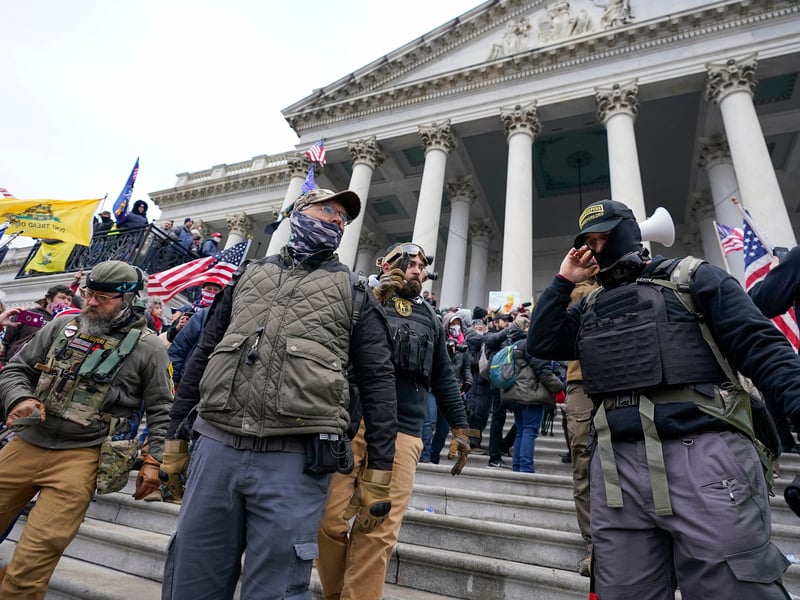
WASHINGTON (CN) — A federal judge ruled Monday that he would not enforce a recently imposed requirement that the leaders of the far-right militia the Oath Keepers seek the court’s permission before reentering Washington or the U.S. Capitol, citing President Donald Trump’s broad clemency powers.
U.S. District Judge Amit Mehta placed the restriction on Friday after Oath Keeper leader Stewart Rhodes met with GOP lawmakers in Congress on Wednesday, days after he and eight of his lieutenants had their years-long prison sentences commuted to time served.
In his first executive action upon returning to the Oval Office on Jan. 20, Trump commuted the sentences of nine Oath Keepers and five Proud Boys and issued nearly 1,600 pardons to each defendant charged in connection with the Jan. 6, 2021, attack on the U.S. Capitol.
“The unconditional quality of President Trump’s proclamation thus can reasonably be read to extinguish enforcement of defendants’ terms of supervised release,” Mehta wrote.
Mehta, a Barack Obama appointee, wrote in his 8-page Monday order that he had issued the restrictions on Friday after consulting with the U.S. Probation office because such restrictions had become commonplace in Jan. 6 cases after Mehta had sentenced the Oath Keepers in May 2023.
“It is not for this court to divine why President Trump commuted defendants’ sentences, or to assess whether it was sensible to do so,” Mehta said, hinting at a sentiment among federal judges in Washington that Trump’s sweeping clemency order is problematic.
He explained that according to a legal precedent set by the 11th Circuit Court of Appeals, federal judges must defer to an executive agency’s interpretation of an executive order it is charged with administering — in this case the agency being the Justice Department.
Soon after Mehta’s initial order on Friday, acting U.S. Attorney for D.C. Ed Martin filed a motion to vacate the release conditions. Martin argued that Trump’s commutation applied to both custodial and non-custodial components of their sentences, therefore any terms of supervised release were “no longer active.”
Mehta found Martin’s reading of Trump’s clemency order reasonable, specifically that it both reduced the Oath Keepers’ prison terms to time served and lifted their terms of release.
Martin’s position was further supported by the fact that Trump’s commutation order was unconditional, meaning the 14 defendants who received commutations do not need to take any actions to benefit, Mehta said.
Mehta added that the unconditional nature of the order contrasted with recent commutations by Obama, Biden and Trump during his first term, where each president specified that the commutations did not reach to the recipients’ terms of release.
However, Mehta denied Martin’s request that the terms of release be dismissed, finding that Trump’s commutation did not alter the original sentences and they therefore remain “intact.” He explained that his Monday order meant the terms of release would not be enforced.
In an emailed statement following the Friday motion to vacate, Martin compared the restrictions to a set of preemptive pardons former President Joe Biden issued for members of his family and targets of Trump’s ire in the government.
“If a judge decided that Jim Biden, General Mark Milley, or another individual were forbidden to visit America’s capital — even after receiving a last-minute, preemptive pardon from the former president — I believe most Americans would object,” Martin said. “The individuals referenced in our motion have had their sentences commuted — period, end of sentence.”
Martin did not have an additional statement in response to Mehta’s decision.
Just across the street from the E. Barrett Prettyman Federal Courthouse, Senate Democrats moved on Monday to condemn Trump’s blanket pardons, offering a resolution signed by all 53 members of the Democratic caucus decrying pardons for Jan. 6 defendants convicted of assaulting Capitol Police officers.
Lawmakers write in the one-line resolution that the resolution “disapproves of any pardons for individuals who were found guilty of assaulting Capitol Police officers.”
Certain GOP lawmakers in Congress have also pushed back against the sweeping nature of Trump’s pardons, most recently from South Carolina Senator Lindsey Graham, who said in an interview with CNN Sunday that it was a “mistake” to pardon or commute the sentences of violent offenders.
According to the Justice Department in its four-year update on the Jan. 6 prosecutions, approximately 600 defendants wrestled charged with assaulting or obstructing law enforcement.
Vice President JD Vance reversed his position on Sunday, defending the pardons as the “right decision,” just two weeks after he said that “if you committed violence that day, obviously you shouldn’t be pardoned.”
 Follow @Ryan_Knappy
Subscribe to our free newsletters
Our weekly newsletter Closing Arguments offers the latest about ongoing trials, major litigation and rulings in courthouses around the U.S. and the world, while the monthly Under the Lights dishes the legal dirt from Hollywood, sports, Big Tech and the arts.