
 Search Articles


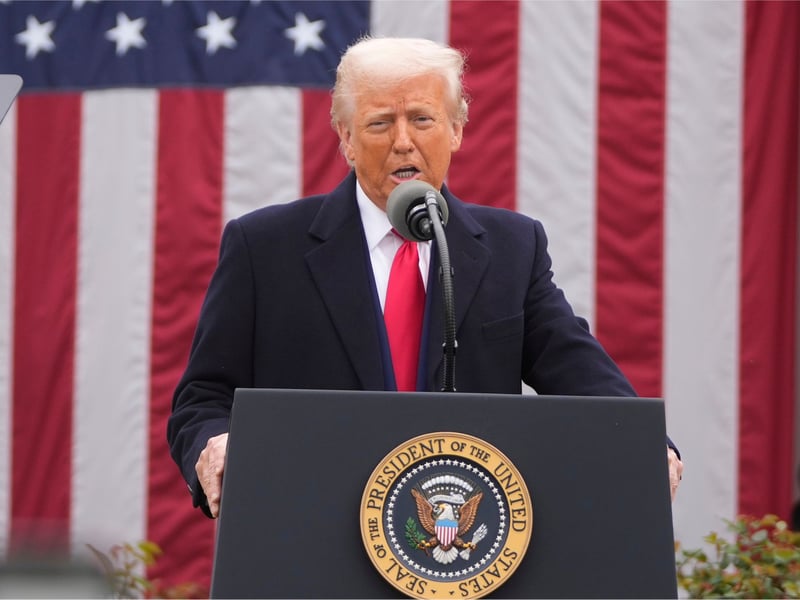
WASHINGTON (CN) — A federal judge temporarily lifted his court order barring President Donald Trump from invoking a Nixon-era statute to impose blanket tariffs on Tuesday, opening the door for more tariffs as an appeal at the D.C. Circuit proceeds.
On May 27, U.S. District Judge Rudolph Contreras ruled that Trump had wrongfully used the International Emergency Economic Powers Act of 1977 to place a universal 10% tariff on 57 countries on April 2.
In addition to the 10% tariff, Trump imposed rates ranging from 11% to 50%, depending on the trade deficit with each country, as determined by the administration.
Contreras, an Obama appointee, explained in his two-page order that a stay was necessary, considering a more sweeping injunction from the Court of International Trade had been stayed by the Federal Circuit last Thursday.
In seeking the stay, the Justice Department argued in a Monday filing that the president should be able to address the so-called “economic emergency” caused by trade deficits, and any judicial interference would raise national security and foreign policy concerns.
“By holding the tariffs invalid, the court’s ruling usurps the president’s authority and threatens to disrupt sensitive, ongoing negotiations with virtually every trading partner by undercutting the premise of those negotiations — that the president’s tariffs are a credible threat,” the Justice Department wrote.
While granting the stay motion, Contreras noted that any concerns would “flow, if at all, from the Court of International Trade’s more sweeping order.”
“A stay in this action is therefore appropriate to protect the president’s ability to identify and respond to threats to the U.S. economy and national security,” Contreras wrote.
Tuesday’s ruling sets up parallel appeals at the Federal Court of Appeals and the D.C. Circuit over the Trump administration’s core economic policy that is all but guaranteed to make it to the Supreme Court.
An 11-judge Federal Circuit panel stayed the trade court’s injunction Thursday, but set briefing deadlines for June 5 and 9 before deciding on the stay motion in full. The panel said it would rule before scheduling any oral arguments.
The case will go before D.C. Circuit Judges Gregory Katsas, Neomi Rao and Justin Walker — the only Trump appointees on that court. Oral arguments have not yet been scheduled.
In his May 27 ruling, Contreras also denied the Justice Department’s motion to transfer the case to the Court of International Trade, which it argued had the “exclusive jurisdiction” over any civil action related to the imposition of tariffs.
Contreras’ ruling struck down tariffs that impacted two small educational toy businesses, Learning Resource Inc. and hand2mind Inc., which manufacture most of their products in China, Taiwan, South Korea, Vietnam, Thailand and India.
“This case is not about tariffs qua tariffs,” Contreras wrote. “It is about whether IEEPA enables the president to unilaterally impose, revoke, pause, reinstate and adjust tariffs to reorder the global economy. The court agrees with plaintiffs that it does not.”
Contreras agreed with the trade court that the statute does not include the words “tariffs,” “duties” or any similar term, only that the president can “investigate, block, regulate, direct and compel, nullify, void, prevent or prohibit” the import or export of certain property.
Further, there is no language in the statute that would grant the executive any additional powers beyond those clearly listed.
He noted that the Justice Department’s interpretation of the statute could, in fact, render it unconstitutional, specifically its view that the term “regulate” should include the ability to impose tariffs.
Under that reading, the section allowing him to regulate “importation or exportation” would allow the president to impose export taxes, which are expressly prohibited by the Constitution.
Alternatively, the Justice Department argued Monday that Contreras’ ruling contradicts the IEEPA’s text, which mirrors language used in other broad tariff statutes.
“It defies the separation of powers, overriding Congress’s decision to delegate broad authority to the president-as Congress has done since the dawn of the Republic—and instead hobbling IEEPA as an international diplomatic tool,” the Justice Department said.
 Follow @Ryan_Knappy
Subscribe to our free newsletters
Our weekly newsletter Closing Arguments offers the latest about ongoing trials, major litigation and rulings in courthouses around the U.S. and the world, while the monthly Under the Lights dishes the legal dirt from Hollywood, sports, Big Tech and the arts.