
 Search Articles


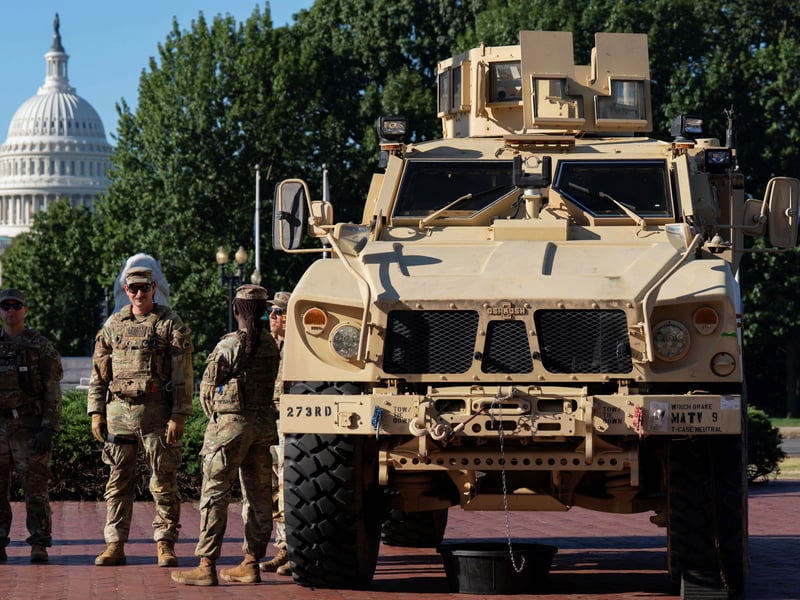
WASHINGTON (CN) — A federal judge ruled Thursday that President Donald Trump’s deployment of nearly 2,000 National Guard members in D.C. under his declared “crime emergency” was unlawful, setting up a protracted appellate court battle that could end their presence before the current February deadline.
U.S. District Judge Jia Cobb stayed her order until Dec. 11, allowing the deployment to continue as the Trump administration appeals her decision.
The Joe Biden appointee found Trump’s deployment violated Title 49 of the D.C. Code by activating troops for non-military, crime-deterrence missions without any request from D.C. Mayor Muriel Bowser.
Further, the government did not have authority under Title 32 Section 502 to request governors from South Carolina, West Virginia, Mississippi, Louisiana, Tennessee, Georgia, Alabama and South Dakota send their own National Guard members to D.C.
Granting the stay effectively permits the National Guard to remain deployed in the city for the time being until an appeals panel rules. The National Guard’s mission is currently set to end on Feb. 28, although Justice Department attorneys have stated in court that the deadline may be pushed to summer 2026 for the “America 250” celebration in July.
Cobb also found the government’s actions had clearly usurped the district’s sovereign powers under the D.C. Home Rule Act — the 1973 statute that granted the federal district a local government — by stripping it of the right to “govern itself” and determining “how best to deter crime and when to call for emergency assistance from other states.”
“The court finds that the district’s exercise of sovereign powers within its jurisdiction is irreparably harmed by defendants’ actions in deploying the guards, and that the balance of equities and public interest weigh in the District’s favor,” Cobb wrote in the 61-page opinion.
Attorney General Brian Schwalb, who first brought the lawsuit on Sept. 4 after it became clear the National Guard would remain in the city beyond the initial Sept. 10 deadline, welcomed the ruling in an emailed statement and said it was “long past time” to let troops return home.
“From the beginning, we made clear that the U.S. military should not be policing American citizens on American soil,” Schwalb said. “Normalizing the use of military troops for domestic law enforcement sets a dangerous precedent, where the president can disregard states’ independence and deploy troops wherever and whenever he wants — with no check on his military power.”
On Aug. 11, Trump invoked a provision of the Home Rule Act to take emergency control of the Metropolitan Police Department for 30 days.
Since then, National Guard troops have largely engaged in “presence patrols” and “high-visibility missions” patrolling public spaces near the National Mall, participating in “beautification” projects and supporting local Metropolitan police.
However, the Justice Department deputized troops as Special Duty U.S. Marshals so they could carry their service weapons on patrol, including M4 rifles and M17 handguns.
The National Guard has not been authorized to make arrests or directly engage in law enforcement activity throughout the deployment — federal agents from the FBI, ICE, Border Patrol and the U.S. Drug Enforcement Administration have made sweeping arrests — but Justice Department attorney Eric Hamilton suggested last month that the authorization would be lawful.
Cobb rejected that interpretation outright, noting that the president already has significant power to federalize the National Guard under Title 10 and the Insurrection Act, which can only be used during an insurrection, invasion, rebellion or when regular forces cannot execute the laws.
When those conditions are not met, the president’s federalizing power is limited, as upheld by the Seventh Circuit Court of Appeals on Oct. 22 regarding Trump’s deployment of the guard in Chicago.
“The federalized National Guard is considered part of the federal armed forces and subject to the Posse Comitatus Act’s prohibition on the use of armed forces in domestic law enforcement,” Cobb wrote. “Defendants’ reading of Section 502(f) would obviate the need to satisfy the predicates found in Title 10 and the Insurrection Act and provide an escape hatch from the PCA, allocating power to the president without any corresponding checks.”
White House spokeswoman Abigail Jackson slammed Cobb’s decision in an emailed statement.
“President Trump is well within his lawful authority to deploy National Guard in Washington D.C. to protect federal assets and assist law enforcement with specific tasks,” Jackson said. “This lawsuit is nothing more than another attempt — at the detriment of D.C. residents — to undermine the president’s highly successful operations to stop violent crime in D.C.”
 Follow @Ryan_Knappy
Subscribe to our free newsletters
Our weekly newsletter Closing Arguments offers the latest about ongoing trials, major litigation and rulings in courthouses around the U.S. and the world, while the monthly Under the Lights dishes the legal dirt from Hollywood, sports, Big Tech and the arts.