
 Search Articles


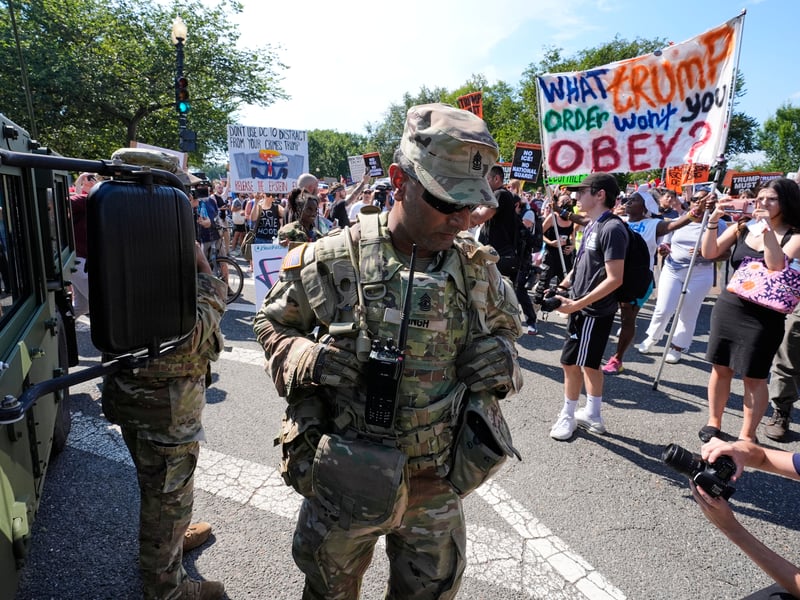
CHICAGO (CN) — A federal judge on Wednesday extended an order that prevents the Trump administration from federalizing and deploying the National Guard in Illinois while awaiting the U.S. Supreme Court’s review of the case.
Christopher Wells, an attorney on behalf of the state of Illinois, reiterated multiple times on Wednesday that U.S. District Judge April Perry’s extension of her order was the government’s request, not the plaintiffs'.
“We are very concerned about possible gamesmanship from other courts, and that what’s happening here has been betrayed,” he said.
The Justice Department agreed in a Tuesday filing to a 30-day extension.
Perry asked Wells why it mattered who requested extending the temporary restraining order, to which he responded: “Principles of equity, your honor.”
After Illinois and Chicago sued in early October, the Joe Biden appointed judge entered the temporary restraining order on Oct. 9, barring President Donald Trump from deploying federal troops to Illinois for two weeks. A Seventh Circuit panel reaffirmed the order on Oct. 16. The order was set to expire on Thursday, but Perry extended it Wednesday afternoon pending final judgment.
Trump quickly looked to the Supreme Court after the Seventh Circuit reaffirmed Perry’s order. He filed an emergency application for an immediate stay of the order the day after the Seventh Circuit panel issued its ruling, which the Supreme Court has yet to rule on.
“The injunction should be stayed so that federal enforcement of federal immigration law in Chicago is not left to the mercy of hostile state and local officials — or violent mobs,” U.S. Solicitor General John Sauer wrote in the emergency application to stay the order.
Justice Department attorney Jody Lowenstein proposed waiting for the Supreme Court to rule on the matter, which Perry denied.
She offered three possible solutions: a full preliminary injunction hearing, a trial on the merits of the case or converting the current temporary restraining order into a preliminary injunction. Ultimately, she didn’t select any of those solutions and extended her current order, which she can only do one time with the agreement of both parties.
The parties will return to court in nine days for a status hearing.
Trump toyed with the idea of sending the National Guard into Illinois beginning in September, citing concerns for the safety of Immigration and Customs Enforcement officers. Since the start of Trump’s recent immigration enforcement crackdown in the Chicagoland area, which he called “Operation Midway Blitz,” federal officers estimate that they’ve arrested around 1,500 people.
Despite the number of arrests, the federal government maintained that the ongoing protests in Chicago have made it impossible for federal immigration agents to do their jobs. In particular, the government cited protests at an immigration processing facility in Broadview, which has become a flashpoint of conflict since Operation Midway Blitz started at the beginning of October.
Justice department attorneys have maintained that the Broadview protests constitute a rebellion and, as such, the president has the authority to send troops in to remedy it.
The Constitution authorizes limited instances in which the president can call in the National Guard: to stop an invasion, to quell an ongoing rebellion, or if the president is unable to enforce U.S. laws with normal forces.
Trump sent the National Guard into Los Angeles in June in response to protests over immigration raids, which a federal judge deemed illegal after a three-day trial. Trump has also spoken about publicly multiple times about sending federalized National Guard troops into San Francisco
He also called for troops to be sent into Portland, Oregon, for similar reasons. A federal judge initially blocked the Oregon deployment, but a Ninth Circuit panel overturned that order and found that Trump had the statutory authority to deploy the guard because federal officers in Portland were unable to fully execute the law.
Within two hours of the panel issuing the order, a Ninth Circuit judge called for a vote on whether the court should rehear the Portland case en banc.
 Follow @RosenCaitlyn
Subscribe to our free newsletters
Our weekly newsletter Closing Arguments offers the latest about ongoing trials, major litigation and rulings in courthouses around the U.S. and the world, while the monthly Under the Lights dishes the legal dirt from Hollywood, sports, Big Tech and the arts.