
 Search Articles


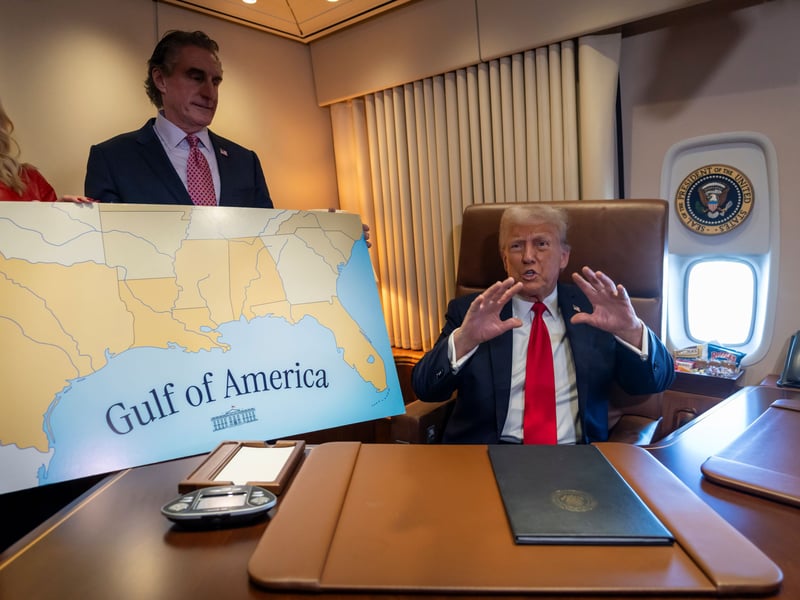
WASHINGTON (CN) — A federal judge on Monday denied an emergency request by the Associated Press to lift the White House’s ban against its reporters to force the use of “Gulf of America” when referring to the Gulf of Mexico.
U.S. District Judge Trevor McFadden, a Donald Trump appointee, said from the bench that he did not think a temporary restraining order was appropriate at this early stage, and ordered a preliminary injunction hearing for March 20 — effectively extending the ban. He suggested the White House’s ban is a form of content-based discrimination, and suggested the Trump administration change its policy.
The AP sued the White House on Friday, claiming the ban is a clear effort by President Donald Trump to control the media outlet’s speech and, through the widely used AP Stylebook, the speech of countless news outlets, scholars and classrooms throughout the country.
The White House’s decision to suddenly bar the AP’s reporters and photographers from the press pool, a group of approximately 13 rotating journalists who accompany the president nearly everywhere he goes. The AP, which has been a part of the pool since its inception, has had two spots for a wire reporter and a photographer.
Brian Hudak, chief of the Civil Division at the U.S. Attorney’s Office for D.C., argued the AP was demanding “special access” on par with one-on-one interviews with the president.
Hudak argued the president has every right to choose which outlets or journalists he sits down with based on the content of their speech. He said that right should extend to which reporters are present for events in the Oval Office, like President Trump’s meeting with French Prime Minister Emmanuel Macron on Monday.
“History is written by the people who observe it,” Hudak said. “The president can choose who will carry his message in the manner he wishes.”
McFadden seemed skeptical of Hudak’s arguments, noting a clear difference between sit-down interviews and mere access to the press pool. Further, it seemed clear that Trump’s motivation to bar the AP specifically was an example of illegal viewpoint discrimination.
McFadden said the president could go about changing the press access practices in sensitive locations like the Oval Office and Air Force One, but he would have to provide notice and opportunity to appeal under the Fifth Amendment and justify his decisions with legal motivations.
The AP’s lawyer Charles Tobin, of Ballard Spahr, argued Trump had clearly violated the First Amendment by trying to force the outlet to adopt “government-issued vocabulary” for a body of water recognized around the world as the Gulf of Mexico.
He said that the ban harmed the AP and every news outlet that relies on its wire service by restricting the sort of reporting journalists can only obtain in person, like the benefits a judge and jury gain from witness testimony at trial.
Tobin cited several D.C. Circuit and Supreme Court cases as binding precedent, including the recent NRA v. Vullo , in which the high court held New York could not coerce the gun rights group’s business associates to distance themselves to suppress pro-gun speech.
Speaking from the bench, McFadden said he denied the emergency motion in part because the facts of the case are unique and that he could not simply rule based on a prior case.
He suggested that while Trump may have some discretion to make changes to press access, it would be a “good idea to consider another change” while the case proceeded.
White House Press Secretary Karoline Leavitt, a named defendant in the case, said in a statement on X that the ruling was a “victory” against the AP and called the Trump administration the “most transparent” in history.
“As we have said from the beginning, asking the president of the United States questions in the Oval Office and aboard Air Force One is a privilege granted to journalists, not a legal right,” Leavitt said. “We stand by our decision to hold the fake news accountable for their lies, and President Trump will continue to grant an unprecedented level of access to the press.”
McFadden’s courtroom at the E. Barrett Prettyman Courthouse in Washington was packed, with the AP’s White House correspondent Zeke Miller and executive editor Julie Pace present.
Hudak was joined by White House Deputy Chief of Staff Taylor Budowich and U.S. Attorney for the District of Columbia Ed Martin.
Martin issued a statement from his office’s official X account after Monday’s hearing began.
“As President Trump’s lawyers, we are proud to fight to protect his leadership as our president and we are vigilant in standing against entities like the AP that refuse to put America first,” Martin wrote.
 Follow @Ryan_Knappy
Subscribe to our free newsletters
Our weekly newsletter Closing Arguments offers the latest about ongoing trials, major litigation and rulings in courthouses around the U.S. and the world, while the monthly Under the Lights dishes the legal dirt from Hollywood, sports, Big Tech and the arts.