
 Search Articles


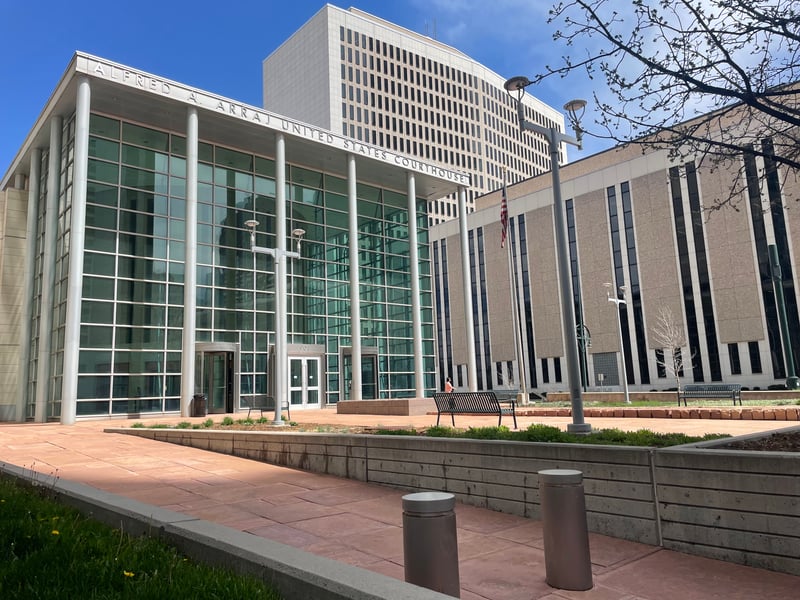
DENVER (CN) — A federal judge on Tuesday granted a petition from two Venezuelan migrants detained in Aurora, Colorado, requesting a temporary restraining order to bar their deportation under President Donald Trump’s use of the Alien Enemies Act to declare war on the foreign gang Tren de Aragua.
“Absent a TRO, petitioners face the risk of being deported — perhaps wrongfully deported — under the act and proclamation in violation of their constitutional rights,” wrote U.S. Judge Charlotte Sweeney in a 35-page order.
The order follows a hearing held Monday to determine whether an extension of a temporary restraining order was necessary, given recent rulings from the U.S. Supreme Court.
“Practically speaking, a TRO would inflict little more on respondents than ensure they adhere to the requirement the Supreme Court has already imposed on them: give petitioners and putative class members adequate notice, with adequate time, to adequately pursue habeas relief,” the Joe Biden appointee wrote.
Two Venezuelan men filed a class action against Trump and the U.S. Department of Homeland Security on April 12, claiming the federal government was misusing the Alien Enemies Act to deport migrants without due process.
One man referred to as D.B.U. is a 32-year-old father of two who entered the U.S. to seek asylum from persecution in his home country, where he faced retaliation due to his political activity. He was apprehended on Jan. 26 at a party characterized by Immigration and Customs Enforcement as “a Tren de Aragua party,” even though D.B.U. says he is not a member of the gang and wears a single tattoo depicting his niece’s name.
Twenty-five-year-old R.M.M. has two children and said in the petition that he sought asylum in the U.S. after Tren de Aragua killed two of his family members in Venezuela. In the complaint, R.M.M. said his tattoos are significant to his family and faith, not the gang.
On the campaign trail last year, Trump amplified claims stemming from a series of TikTok videos that Venezuelan gangs had taken over Aurora, Colorado, generating support for his proposed increase in deportations. Trump began carrying out the campaign promise with a March 15 executive order deploying the rarely used Alien Enemies Act to declare the gang Tren de Aragua a foreign enemy, authorizing deportation of “all Venezuelan citizens 14 years of age or older who are members of TdA.”
In their lawsuit, D.B.U. and R.M.M. claim the Trump administration is misusing the 1798 law that gives the president the power to deport foreigners in times of war or invasion. This marks the fourth time in the nation’s history that the Alien Enemies Act has been used, with past presidents deploying the law during the War of 1812 and both world wars.
President Franklin D. Roosevelt notoriously used the Alien Enemies Act in 1941 to intern Japanese noncitizens along with Americans in concentration camps through the duration of World War II.
In analyzing Trump’s use of the Alien Enemies Act, Sweeney agreed with the migrants that the law’s “text and history use these terms to refer to military actions indicative of an actual or impending war — not mass illegal migration or criminal activities,” therefore, “the act cannot sustain the proclamation.”
Sweeney referred to definitions of “invasion” from English dictionaries published in 1773 and 1828 to use the word as understood “at the founding.”
The March deportation of 127 men to a notorious prison in El Salvador, including legal U.S. resident Kilmar Armando Abrego Garcia, prompted the U.S. Supreme Court to issue an order declaring that individuals be given notice and a chance to challenge their removal through the habeas corpus process.
After migrant detainees were moved from a detention center in Pennsylvania, where a temporary restraining order prevented deportation, to a detention center in northern Texas, where there was no restraining order in place, ACLU attorneys filed an appeal to the U.S. Supreme Court on Friday requesting a stay of deportation across the class.
The high court on Saturday issued an unsigned order preventing the removal of detainees challenging deportation under the Alien Enemies Act pending a Fifth Circuit appeal.
In light of the Supreme Court’s recent flurry of rulings, U.S. Attorney Michael Velchik argued D.B.U. and R.M.M. are not currently facing removal under the Alien Enemies Act, so Sweeney lacks jurisdiction to review their case. Following similar logic, Velchik further argued the migrants’ perceived harm of removal was speculative.
“The ‘speculative harm’ argument echoes respondents’ jurisdictional habeas argument and rings hollow for substantially similar reasons,” Sweeney wrote. “At bottom, petitioners have shown a sufficient risk of ‘being designated’ as TdA members, and thus falling under the proclamation, to, at this procedural stage, survive respondents’ ripeness and standing challenges.”
ACLU attorney Timothy MacDonald, who represents the migrants, countered that the possibility and swiftness of removal still warranted an extension of an April 14 restraining order.
Sweeney also ordered the U.S. to provide 21 days of notice before removing individuals from the District of Colorado under the Alien Enemies Act and executive order. The number represents a compromise between the migrants’ request of 30 days — based on notice given to Nazis during World War II — and U.S. attorneys’ suggestion of 24 hours. Under Sweeney’s order, notice of removal must be provided in a language the recipient understands, and explicitly inform them of their right to seek judicial review.
A spokesperson for the U.S. Department of Justice declined to comment on the development.
Via email, ACLU deputy director Lee Gelernt celebrated the order.
“The court properly recognized that this wartime authority cannot be used during peacetime and that the government is not complying with due process,” Gelernt wrote.
During Monday’s hearing, MacDonald told Sweeney he intended to file a motion for preliminary injunction on behalf of the class. In her order, Sweeney issued deadlines for briefs and responses during the first week of May.
 Follow @bright_lamp
Subscribe to our free newsletters
Our weekly newsletter Closing Arguments offers the latest about ongoing trials, major litigation and rulings in courthouses around the U.S. and the world, while the monthly Under the Lights dishes the legal dirt from Hollywood, sports, Big Tech and the arts.