
 Search Articles


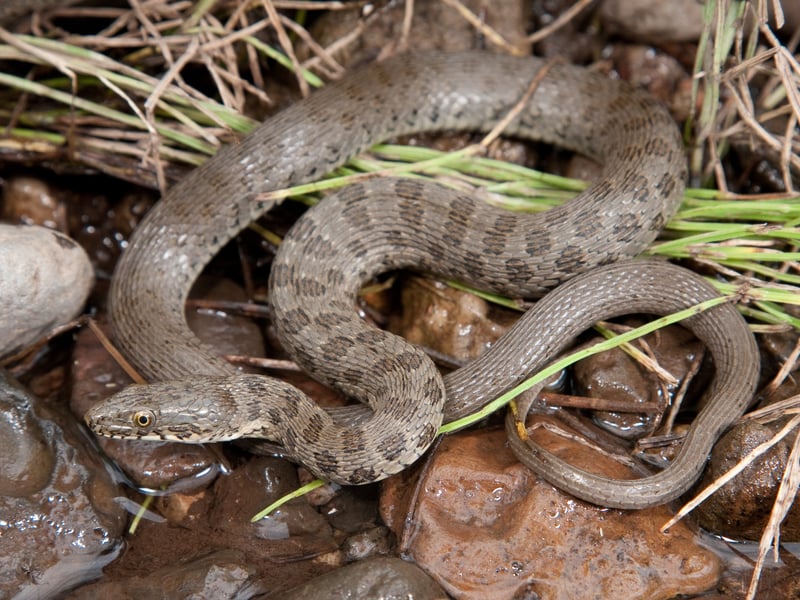
TUCSON (CN) — Reduced critical habitat protections for two endangered garter snakes do not violate the Endangered Species Act, according to a federal judge.
In an order issued Friday, U.S. District Judge Raner Collins found the U.S. Fish and Wildlife Service relied on the best available science when designating occupied habitat and excluding unoccupied areas for the northern Mexican and narrow-headed garter snakes. He granted summary judgment to the agency.
To prevail under the Endangered Species Act and Administrative Procedure Act, a plaintiff must show not merely that the agency reached the wrong conclusion, but that it ignored or failed to consider the available science.
Collins, a Bill Clinton appointee, found the center failed to make that showing.
“CBD’s displeasure with FWS’s determination does not equal a failure to address CBD’s concerns,” Collins wrote in a 20-page ruling.
In a 2023 complaint, the Center for Biological Diversity and garter snake expert Erika Nowak argued Fish and Wildlife ignored snake experts and its own scientists in shrinking the snakes’ protected habitat by excluding thousands of acres of ephemeral streams, among other actions the center says were inconsistent with “the best available science.”
“What a tragic loss for a species that represents disappearing and increasingly imperiled riparian habitat," Robin Silver, co-founder of the center, told Courthouse News in an email. “Congratulations to USFWS for confusing a federal judge to the detriment of a species that now will not have enough protection to prevent its extinction.”
Fish and Wildlife didn’t exclude all ephemeral streams, but found, through its own studies, that garter snakes occupy only ephemeral streams that connect two perennial streams or larger bodies of water.
“FWS’s conclusion that purely ephemeral streams do not provide habitat for either species was justifiable and was supported by the best available evidence,” Collins wrote. “FWS included areas used to connect water sources, areas where the species had been spotted foraging, and areas that provided appropriate groundcover. FWS considered CBD and Nowak’s comments, but drew reasonable conclusions based on all of the evidence. The court will not question FWS’s expertise.”
The center also argued that the agency improperly excluded overland areas between perennial stream systems that snakes often use to move between aquatic areas for certain life-cycle functions, such as overwintering and reproduction.
Fish and Wildlife’s research found that most garter snakes use vegetative cover for travel, but not grasslands, so it excluded grasslands. Previous assumptions about habitat boundaries were based on property boundaries around stock tanks rather than on actual land use by the species, so the agency’s updated findings naturally excluded some previously accounted-for land.
“With the limited information available, FWS acknowledged that the 2013 proposed designation of critical habitat around property boundaries had no correlation with species’ use,” Collins wrote. “In addition, FWS realigned the boundaries to better account for habitat that correlated with water boundaries and vegetative groundcover. FWS acknowledged and explained its change in position, considered the available evidence, and addressed Dr. Nowak’s comments.”
In deciding what areas to consider occupied, Fish and Wildlife disregarded data collected before 1998 because most garter snakes don’t live more than 15 years. The center argued that 15 is an arbitrary estimate, and that the elusive, secretive nature of the snakes makes it difficult to track or make such assumptions.
Again, Collins found the agency’s assumptions to be reasonable, given the surveys and historical data available to it
Because of the snakes’ small populations and poor genetic health, the center argued that protecting unoccupied habitat is essential to prevent extinction. Expanding the habitat range, the center said, would improve the species’ chances of long-term survival.
The Endangered Species Act requires the agency to show that expanded habitat is “indispensable” to the species’ survival, not merely helpful. The U.S. Fish and Wildlife Service found no unoccupied areas within the snakes’ historic range that contain perennial streams, suitable prey and limited nonnative predators. As a result, it concluded additional habitat would not be beneficial, much less indispensable.
In 2013, the U.S. Fish and Wildlife Service proposed protecting more than 630,000 acres for the northern Mexican and narrow-headed garter snakes before both species were listed as endangered in 2014. The proposal was never finalized. The Center for Biological Diversity says the more than 90% reduction adopted in 2021 violates the Endangered Species Act and the Administrative Procedure Act.
Both snakes occupy perennial and ephemeral streams and wetlands across Arizona, New Mexico and northern Mexico. The northern Mexican garter snake received 20,326 acres of protected land — a 95% reduction from its proposed 421,423 acres. The narrow headed garter snake received 23,785 acres — an 89% reduction from its proposed 210,289 acres.
Under the 2013 proposed rule, an entire stream would be protected if it contains record of at least one snake and at least one native prey. But the 2021 revision protects only 2.2 miles both up and downstream “from a known garter snake observation record.”
Neither party immediately replied to requests for comment.
 Follow @JournalistJoeAZ
Subscribe to our free newsletters
Our weekly newsletter Closing Arguments offers the latest about ongoing trials, major litigation and rulings in courthouses around the U.S. and the world, while the monthly Under the Lights dishes the legal dirt from Hollywood, sports, Big Tech and the arts.