
 Search Articles


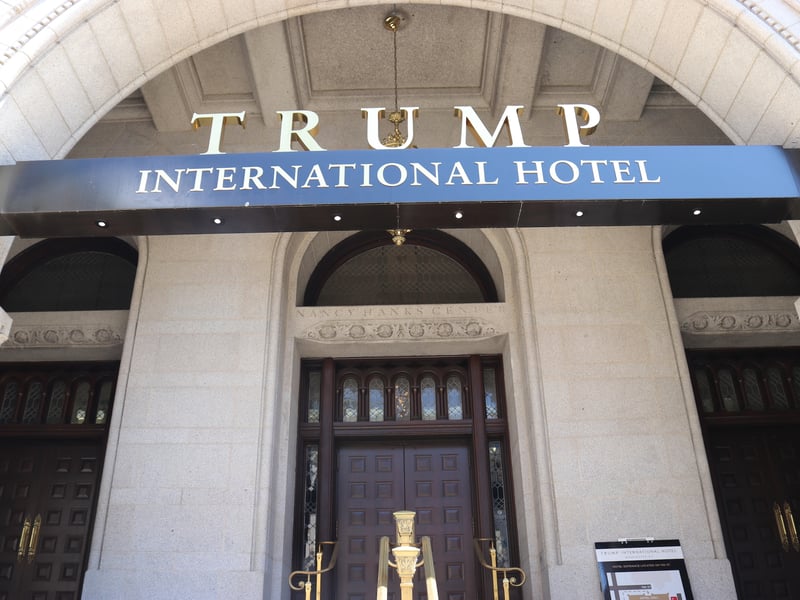
WASHINGTON (CN) — A recent report from House Democrats detailing possible violations of the Constitution’s presidential emoluments clause may also raise unexplored questions about judicial ethics, according to at least one legal expert.
Democrats on the House Oversight Committee on Friday unveiled what they called “legally and ethically questionable payments” from federal and state officials who stayed at former President Donald Trump’s Washington, D.C., hotel during his tenure in office.
In their 58-page report, lawmakers cited more than a dozen people, including ambassadors, state government officials and people seeking presidential pardons, who spent thousands of dollars at Trump International Hotel during the former president’s administration.
Among those hotel guests were three of Trump’s judicial nominees, all of whom Democrats say stayed at Trump’s property while they were seeking his nomination to the bench.
According to the report, Elizabeth Branch, now a judge on the 11th Circuit Court of Appeals, stayed at the hotel on two occasions in 2017 and 2018, spending nearly $2,800. At the time, she was a judge on the Georgia Court of Appeals. Branch’s first stay at the Trump hotel coincided with her confirmation hearing in the Senate Judiciary Committee.
Rodolfo Ruiz, a judge in the Southern District of Florida since 2019, was a guest at the former president’s hotel three times in 2017 and 2018, racking up nearly $5,000 in bills. Ruiz, then a state judge for Florida’s 11th Judicial Circuit, stayed at the Trump hotel while he was in town meeting with Florida Senator Marco Rubio and the White House regarding his potential nomination, Democrats said.
Ninth Circuit Judge Bridget Bade was the third Trump nominee with a room at the Trump International Hotel, where she spent one night in April 2018 at a price point of roughly $400. According to the lawmakers, Bade, then a U.S. magistrate judge for the District of Arizona, was in Washington for an interview with White House attorneys for her appellate nomination.
All three prospective jurists were confirmed by the Senate and still sit on the federal bench.
The Democrats’ report dialed in on the possible unconstitutional nature of these stays, which lawmakers argued would violate the Constitution’s domestic emoluments clause if they were paid for using taxpayer funds. The clause prevents presidents from earning money or perks from a state or federal government outside their salary during their terms.
But the appearance of three judges in the Trump hotel’s guest book may also raise new — and unprecedented — questions about judicial ethics.
“It’s a nice question, and not a clear one,” said Carl Tobias, chair of the University of Richmond School of Law. He pointed out that there is little historical background for comparison.
“I don’t think that this has happened very often in the past,” Tobias said.
Both state and federal courts maintain strict ethical standards to which jurists are required to adhere. The U.S. Judicial Conference, the preeminent policymaking body for the federal judiciary, holds in its code of conduct that judges should avoid even the appearance of impropriety in all activities.
“A judge should neither lend the prestige of the judicial office to advance the private interests of the judge or others nor convey or permit others to convey the impression that they are in a special position to influence the judge,” the Judicial Conference’s code of conduct reads.
An appearance of impropriety, the conference adds, occurs when “reasonable minds” would conclude that a judge’s honesty, integrity or impartiality as a jurist may be affected. Efforts to avoid that appearance apply to both “professional and personal conduct.”
State courts, while not bound by Judicial Conference regulations, employ similar codes of ethics. Both Florida and Georgia employ nearly identical language to federal guidelines on judicial impropriety in their own standards.
But whether the trio of prospective jurists ran afoul of state or federal ethics codes by staying at the Trump International Hotel while seeking the White House’s nomination remains murky, said Tobias.
“I don’t think it’s clear-cut, but I think people could make an argument that there is possibly an appearance there,” he said. “I think an argument could be made that it doesn’t look very good.”
The situation is further complicated by the fact that the prospective federal judges were nominees at the time, and not all subject to the Judicial Conference’s standards. Now that they’re on the bench, Tobias said, it’s difficult to say whether those rules could be enforced.
“I think it’s delicate and tricky, and I don’t know what the enforcement mechanism would be, if there is one,” he said. “It’s never happened before, so it’s hard to wrap your brain around it and see where it would lead.”
Of course, Tobias added, the three Trump nominees may have selected the former president’s hotel — located in the Old Post Office building in downtown Washington — because it’s convenient to Capitol Hill and the Justice Department. But it’s hard to avoid the optics, he said.
“Trump wants loyalty from the judges, so it just doesn’t look good,” Tobias said. “I’m a little surprised that they weren’t a little more careful, especially since they were two sitting state judges and a magistrate judge. Why would they risk it?”
Lawmakers have in recent months placed a microscope over ethical standards in the federal judiciary — particularly at the Supreme Court, where reports have emerged that several of the justices failed to report luxury vacations and other gifts lavished on them by wealthy conservative benefactors.
Scrutiny on the high court spawned a year of legislative activity on Capitol Hill, as Democrats led efforts to force ethics reform in the judiciary. While the push has yielded little fruit, lawmakers leading the charge are cautiously optimistic about their prospects after November’s presidential election.
 Follow @BenjaminSWeiss
Subscribe to our free newsletters
Our weekly newsletter Closing Arguments offers the latest about ongoing trials, major litigation and rulings in courthouses around the U.S. and the world, while the monthly Under the Lights dishes the legal dirt from Hollywood, sports, Big Tech and the arts.