
 Search Articles


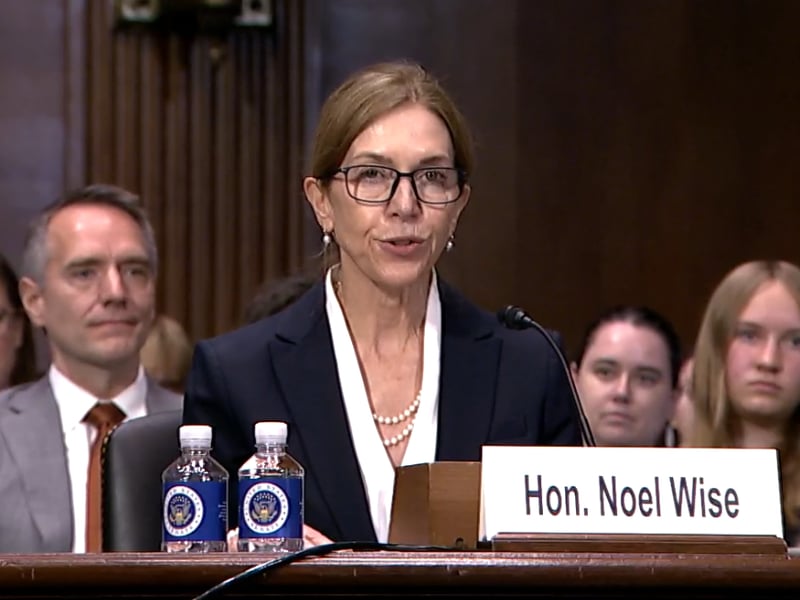
WASHINGTON (CN) — As the Senate Judiciary Committee met Wednesday to question the Joe Biden administration’s latest slate of federal court nominees, panel chair Senator Dick Durbin issued an evergreen warning to would-be judges.
“I would counsel a high school student who says they’d like to be a federal judge that it’s a great idea,” the Illinois Democrat said. “But one piece of advice: don’t put anything in writing from this moment forward.”
Durbin’s quip drew laughter from the gathered audience in the Judiciary Committee chamber. But it was nonetheless a signal that the chairman knew what sort of Republican cross-examination awaited the slate of blue state nominees tapped to fill vacancies in Pennsylvania, Minnesota and California.
It was Noël Wise, the White House’s nominee for the Northern District of California, who drew the brunt of the GOP’s scrutiny.
Wise, who was before her nomination a sitting judge in the California Superior Court and who Durbin described as a “prolific author,” faced tough questions from Republicans for several articles that she wrote while serving on the bench. Lawmakers were particularly critical of a 2017 article published in Time Magazine in which she explored the legal implications of expanding scientific understanding of biological sex and gender identity.
In the article, Wise cited specific examples of babies born with genetic irregularities which make their sex ambiguous and pointed out that as many as five visibly intersex people are born in the U.S. daily.
“The more we learn about our DNA, the more that biological sex — from the moment of conception — looks like an intricate continuum and less like two tidy boxes,” she said. “This understanding makes it virtually impossible for judges to consistently apply a law that permits or prohibits conduct based on whether someone is a man or a woman.”
Though she criticized laws clamping down on LGBTQ rights, such as the Defense of Marriage Act and North Carolina’s controversial “bathroom bill,” Wise argued that legal issues facing intersex people had little to do with the subject.
“This physiological truth is unrelated to whether someone is straight, gay or transgender,” she wrote.
But Republicans on Wednesday were keen to frame her work as a sweeping generalization about how courts should address constitutional questions of sex and gender identity.
“I think these positions are insane,” said Missouri Senator Josh Hawley, reading a passage from Wise’s article in which she said that legislators blur the lines of church and state with laws that lay out a clear gender binary. The nominee contended such laws place an “impossible burden” on the judiciary.
“I think the idea that laws based on the distinction between male and female are in violation of church and state is insane,” Hawley said.
Wise said she had not taken a position on the way legislation affects the LGBTQ community but was rather making an observation about the specific challenges of people with biologically ambiguous gender.
“The thesis of the article … makes it absolutely clear that my article has nothing to do with people who are transgender or gay,” she said. “It dealt with a narrow issue about babies who are born and doctors are challenged to make a determination about sex.”
Wise added it could be difficult for a sitting judge to square that biological reality with laws that force them to make a binary choice between male and female.
The GOP, though, was not convinced. Utah Senator Mike Lee framed the nominee’s writing as advocating for gender-neutral spaces such as bathrooms or locker rooms — but Wise argued lawmakers were still misunderstanding the thrust of her article.
“I care very much about the rule of law,” she said. “I wrote nothing about people who are gay, straight or transgender at all.”
Republicans also dialed in on other articles Wise wrote while serving on the bench of the Superior Court of California, including a 2020 piece published in The Atlantic in which she argued that federal judges appointed under the then-Donald Trump administration did not reflect American diversity.
Lawmakers were also critical of her decision to offer her opinion on various legal issues while a sitting judge.
“Interesting choice to be writing opinion pieces about your cases,” Hawley said.
South Carolina Senator Lindsey Graham, the Judiciary Committee’s Republican ranking member, said he thought it was uncommon for jurists to write articles for major publications.
“I think it’s common for judges to publish law review articles or other forms of articles,” Wise replied.
Democrats, for their part, pushed back on Republican criticism of Wise’s writings, taking aim at comments about her 2020 article on judicial diversity.
“People may not like it, but it happens to be true,” Hawaii Senator Mazie Hirono said of the nominee’s observations about Trump-era judges. “In my view, his nominees do not reflect the diversity of our country.”
Durbin concurred, adding that it was “painful for some … to accept the reality of diversity.”
“There seems to be a resistance when there are women nominees, particularly women of color,” the Judiciary Committee chair said. “Nevertheless, we will move forward … we will continue along those lines.”
Meanwhile, the Judiciary Committee questioned two other nominees: Mary Costello, nominated to the Eastern District of Pennsylvania, and Laura Provinzino, tapped by the Biden administration to fill a vacancy on the District of Minnesota.
 Follow @BenjaminSWeiss
Subscribe to our free newsletters
Our weekly newsletter Closing Arguments offers the latest about ongoing trials, major litigation and rulings in courthouses around the U.S. and the world, while the monthly Under the Lights dishes the legal dirt from Hollywood, sports, Big Tech and the arts.