
 Search Articles


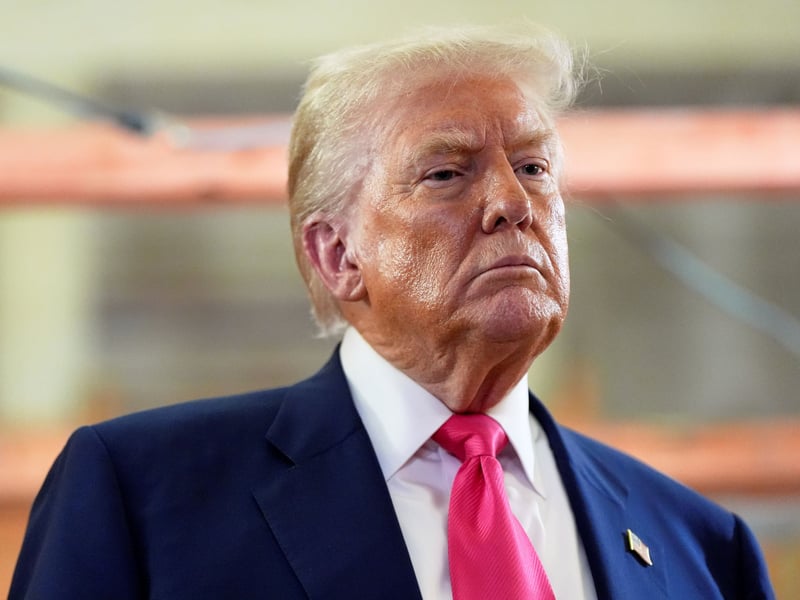
WASHINGTON (CN) — The Federal Circuit Court of Appeals ruled Friday that President Donald Trump did not have the authority to unilaterally levy April’s “Liberation Day” tariffs under the International Emergency Economic Powers Act.
In a 7-4 decision, the en banc panel held that while the 1977 statute — commonly referred to as IEEPA — does grant the president authority to “regulate” imports, that does not include the ability to unilaterally impose tariffs via executive order.
“We discern no clear congressional authorization by IEEPA for tariffs of the magnitude of the reciprocal tariffs and the trafficking tariffs,” the court wrote in a per curiam opinion. “Reading the phrase ‘regulate … importation’ to include imposing these tariffs is ‘a wafer-thin reed on which to rest such sweeping power.’”
U.S. Circuit Judges Alan Lourie, Timothy Dyk, Jimmie Reyna, Todd Hughes, Kara Stoll, Tiffany Cunningham and Leonard Stark made up the majority, while U.S. Circuit Judges Richard Taranto, Kimberly Moore, Sharon Prost and Raymond Chen dissented.
The case, brought by a coalition of small businesses and 12 states, challenges Trump’s blanket 10% tariffs and varied reciprocal tariffs imposed on April 2 before issuing a 90-day pause when the stock markets melted down.
In an email to Courthouse News Friday, White House spokesman Kush Desai defended Trump’s tariffs and asserted that they remain in effect.
“President Trump lawfully exercised the tariff powers granted to him by Congress to defend our national and economic security from foreign threats,” Desai said. “The president’s tariffs remain in effect, and we look forward to ultimate victory on this matter.”
In its decision, the court noted that Trump has declared several national emergencies — regarding the border, fentanyl trafficking and crime in Washington, among others — as a method to exert powers normally unavailable to the president.
The panel sided with Neal Katyal, the business coalition’s lead attorney of Milbak, who said at July’s oral arguments that Trump’s blanket tariffs should clearly invoke the so-called major questions doctrine in the same way former President Joe Biden’s effort to erase wide swaths of student debt did.
The doctrine, created by the Supreme Court, holds that executive agencies can only act on issues of national significance with clear congressional authorization.
In a footnote, the panel noted that Trump’s tariffs are projected to have a much larger economic impact than either of the two cases the Supreme Court found implicated the major questions doctrine — Biden v. Nebraska and Alabama Association of Realtors v. Department of Health & Human Services — where either case was expected to leave a $50 billion and $519 billion impact, respectively.
“As noted, the government’s estimates of the reciprocal and trafficking tariff’s impacts are at least five times larger,” the court wrote. “And given the president’s continued invocation of IEEPA to impose additional expansive tariffs during the pendency of this appeal, the overall economic impact of the tariffs imposed under the government’s reading of IEEPA is even larger still.”
Taranto, a Barack Obama appointee, wrote the dissent and found IEEPA does in fact authorize tariffs as a means to regulate importation.
“We conclude that IEEPA’s authorization of presidential action in this realm is not an unconstitutional delegation of legislative authority under the Supreme Court’s decisions, including tariffing authority, in this foreign-affairs-related area,” Taranto wrote.
Friday’s ruling marks the second time a federal court has rejected Trump’s authority to impose the tariffs, which have become central to his economic agenda and his promises to bring manufacturing jobs back to the U.S.
A Court of International Trade panel ruled May 28 that Trump had exceeded his constitutional authority by declaring an “economic emergency” and imposing blanket tariffs on 57 countries.
The three-judge trade court panel unanimously struck down Trump’s tariffs, finding that ruling otherwise would amount to an unconstitutional and “unlimited delegation of tariff authority” from Congress to the White House.
On top of the 10% tariffs, Trump levied additional rates ranging from 11% to 50% depending on the trade deficit with each country, determined by the administration.
There is a second case, pending before the D.C. Circuit Court of Appeals, challenging Trump’s use of IEEPA to impose his tariffs, brought by two small educational toy businesses.
A three-judge panel made up of D.C. Circuit Judges Gregory Katsas, Neomi Rao and Justin Walker — the only Trump appointees on that court — will hear arguments in the case on Sept. 30.
 Follow @Ryan_Knappy
Subscribe to our free newsletters
Our weekly newsletter Closing Arguments offers the latest about ongoing trials, major litigation and rulings in courthouses around the U.S. and the world, while the monthly Under the Lights dishes the legal dirt from Hollywood, sports, Big Tech and the arts.