
 Search Articles


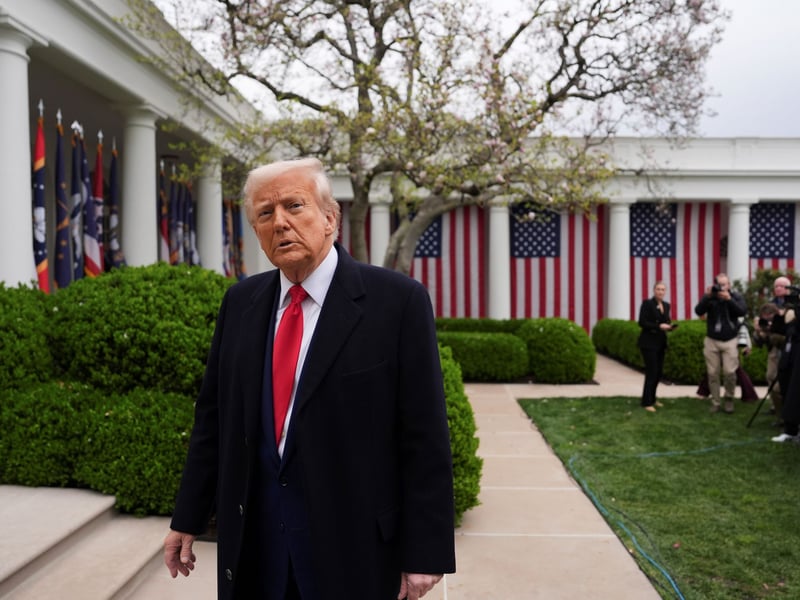
WASHINGTON (CN) — An en banc appellate panel appeared skeptical Thursday that President Donald Trump had the authority to unilaterally levy his “Liberation Day” tariffs, expressing concern that he misused an emergency power to address trade deficits.
Thursday’s arguments before the U.S. Federal Circuit Court of Appeals consolidated two cases challenging Trump’s blanket 10% tariffs and varied reciprocal tariffs — many of the reciprocal tariffs are currently set to take effect Friday — which were brought by a coalition of small businesses and 12 states.
The three-judge trade court panel unanimously struck down Trump’s tariffs, finding that ruling otherwise would amount to an unconstitutional and “unlimited delegation of tariff authority” from Congress to the White House.
Several members of the 11-judge panel noted that the 1977 statute, commonly referred to as IEEPA, does specifically grant the president the power to impose tariffs.
At most, the panel noted, it allows the executive to “regulate” imports, even to the point of freezing imports from a certain country. Yet, it seemed unlikely that Congress would have delegated its authority over imposing tariffs without explicitly saying so.
“It’s just hard for me to see that Congress intended to give the president in IEEPA the wholesale authority to throw out the tariff schedule that Congress has adopted after years of careful work and revise every one of these tariff rates,” U.S. Circuit Judge Timothy Dyk said. “It’s really kind of asking for an extraordinary change to the whole approach.”
Justice Department attorney Brett Shumate, assistant attorney general for the Justice Department’s civil division, argued that the president has broad discretion to impose the tariffs under his foreign affairs and national security powers.
He said Trump, when declaring a national emergency regarding fentanyl trafficking and the consequences of the trade deficit — such as impacts on the nation’s manufacturing industry and its military readiness — was empowered to regulate imports, which should include the ability to levy tariffs.
On top of the 10% tariffs, Trump levied additional rates ranging from 11% to 50% depending on the trade deficit with each country, determined by the administration.
Shumate further argued that the court had a limited role in reviewing Trump’s decision and could only review whether the tariffs are in fact an exercise of the regulatory authority under IEEPA. The court has no role, Shumate said, in reviewing Trump’s emergency declarations, which could only be overturned by Congress itself.
U.S. Circuit Judge Leonard Stark, a Joe Biden appointee and the newest member of the court, noted that one of the cases central to the government’s argument, the 1975 United States v. Yoshida, holds that while “regulate” can be interpreted to include imposing tariffs, they were limited to those related to the declared emergency.
“The court said ‘the declaration of a national emergency is not a talisman enabling the president to rewrite the tariff schedule’ because it would ‘sound the death-knell of the Constitution,’” Stark said. “It seems pretty clear to us that Yoshida is telling us that, no, the president doesn’t have the authority to rewrite the tariffs.”
Neal Katyal, of Milbank and representing the business coalition, decried the government’s position.
“You just heard an argument in response to Judges [Todd] Hughes, Stark and Dyk, that our federal courts are powerless, that the president can do whatever he wants, whenever he wants, for as long as he wants, so long as he declares an emergency,” Katyal said. “That is as major a question as it gets, a breathtaking claim to power that no president has asserted in 200 years. The consequences are staggering.”
Katyal said the blanket tariffs should invoke the so-called major questions doctrine — a legal practice created by the Supreme Court holding that executive agencies can only act on issues of national significance with clear congressional authorization — in the same way former President Biden’s effort to erase wide swaths of student debt did.
He argued that, just as the Supreme Court rejected Biden’s effort in the 2023 Biden v. Nebraska, the courts should reject Trump’s effort to unilaterally take Congress’ tariff powers.
Thursday’s case is one of two currently challenging the president’s “Liberation Day” tariffs, as a D.C. Circuit panel is set to hear arguments in a case brought by two small educational toy businesses on Sept. 30.
A three-judge panel made up of D.C. Circuit Judges Gregory Katsas, Neomi Rao and Justin Walker — the only Trump appointees on that court — will hear the case.
 Follow @Ryan_Knappy
Subscribe to our free newsletters
Our weekly newsletter Closing Arguments offers the latest about ongoing trials, major litigation and rulings in courthouses around the U.S. and the world, while the monthly Under the Lights dishes the legal dirt from Hollywood, sports, Big Tech and the arts.