
 Search Articles


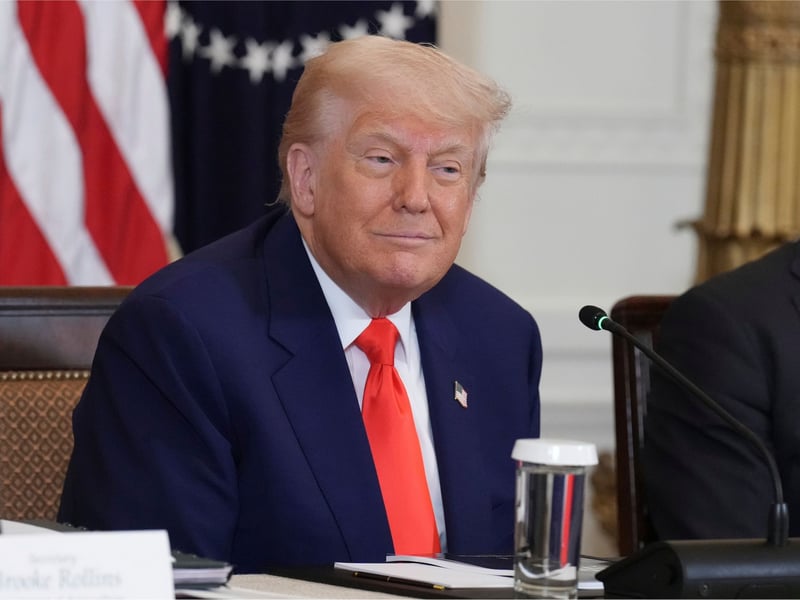
WASHINGTON (CN) — A federal appeals panel temporarily froze a court order on Thursday that blocked President Donald Trump’s blanket “Liberation Day” tariffs, setting up a protracted legal battle all but guaranteed to end up at the Supreme Court.
The Trump administration sought immediate emergency relief from an 11-judge panel at the U.S. Court of Appeal for the Federal Circuit, warning that without “at least interim relief,” the government would appeal to the Supreme Court on Friday.
Led by Chief Circuit Judge Kimberly Moore, a George W. Bush appointee, the panel granted the stay and froze the Court of International Trade’s permanent injunction as the appeals court weighs the government’s stay motion in full.
On top of the 10% tariff, Trump levied additional rates ranging from 11% to 50% depending on the trade deficit with each country determined by the administration.
In its unanimous ruling, the three-judge trade panel struck down Trump’s tariffs — leaving his so-called “trafficking tariffs” imposed on Mexico, Canada and China over apparent fentanyl trafficking — finding that ruling otherwise would amount to an unconstitutional and “unlimited delegation of tariff authority” from Congress to the White House.
Thursday’s ruling staves off an emergency appeal to the Supreme Court, what was once a particularly rare move that has become common as Trump challenges emergency court rulings temporarily freezing his controversial agenda.
The plaintiffs in the case, a coalition of small businesses and 12 attorneys general, must respond to the Trump administration’s stay motion by next Thursday, June 5, while the government must file its response by June 9.
The ruling is a temporary reprieve amid two legal losses for Trump’s central economic policy thus far in his second term.
Earlier on Thursday, U.S. District Judge Rudolph Contreras struck down certain tariffs that impacted two small educational toy businesses, Learning Resource Inc. and hand2mind Inc., who manufacture most of their products in China, Taiwan, Korea, Vietnam, Thailand and India.
The Barack Obama appointee’s ruling only applied to the specific plaintiffs, but Contreras echoed the Court of International Trade’s decision that Trump misused the Nixon-era statute.
“This case is not about tariffs qua tariffs,” Contreras wrote. “It is about whether IEEPA enable the president to unilaterally impose, revoke, pause, reinstate and adjust tariffs to reorder the global economy. The court agrees with plaintiffs that it does not.”
Contreras agreed with the trade court that the statute does not include the words “tariffs,” “duties” or any similar term, only that the president can “investigate, block, regulate, direct and compel, nullify, void, prevent or prohibit” the import or export of certain property.
Further, there is no language in the statute that would grant the executive any additional powers beyond those clearly listed.
He noted that the Justice Department’s interpretation of the statute could in fact render it unconstitutional, specifically its view that the term “regulate” should include the ability to impose tariffs.
Under that reading, the section allowing him to regulate “importation or exportation” would allow the president to impose export taxes, which are expressly prohibited by the Constitution.
White House Press Secretary Karoline Leavitt commented on the Court of International Trade’s ruling during a press briefing on Thursday, accusing the panel of “brazenly abusing[ing] their judicial power to usurp the authority of President Trump.”
“These judges failed to acknowledge that the President of the United States has core foreign affairs powers and authority given to him by Congress to protect the United States’ economy and national security,” Leavitt said.
Leavitt claimed that, under the National Emergencies Act, Congress created a method to deal with “improper IEEPA use” and had already adjudicated that question when Kentucky Senator Rand Paul’s bid to reject Trump’s blanket tariffs failed in April.
The bid failed with a 49-49 vote, just weeks after the Senate approved a resolution to halt Trump’s tariffs on Canada. That resolution passed 51-49, with Republican Senators Susan Collins, Lisa Murkowski, Mitch McConnell and Paul joining the Democrats, but was reversed by the later vote.
“Ultimately, the Supreme Court must put an end to this for the sake of our Constitution and our country,” Leavitt said.
 Follow @Ryan_Knappy
Subscribe to our free newsletters
Our weekly newsletter Closing Arguments offers the latest about ongoing trials, major litigation and rulings in courthouses around the U.S. and the world, while the monthly Under the Lights dishes the legal dirt from Hollywood, sports, Big Tech and the arts.