
 Search Articles


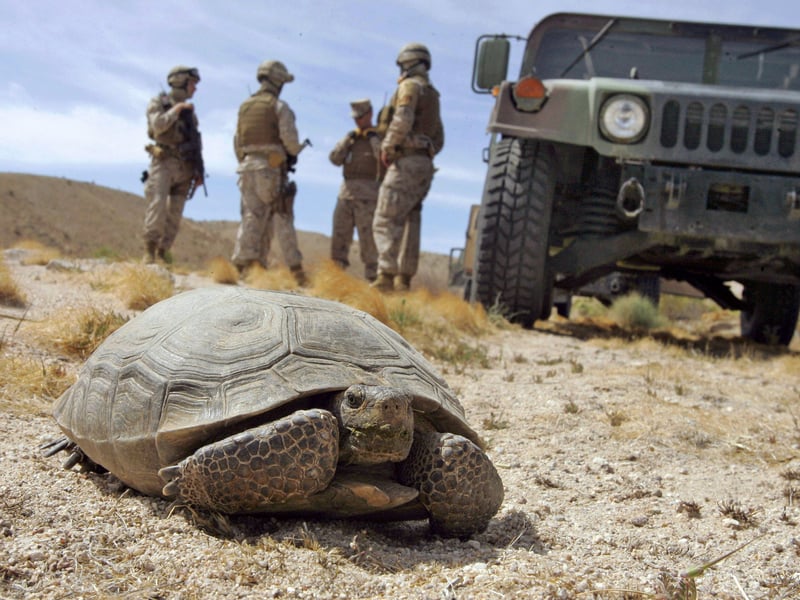
SAN FRANCISCO (CN) — A federal judge partially ruled in favor of environmental groups in their suit challenging the Bureau of Land Management’s approval of route networks for off-highway vehicles in the Western Mojave Desert.
The groups say these routes are harmful to the Mojave desert tortoise — which is listed as threatened under the Endangered Species Act but recognized as endangered by the California Fish and Game Commission.
“The record does not affirmatively demonstrate how the BLM designated OHV routes with the objective of minimizing impacts on the desert tortoise, the Lane Mountain milk-vetch, and other resources,” Senior U.S. District Judge Susan Illston wrote in a 107-page order Tuesday.
The Bill Clinton appointee wrote that the bureau improperly relied on optional mitigation measures to satisfy its obligation to designate off-highway vehicle routes that complied with regulatory law.
The judge also found the Fish and Wildlife Service violated the Endangered Species Act in “several respects, including by relying on the BLM’s optional mitigation measures to avoid ‘jeopardy’ to the desert tortoise and ignoring the best available science when reaching its ‘no jeopardy’ findings.”
The plaintiffs — The Center for Biological Diversity, the Sierra Club, Desert Survivors, California Native Plant Society, Defenders of Wildlife, and the Desert Tortoise Council — argued that Fish and Wildlife’s biological opinion ignored two key studies regarding desert tortoises, and therefore violated the Endangered Species Act’s requirement to base its determination on the “best scientific and commercial data available.”
“Plaintiffs contend that if FWS had addressed these studies, the agency might have determined that far fewer OHV routes were necessary in order to protect the desert tortoise because these studies show that OHV use is associated with the most ‘precipitous’ decline of desert tortoises and that exclusion of OHVs is critical to tortoise conservation,” Illston wrote.
Fish and Wildlife argued that it did not need to consider these studies because the FWS’s 2011 Revised Recovery Plan is the most comprehensive review of all threats to the desert tortoise. That plan lists multiple reasons for the tortoise’s decline, including off-highway vehicle activity and grazing, but does not designate off-highway vehicle use as a “primary cause of decline” of the tortoises.
“FWS violated its obligation to insure that its no jeopardy determination was based on ‘the best scientific and commercial data available.’ As an initial matter, both studies post-date the 2011 Revised Recovery Plan, and thus were not considered in that plan,” Illston wrote.
The plaintiffs also claimed that bureau’s roads violated the National Environmental Policy Act because the roads harmed riparian zones and springs, as well as air quality, and that bureau provided incomplete or misleading information in its Environmental Impact Statement.
“The Court declines to find that the BLM’s description of its process was inadequate as a NEPA matter,” Illston wrote, granting summary judgment to bureau on the National Environmental Policy Act claims.
In their 2021 complaint, the environmental groups claimed that off-road vehicle routes in the West Mojave Desert were designed illegally and that regulations require the bureau to close areas to off-road vehicles where they are causing or will cause negative impacts to soil, vegetation, wildlife, wildlife habitat, cultural resources, wilderness suitability, or threatened and endangered species.
The plaintiffs claimed that off-road vehicles presented a particular harm to the Mojave desert tortoise. The tortoises are hard to see, so off-road vehicles can run them over, and the presence of off-road vehicles can alter the tortoise’s behavior, degrade the soil and introduce and spread non-native plant species in its environment. They are native to southeastern California, southern Nevada, southwestern Utah, and northwestern Arizona
At a hearing last year, the plaintiffs showed Illston data that there was a total decline of almost 50% in the population of Western Mojave adult tortoises from 2004 to 2014, and that more than 67,000 tortoises were killed. There was also a decline in juveniles, calling into question the species’ future.
The parties’ attorneys did not immediately respond to requests for comment.
Subscribe to our free newsletters
Our weekly newsletter Closing Arguments offers the latest about ongoing trials, major litigation and rulings in courthouses around the U.S. and the world, while the monthly Under the Lights dishes the legal dirt from Hollywood, sports, Big Tech and the arts.