
 Search Articles


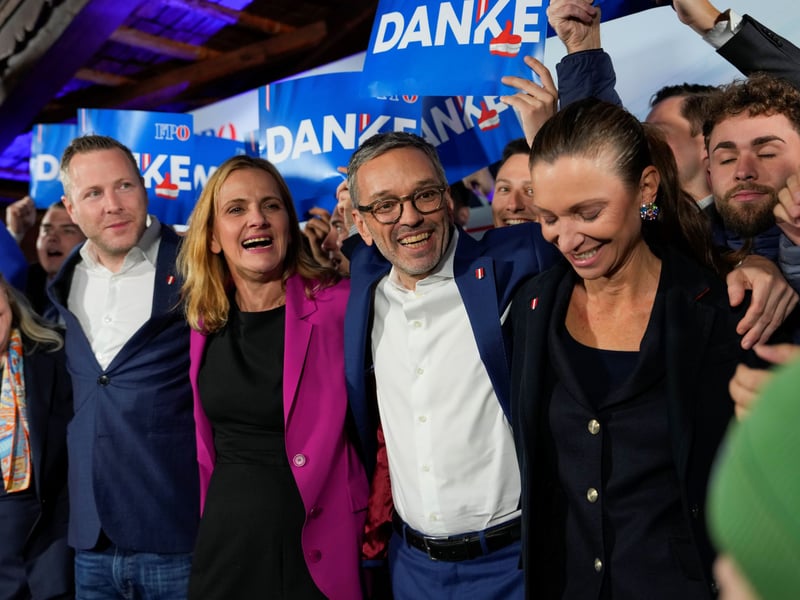
(CN) — In a historic and troubling shift for Europe and Austria, Vienna on Monday was the scene of the unthinkable: Austria’s far-right party stood on the cusp of seizing the chancellorship for the first time in the country’s post-World War II history.
On Monday, Herbert Kickl, the leader of the Freedom Party of Austria, was given permission to lead the formation of a new government with Austria’s mainstream conservatives, the Austrian People’s Party.
In September, the Freedom Partywon national elections for the first time since World War II after it ran on a campaign centered on anti-immigrant “Fortress Austria” slogans, opposition to Western support for Ukraine, strong anti-European Union rhetoric and pledges to cut taxes.
An Austria under Kickl’s leadership then would pose new headaches for Brussels and give anti-EU forces in Europe, such as Hungarian Prime Minister Viktor Orbán, a major ally.
Kickl’s rise to power was held in check for three months as centrist parties, led by the long-dominant People’s Party, tried to cobble together a workable majority.
But the talks among the conservatives, the center-left Social Democrats and a liberal group collapsed due to disagreements over how to rein in Austria’s skyrocketing deficit and inflation.
Over the weekend, the People’s Party announced it was ready to join a Kickl government, a move that left many Austrians in shock. In the fallout, the People’s Party was rocked too with its leader, outgoing Chancellor Karl Nehammer, resigning.
Nehammer, along with much of Austria’s political class, strongly opposed Kickl. From his end, Kickl has called Nehammer “the nation’s biggest plague.”
The 56-year-old Kickl is an irreverent and ribald politician who gained prominence as the speechwriter for Jörg Haider, the deceased former Freedom Party leader whose electoral successes in the 1990s became an early example of the neo-fascist movement now sweeping Europe.
On Monday morning, Kickl was invited by Austrian President Alexander Van der Bellen to the Hofburg Palace, the former imperial palace of the Habsburg dynasty and now the residence of Austrian presidents.
The 80-year-old Van der Bellen, who is aligned with the Social Democrats and Greens, has tried to stop elevating Kickl to the chancellorship, but he has few options left.
At the Hofburg, a grinning Kickl and Van der Bellen coldly shook hands for the assembled television crews, reporters and photographers before they disappeared for talks.
Afterward, Van der Bellen reluctantly said the constitution compelled him to authorize Kickl to form a government.
“I didn’t take this step lightly,” he said in his speech. “I will continue to ensure that the principles and rules of our Constitution are correctly observed and adhered to.”
“I can have certain wishes and ideas about the composition of this majority,” Van der Bellen said. But he said he had to uphold “respect for the voters.”
Pundits speculate Van der Bellen might even consider resigning to avoid the humiliation of carrying out a swearing-in ceremony for Kickl. But that move could lead to new elections and the Freedom Party is poised to do as well or even better in a new round of voting than it did in the September ballot.
Van der Bellen said the new Austrian government must respect the basic pillars of democracy, including the rule of law, the separation of powers, the rights of minorities and commitment to the EU and a free media.
Presidents in Austria wield some power, but the day-to-day duty of running the government rests with the chancellor and a cabinet. Presidents serve mostly a ceremonial role, though they appoint chancellors and can even remove them.
Kickl avoided comments to the media after his visit to the Hofburg, but wryly added that meetings with Van der Bellen were “always good.” Kickl has frequently ribbed Van der Bellen, calling him “that mummy in the Hofburg” and “senile.”
The FPÖ was founded by former Nazi members in the 1950s and it has long embraced ultranationalist, anti-EU and anti-immigrant stances.
As the birthplace of Adolf Hitler, Austria has struggled with its Nazi past and the scars left by Hitler’s legacy and the Third Reich’s annexation of Austria in 1938.
For many in Austria and Europe, the prospect of the Freedom Party taking power is seen as a deeply troubling development for democracy and a haunting reminder of the continent’s ultranationalist past.
On Monday, hundreds of heavily dressed protesters stood outside the Hofburg to denounce the looming Kickl government and hurl invective at Kickl when he exited the palace.
Hundreds of people also gathered outside the Ballhausplatz, the chancellor’s office, to express their outrage.
“We don’t want a right-wing extremist chancellor,” one banner read, as reported by Der Standard, a daily newspaper in Austria.
“I am simply afraid of the setbacks that could await us under Chancellor Kickl,” Karl Schmidl, draped in a Socialist Youth flag, told the newspaper.
The far right in Europe has steadily gained in strength in recent years and made major gains in France, Italy, Germany, Spain, the Netherlands and elsewhere.
Perhaps the biggest breakthrough came in September 2022 with the election of Italian Prime Minister Giorgia Meloni. She became the first leader from a party with neo-fascist roots to lead any of the six nations that founded the EU — Germany, France, Italy, Belgium, Luxembourg and the Netherlands.
Conditions seem ripe for even more far-right breakthroughs.
Across Europe, there is rising anger and disillusionment as economic hardship, caused largely by the coronavirus pandemic and the Ukraine war, bites. Many national treasuries, including those in France and Germany, are squeezed for cash and governments face tough budget slashing. The economic trouble is feeding into the popularity of far-right parties.
In his speech, Van der Bellen acknowledged the country’s woes.
“Austria is in a persistent recession,” he said. “Unemployment is rising. Our national budget needs to be restructured. Not all measures will be popular, but they will have to be implemented.”
Europe’s far right also is gaining clout following Donald Trump’s reelection in the United States; the new political calculus is favoring those who hold Trump’s anti-establishment, anti-immigrant, anti-left and anti-green world view.
In Austria, the Freedom Party has a long history and it has served in three national governments, twice at the behest of the People’s Party since 2000. The two parties are best known by their German initials, respectively ÖVP for the People’s Party and FPÖ for their hard-right Freedom Party rivals.
Kickl would become Austria’s first chancellor from the FPÖ. The party first entered national government in a coalition with the Social Democrats between 1983 and 1986, a period when the FPÖ was more moderate and adopted liberal policies before the party was taken over by Haider.
Peter Filzmaier, a political scientist at the Universities of Graz and Krems, said in an email that a Kickl-led government would represent “a fundamental political change” for Austria.
In the previous ÖVP-FPÖ and Social Democrat-FPÖ governments, the major parties held the chancellorship because they were the bigger electoral parties in parliament. European systems customarily award the top government office to the largest party.
So this time around, the ÖVP-FPÖ parties would see their roles reversed because the FPÖ won 29% of the vote in September to the ÖVP’s 26%. Kickl has refused to consider ceding the chancellorship to the ÖVP. A new FPÖ-ÖVP government deal is expected to be announced soon.
In the September election, the FPÖ made surprisingly big gains among women, wealthier and younger voters and garnered support from many longtime nonvoters.
Courthouse News reporter Cain Burdeau is based in the European Union.
 Follow @cainburdeau
Subscribe to our free newsletters
Our weekly newsletter Closing Arguments offers the latest about ongoing trials, major litigation and rulings in courthouses around the U.S. and the world, while the monthly Under the Lights dishes the legal dirt from Hollywood, sports, Big Tech and the arts.