
 Search Articles


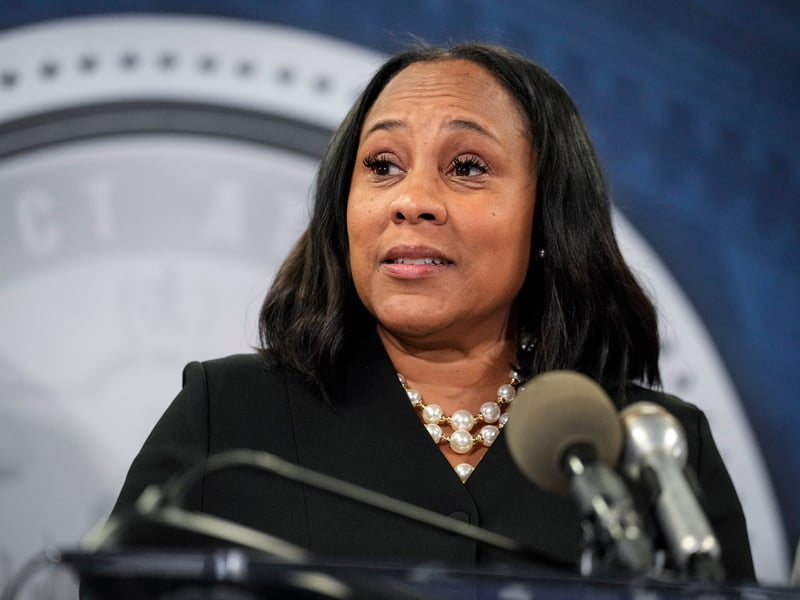
ATLANTA (CN) — The Georgia Court of Appeals ruled Thursday that Fulton County District Attorney Fani Willis and her office should be removed from the 2020 election interference case against Donald Trump.
The move comes after the court abruptly canceled its scheduled oral arguments on the issue without reason earlier this month.
In a 2-1 opinion, a panel of all Republican-appointed judges concluded that a Fulton County judge’s decision to allow Willis to remain on the case, despite finding an “appearance of impropriety,” was not a sufficient remedy.
“The remedy crafted by the trial court to prevent an ongoing appearance of impropriety did nothing to address the appearance of impropriety that existed at times when DA Willis was exercising her broad pretrial discretion about who to prosecute and what charges to bring,” Judge Trenton Brown wrote for the majority.
“While we recognize that an appearance of impropriety generally is not enough to support disqualification, this is the rare case in which disqualification is mandated and no other remedy will suffice to restore public confidence in the integrity of these proceedings,” he added.
Brown noted that Fulton County prosecutors never filed a cross appeal asserting that the judge’s finding should be reversed. He explained that the panel was not asked to review whether or not an actual appearance of impropriety existed, but whether the remedy imposed was sufficient.
Under Georgia law, an appearance of impropriety does not mean a prosecutor should be automatically dismissed and that the particular facts and circumstances of each case should be examined, Brown said.
“These considerations take this case out of the continuum of cases involving an appearance of impropriety in connection with the conduct of private counsel and a client’s interest in counsel of choice balanced against a more nebulous public interest,” the judge wrote.
The court did, however, refuse to dismiss the indictment as requested in the defendants’ appeal.
“We cannot conclude that the record also supports the imposition of the extreme sanction of dismissal of the indictment under the appropriate standard,” the judge wrote.
Brown was joined by Judge Todd Markle. A third judge, Benjamin Land, issued a strongly worded dissent.
“I am particularly troubled by the fact that the majority has taken what has long been a discretionary decision for the trial court to make and converted it to something else entirely,” Land wrote in his dissent.
Land added that the role of appellate judges is to ensure the law has been applied correctly and correct any legal errors, not to “second-guess trial judges or to substitute our judgment for theirs.”
He pointed to the March ruling from the Fulton County Superior Court Judge overseeing the case, Scott McAfee, who found that the defendants failed to meet their burden of proving that the district attorney had an actual conflict of interest.
“For at least the last 43 years, our appellate courts have held that an appearance of impropriety, without an actual conflict of interest or actual impropriety, provides no basis for the reversal of a trial court’s denial of a motion to disqualify. This is true in civil cases and criminal cases, and it applies to prosecutors,” Land wrote.
The judge cited several other cases, including from the Supreme Court, where disqualification was only discussed as a remedy when actual conflicts of interest or forensic misconduct was found.
Nine defendants in the case, including Trump, had argued that Willis received a “material financial benefit” from hiring special prosecutor Nathan Wade, and from being temporarily romantically involved with him.
But McAfee found that there was not enough evidence to show that, nor that Willis purposefully pursued the prosecution for financial gain, nor that her conduct affected the case to their detriment.
He was, however, critical of Willis’ choices and condemned her for making them.
“I take no issue with that criticism, and if the trial court had chosen, in its discretion, to disqualify her and her office, this would be a different case,” Land wrote.
“But that is not the remedy the trial court chose, and I believe our case law prohibits us from rejecting that remedy just because we don’t like it or just because we might have gone further had we been the trial judge.”
McAfee’s ruling allowed Willis to stay on the case only if Wade resigned. Wade submitted his letter of resignation just hours after the order’s release.
Thursday’s decision is a massive blow to Willis, one of the most recognizable prosecutors in the country who was reelected to a second term last month against her Republican opponent. It also could be the death knell for the fourth and final case that resulted in criminal charges against a former president for the first time in history, after Trump left office in January 2021.
But the decision is not the final word on the case, as Willis is expected to appeal the ruling to the Supreme Court of Georgia. The case could also be assigned to a prosecutor from another jurisdiction.
Trump’s reelection brought the two federal criminal cases against him — the election subversion case in Washington and the classified documents case in Florida — to an end.
This is due to longstanding Justice Department policy that says a sitting president cannot be criminally charged.
Before the 2024 election, Trump had already been convicted of 34 felony counts involving hush money paid to an adult film star.
But in light of Trump’s presidential victory, New York Supreme Court Justice Juan Merchan indefinitely delayed his previously scheduled Nov. 26 sentencing last month.
In the Georgia case, Trump is charged with racketeering and a dozen other felonies, including solicitation of violation of oath by a public officer, conspiracy to commit forgery in the first degree and false statements and writings.
He and 18 of his associates were indicted in August 2023 for refusing to accept that Trump lost the 2020 election, and knowingly and willfully joining a conspiracy to unlawfully change the outcome of the election in his favor.
 Follow @Megwiththenews
Subscribe to our free newsletters
Our weekly newsletter Closing Arguments offers the latest about ongoing trials, major litigation and rulings in courthouses around the U.S. and the world, while the monthly Under the Lights dishes the legal dirt from Hollywood, sports, Big Tech and the arts.