
 Search Articles


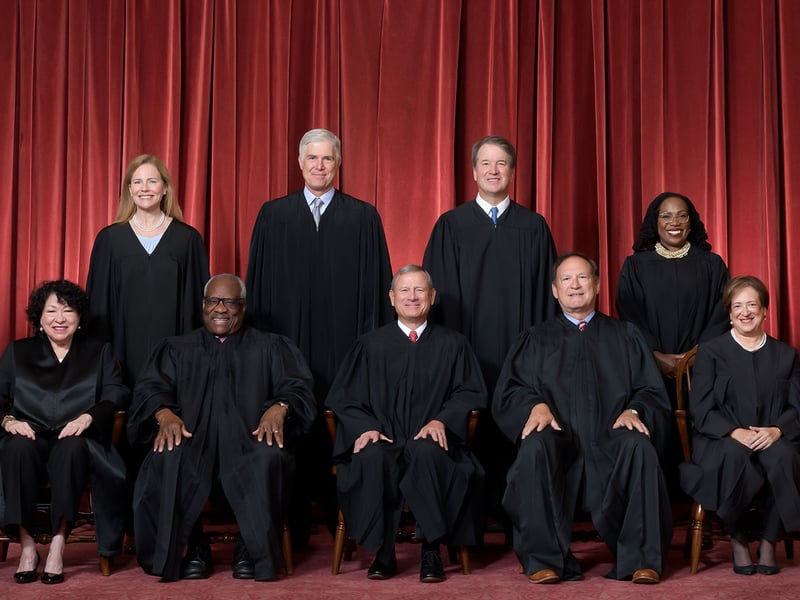
WASHINGTON (CN) — While the role of decider-in-chief is typically reserved for the president, court watchers say the justices are vying for the position, ruling in major cases this term to give the Supreme Court more sway over a country at a time when the public is at odds with the court.
“It’s a story of judicial aggrandizement, whether they acknowledge it or not,” Alison LaCroix, a professor of law and history at the University of Chicago, said in a phone call.
LaCroix said the court put itself at the center of a vast array of high-stakes issues, giving the justices authority over things people experience in their everyday lives. The conservative supermajority’s decision to overrule Chevron v. Natural Resources Defense Council paints a picture of the breadth of the court’s influence.
For decades, the executive branch leveraged authority through agency rule-making, setting air pollution standards, workplace safety protocols or even regulating third-party monitoring on fishing vessels. When challenged, the expert agencies were given deference to decide policy issues. Now judges are taking over the reins.
“This means that the court’s views of what makes good policy will control, not the actions of administrative agencies that are accountable to the president and to the electorate,” Adam Winkler, a professor at UCLA School of Law, said in a phone call. “So that’s a big power grab.”
Beyond questioning their authority, Winkler said the justices cast doubt on the validity of federal agency rules.
“We have the court not only overturning Chevron and saying courts should not defer to administrative agencies, but in the bump stock case, the court sort of suggests that the court is likely to be pretty skeptical going forward of administrative agencies,” Winkler said referring to a 6-3 ruling that shot down prohibitions on the semiautomatic weapon add-on device.
Evidence of judicial aggrandizement also came in the breadth of several rulings. Legal experts said the court unnecessarily limited states’ ability to disqualify candidates without an act of Congress when ruling against efforts to remove Donald Trump from Colorado ballots.
Court watchers said the justices also went out of their way to answer questions not posed by Trump’s presidential immunity appeal, immunizing not only the president’s official duties but also preventing prosecutors from using any of those actions as evidence.
Thomas Wolf, director of democracy initiatives at the Brennan Center, said even then the court maintained its grip on authority.
“At the same time it’s empowering presidents, it’s also empowering itself to be the final arbiter of what’s legal and what’s not,” Wolf said in a phone call. “And shockingly, it’s doing it in a case where the president is essentially attempting to exercise the powers of a strong man, trying to overturn the election that threw him out of office.”
Presidential immunity hadn’t been recognized before July, Wolf said, stating that the court created the rule out of thin air. Several court watchers echoed the sentiment, saying that the immunity ruling and others abandoned standard judicial interpretations to reach their desired outcome.
“One of the themes of the court is that this is a court that’s populated by originalists, but they seem susceptible to the same judicial activism of living constitutionalists,” Winkler said.
The court’s use of originalism has come under scrutiny, for both the history they do and do not cite. LaCroix said the court tends to miss the intricacies of historical analysis, citing outdated research or omitting contradictory evidence.
“One of the things about the way the Supreme Court talks about history is they sometimes have this “anyone can do it” idea,” LaCroix said. “Like I can read the Federalist essays, I can read the ratification debates, and they don’t always have the respect for history that I think they profess for other disciplines, which gets them into trouble sometimes.”
Court watchers said originalism’s appeal came from its constraints on judges. Forcing courts to look to the framers’ intent was supposed to keep judges in their lane. In practice, legal experts say those guardrails have not been effective.
“I think there’s an irony there that we’re seeing more and more of as history is being used in a selective way and in a way that gives the court more power, which is not I think what many originalists thought the purpose of the project was,” LaCroix said.
Many legal experts characterized the court’s rulings as judicial activism, but Kermit Roosevelt, a law professor at the University of Pennsylvania Carey Law School, said activism claims usually have less to do with the judicial interpretation and more to do with the decision itself.
“Usually people will call a decision activist if they don’t like it or disagree with it,” Roosevelt said in a phone call. “And they sort of mean something like the judges are ruling on policy rather than law.”
Part of the justices’ role, Roosevelt said, is to interpret vague areas of the Constitution, and often those judgments seem moral or political. He said the Roberts court’s problem comes from how their choices are viewed by the public.
“As long as the court is promoting values that are within the mainstream of American public opinion, it doesn’t look that political because it looks like what it’s doing is reasonable or common sense or statesmanlike because your own politics don’t usually look political to you,” Roosevelt said.
Democrats have won five of the last eight elections and seven of the last eight popular votes but there are only three Democrat-appointed justices on the court.
Since the conservative supermajority has cemented control of the court, public approval has declined. In 2021, only 40% of Americans — a record low — approved of how the Supreme Court was handling its job. The justices’ approval has only seen single-digit gains in the subsequent years.
“Lawyers may care a lot about stare decisis, but I don’t think the general public cares as much about whether the court sticks to precedent,” Tara Grove, a professor at the University of Texas Law School, said in a phone call. “What bothers them is when the court overrules the precedent that the public liked, and I think that’s the story we’re seeing.”
 Follow @KelseyReichmann
 Follow @kelseyreichmann.bsky.social
Subscribe to our free newsletters
Our weekly newsletter Closing Arguments offers the latest about ongoing trials, major litigation and rulings in courthouses around the U.S. and the world, while the monthly Under the Lights dishes the legal dirt from Hollywood, sports, Big Tech and the arts.