
 Search Articles


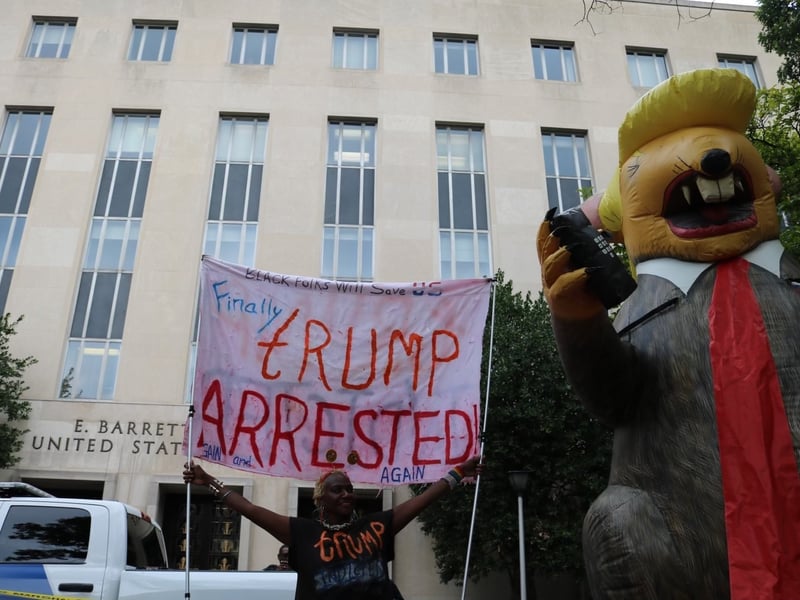
WASHINGTON (CN) — As Donald Trump’s legal challenges continue to mount with a Georgia grand jury indictment over interference in the 2020 election, questions about how the former president will defend himself in these unprecedented cases are beginning to rise with trials and a presidential election on the horizon.
A panel of legal experts tried to answer that question in a discussion hosted by the Media Law Resource Center on Tuesday, focusing on potential defenses Trump and his lawyers have floated in regard to the federal Jan. 6 case brought by special counsel Jack Smith this month.
Smith charged Trump with four counts — conspiracy to defraud the United States, conspiracy to obstruct an official proceeding, conspiracy against the right to vote and have one’s vote be counted, and obstruction of an official proceeding.
A central thread in the indictment involves accusations that Trump spread false claims about the 2020 election to provide justification for his illegal activities, like trying to use a false slate of electors from swing states like Arizona, Michigan and Georgia to create a chance for then-Vice President Mike Pence to turn those state’s electoral votes over to Trump during the Jan. 6 election certification.
Smith also links the false claims directly to the actions of the mob of Trump supporters who descended on the Capitol with the belief that the election had in fact been stolen.
Trump and defense attorney John Lauro, of Lauro & Singer, have hinted that they may characterize those statements as political speech protected by the First Amendment.
Carey Dunne, founder of the Free and Fair Litigation Group and a former general counsel at the Manhattan District Attorney’s office, called that defense crazy.
Dunne said that while it may be politically beneficial for Trump to frame these indictments as charging him for challenging an election he lost, it likely won’t hold up well in court.
Further, the charges brought by Smith focuses on the activity that Trump grounded on these false claims, not the claims themselves. Even if Trump believed that the election was stolen from him, that does not mean he could try to steal it back, Dunne said.
“If you have a good faith belief that the bank has wrongly refused to release certain funds to you, you don’t have the right to rob the bank and get it back,” Dunne said.
Trump’s First Amendment rights have already come up in court this past week during a hearing over a protective order — which U.S. District Judge Tanya Chutkan issued later that day — that blocks Trump from sharing sensitive information publicly.
Chutkan, a Barack Obama appointee, said that the order, which is common in criminal cases, is not a curtailment of Trump’s right to free speech, but rather a bid to keep Trump’s statements and social media posts from prejudicing potential jurors or intimidating potential witnesses.
Before concluding the hearing, Chutkan warned Lauro, along with fellow defense attorneys Gregory Singer and Todd Blanche, that as long as their client continues to make inflammatory statements, the “greater the need to move quickly to trial.”
Dunne said that in such an unprecedented case, where a former president accused of trying to upend American democracy is actively campaigning for president, accelerating the trial stage could be the most extreme measure Chutkan can take without creating a First Amendment crisis.
He pointed to a recent decision by a New York federal judge to revoke FTX founder Sam Bankman-Fried’s home detention and send him to jail over witness tampering and his leak of a star witness’s diary to The New York Times.
If Trump continues to make such statements, like the series of attacks he launched at Chutkan herself over the weekend, detention could be the “only effective remedy if you’ve got a recalcitrant defendant who just won’t behave.”
Chutkan has yet to respond to the statements Trump made with any order but will likely address them at the next hearing on Aug. 28.
Another potential defense Trump’s lawyers may argue is that their client was acting on the advice of his lawyers, such as Rudy Giuliani, John Eastman and Sidney Powell — who are most likely among the six co-conspirators listed in the Jan. 6 indictment — and that he acted in good faith and acted on their recommendations.
Dunne said that this was a more realistic defense than a First Amendment defense but would require the defense to convince a jury that Trump fully believed that the election was stolen from him, despite countless advisors, lawyers and senior members of the administration telling Trump that he lost.
The panel also addressed the possibility of the Jan. 6 proceeding and the three other cases in New York, Florida and Georgia being televised to the public.
Mike Balsamo, lead Justice Department and law enforcement reporter for The Associated Press, said that the case in Georgia will “almost certainly” be televised.
Trump will also likely have to take his first mugshot in Georgia, something he has avoided in each of his prior arraignments. Fulton County Sheriff Pat Labat said in a press conference this month that they plan on it.
“Unless somebody tells me differently, we are following our normal practices, and so it doesn’t matter your status, we’ll have a mugshot ready for you,” Labat said.
Balsamo said it is unlikely there will be cameras in the Florida or New York courtrooms, but there is an active effort by the media to get approval from the federal court in Washington. The court has indicated that there will be livestreams within the courthouse so that reporters can transmit updates from the case in real time.
 Follow @Ryan_Knappy
Subscribe to our free newsletters
Our weekly newsletter Closing Arguments offers the latest about ongoing trials, major litigation and rulings in courthouses around the U.S. and the world, while the monthly Under the Lights dishes the legal dirt from Hollywood, sports, Big Tech and the arts.