
 Search Articles


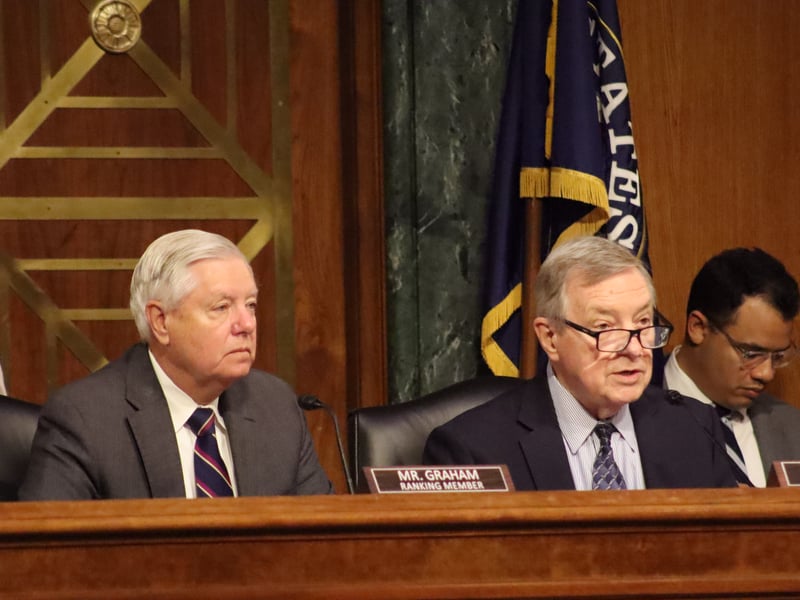
WASHINGTON (CN) — The Senate Judiciary Committee on Tuesday met to examine for the first time a controversial Supreme Court ruling handing former President Donald Trump and future presidents broad legal immunity for official acts of office.
In a hearing which brought together constitutional scholars and former Justice Department officials, Democrats who have bristled at the high court’s decision again made the case that it threatened constitutional separation of powers by shielding presidents from prosecution for a range of conduct if they can arguably be considered “official acts.”
“It means that any sitting president may hide behind their office for protection from prosecution for even the most egregious form of wrongdoing,” Senate Majority Whip Dick Durbin, the committee chair, said during opening remarks. “It means effectively condoning Richard Nixon’s claim that ‘when the president does it, that means that it’s not illegal.’”
The Supreme Court held in July that presidents enjoy absolute legal immunity for their core powers and presumptive immunity for actions in the “outer perimeter” of their official duties — though the justices left the definition of official acts up for interpretation.
And the 6-3 decision also observed that Trump would be immune from prosecution for any conversations he may have had with Justice Department officials as he attempted to overturn the 2020 election, during which the former president tried to get the agency to pressure states to reconsider their electoral votes.
Rhode Island Senator Sheldon Whitehouse, one of the leading Democrats on Supreme Court oversight, blasted the immunity ruling as a “grandiose partisan leap,” and pointed out that the court’s majority opinion relied on a novel interpretation of legal immunity laid out in the Constitution.
“The Trump justices invented presidential immunity, and they didn’t even carve out treason,” he said.
Whitehouse also suggested that the decision was key in helping Trump avoid a criminal trial before the presidential election.
“Had the court intended to shelter the Republican nominee from unpleasant accountability before the election for criminal acts, it hardly could have done better,” he said, adding that the justices had given Trump a “slow-mo Bush v. Gore ,” alluding to the 2000 Supreme Court case that handed then-candidate George W. Bush the White House.
Vermont Senator Peter Welch pushed back on the perception that Democrats’ opposition to the immunity ruling chipped away at the powers of the presidency.
“My concern is that the rule of law is being whittled away,” he said. “My concern is that constitutional freedoms are in the process of being whittled away.”
But while Tuesday’s hearing was an opportunity for Democrats to voice their grievances with the immunity ruling and its consequences, Republicans set out to paint their warnings as a malicious overreaction.
“The bottom line is that this hearing is not about righting a wrong,” said South Carolina Senator Lindsey Graham, the Judiciary Committee’s GOP ranking member. “This hearing is about a continued narrative of delegitimizing a court you don’t like.”
Graham redeployed an argument that Republicans have used to counter months of Supreme Court oversight calls from Democrats — that their colleagues across the aisle have put the court’s conservative majority in their sights as a form of political retribution for a recent string of rulings.
“My Democratic colleagues want to destroy this court,” said Graham.
Claims that the Supreme Court’s immunity ruling was an unprecedented expansion of executive authority are also unfounded, Republicans contended. Texas Senator Ted Cruz said such an assertion was “utterly ahistorical.”
Utah Senator Mike Lee argued that the decision was not novel but rather based in a longstanding interpretation of the president’s immunity from prosecution.
“They’re not making this up,” he said of the justices. “It is rooted in text. It is rooted in the structure.”
Expert witnesses invited to testify, meanwhile, were similarly split on what the Supreme Court’s immunity ruling would mean for presidential power and for democracy.
Philip Lacovara, former deputy solicitor general and counsel in the Watergate special prosecutor’s office, said that the decision was “profoundly wrong,” echoing Whitehouse’s complaint that the justices had not provided any textual support for their assertions about the president’s legal immunity.
In fact, he argued, the impeachment clause of the Constitution suggests exactly the opposite. The constitutional rules governing impeachment hold that a president can be indicted for bribery, treason and other high crimes and misdemeanors — which Lacovara said “necessarily” indicate the abuse of official acts of office.
“The text of the Constitution could not be clearer that a president is subject to indictment, trial and punishment for that kind of improper — that is, illegal — performance of official function,” he argued.
But Jennifer Mascott, director of the Separation of Powers Institute at Catholic University of America’s School of Law, argued that the immunity ruling had been “significantly mischaracterized.”
Rather than broadly shielding the president from prosecution, Mascott contended that the decision simply settled a dispute over what kinds of acts for which the executive can face prosecution. The justices also held that former presidents can be held accountable for unofficial conduct, she pointed out.
Michael Mukasey, who served as attorney general in the Bush administration, also defended the immunity ruling, telling the Judiciary Committee that it had a “firm basis” in precedent. And he warned about what he saw as the knock-on effect of allowing the prosecution of former presidents.
“What’s allowed our system to function is that, even in doubtful cases, we have so far declined to become the kind of country in which incoming administrations take out their grievances against their predecessors by prosecuting them,” Mukasey said.
Separately, Mascott argued that amid scrutiny on the high court, the justices faced challenges to their institutional integrity and norms. She pointed to recent reports from The New York Times which relied on internal memos sent to the jurists by Chief Justice John Roberts, calling them a “breach of confidentiality.”
“Maintenance of longstanding norms of civility, humility in public service, principle and integrity necessitates a sober approach to the characterization of governmental actions that involves taking a careful, steady look at the actions of fellow governmental servants,” she told lawmakers.
In the weeks after the Supreme Court’s July decision, Democrats unveiled legislation aimed at papering over the justices’ ruling on presidential immunity. The No Kings Act, sponsored by Senate Majority Leader Chuck Schumer, would affirm that presidents do not have immunity for actions that violate U.S. criminal law.
The measure would also block the high court from litigating a president’s challenges to their legal immunity.
 Follow @BenjaminSWeiss
Subscribe to our free newsletters
Our weekly newsletter Closing Arguments offers the latest about ongoing trials, major litigation and rulings in courthouses around the U.S. and the world, while the monthly Under the Lights dishes the legal dirt from Hollywood, sports, Big Tech and the arts.