
 Search Articles


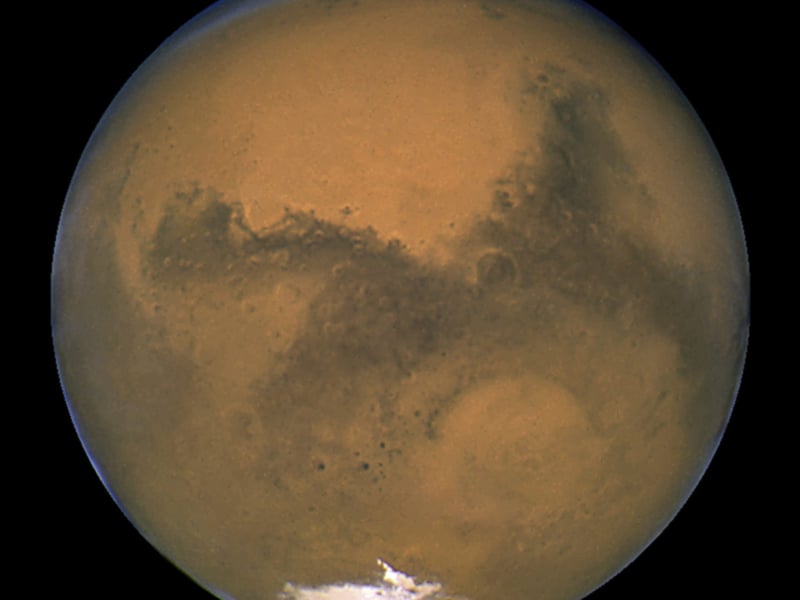
(CN) — At some point in the past, the Jezero crater on the planet Mars was a lake, filled with water. Scientists have suspected that to be the case for years, but a new research paper, published Friday in journal “Science Advances,” confirms it.
The confirmation comes by way of data from the Perseverance, a car-sized rover that’s been on Mars since February 2021, exploring the 28-mile diameter crater. The rover’s main goal is to search for signs that life may have existed on the planet, and evidence that the planet is capable of supporting life.
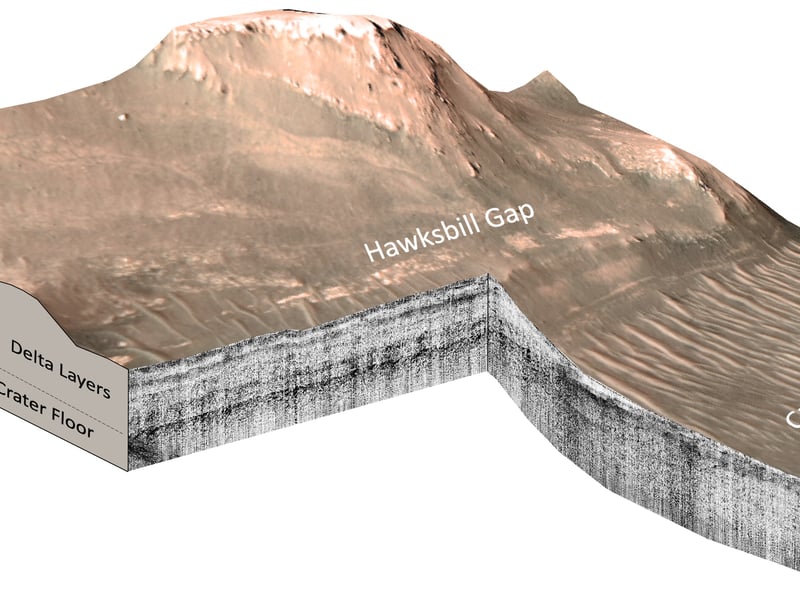
Between May and December of 2022, the Perseverance drove from the crater’s floor up to the top, onto the delta filled with 3 billion-year-old sediments. The rover is equipped with 19 cameras, two microphones and seven scientific instruments, including the Radar Imager for Mars’ Subsurface Experiment, or RIMFAX, which uses radar waves to probe down as far as 20 meters feet below the ground.
“From orbit we can see a bunch of different deposits, but we can’t tell for sure if what we’re seeing is their original state, or if we’re seeing the conclusion of a long geological story,” said David Paige, a UCLA professor and lead author of the paper, in a written statement. “To tell how these things formed, we need to see below the surface.”
Images taken by RIMFAX indicated that, at some point, the crater was filled with water, depositing sediments onto the lake floor. As the water receded, those sediments remained to be eroded. The deposition and erosion revealed by Perseverance took place over eons, which means that it likely took billions of years for the lake to drain.
Researchers documented two separate periods of sediment deposition in between two distinct periods of erosion. Radar images also show that these sediments are not unlike those of sediments deposited in lakes on our own planet, with regular and horizontal patterns.
“The changes we see preserved in the rock record are driven by large-scale changes in the Martian environment,” Paige said. “It’s cool that we can see so much evidence of change in such a small geographic area, which allows us extend our findings to the scale of the entire crater.”
In 2022, NASA announced that Preservation had found organic material in rock samples.
“The rocks that we have been investigating on the delta have the highest concentration of organic matter that we have yet found on the mission," said Perseverance project scientist Ken Farley at a 2022 press conference. “And of course, organic molecules are the building blocks of life. So this is all very interesting, in that we have rocks that were deposited in a habitable environment in a lake which carry organic matter.”
 Follow @hillelaron
Subscribe to our free newsletters
Our weekly newsletter Closing Arguments offers the latest about ongoing trials, major litigation and rulings in courthouses around the U.S. and the world, while the monthly Under the Lights dishes the legal dirt from Hollywood, sports, Big Tech and the arts.