
 Search Articles


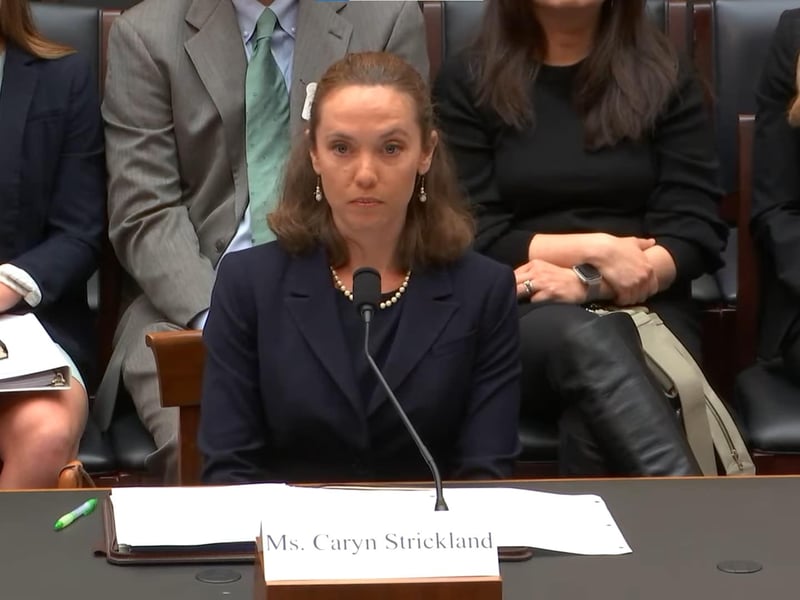
RICHMOND, Va. (CN) — A former assistant federal public defender argued before a Fourth Circuit panel Monday that she was denied due process after reporting sexual harassment in the workplace.
In 2017, Caryn Strickland began working at the federal defender’s office for the Western District of North Carolina. The office’s first assistant took an interest in her, offering her rides home, asking her out for drinks and insisting she participate in mentoring activities with him that impeded her other work, she said, along with cornering her and sending her a “quid pro quo” email about pay raises.
Seeking options, she spoke to the head federal public defender, Anthony Martinez, who began a workplace dispute resolution process. She then applied for a promotion and was not invited to interview, and her work duties were reclassified, with botched paperwork resulting in a nearly 15% pay cut — retaliation, she claimed, from Martinez.
Strickland said she was afraid for her safety, and Martinez moved her to working online. The judiciary spent four months on an investigation into her claims of sexual harassment and retaliation before she left in March 2019, claiming she was constructively discharged.
The judiciary’s handling of her complaint was unconstitutional, she told a panel of judges Monday. Strickland couldn’t sue her employer under the Title VII of the Civil Rights Act, which prohibits employment discrimination based on race, religion or sex. As a judicial employee, she isn’t covered by the Civil Rights Act. She claimed constitutional violations when she filed suit in March 2020, and a federal judge sympathetically dismissedher claims last year while criticizing the judiciary and issuing recommendations for it to revise its dispute resolution plan.
The judiciary’s handling of her through the Fourth Circuit’s internal complaint process — the Employment Dispute Resolution Plan — violated Title VII standards, she said, and denied her protections from sex discrimination that she is entitled to. The process is also fundamentally unfair to victims, she said, violating her due process rights under the Fifth Amendment.
The office made the decision to take no disciplinary actions until a final hearing in her case, which did not occur because she withdrew her dispute with her resignation. Strickland believed that Martinez would have influence over the final hearing, which would have made the process “futile” and “fundamentally unfair,” she said.
“I would not have been protected from further sexual harassment and retaliation because Martinez was the final decision maker on discipline, and he did not even follow the meager recommendations in the investigation report,” she told the panel.
Kevin Sotor, an attorney from the U.S. Department of Justice, represented the defendants, including Chief Judge Albert Diaz and Fourth Circuit Executive James Ishida.
Even if Strickland had shown an equal protection violation, the record does not support any prospective relief for this claim, the defendants argue, and she can’t make a last-minute constitutional challenge to the Civil Rights Act’s exclusion of judiciary employees.
Strickland needed to show that circuit employees acted with deliberate indifference and responded to her claims with discriminatory intent, Soter said. The defendants’ actions do not become “clearly unreasonable” simply because a victim advocated for stronger remedial measures, he said.
A person cannot claim there is a procedural due process violation if they opt out of participating in that process, he said.
However, the judges didn’t seem wholly convinced that the process was entirely reasonable, pointing to the lengthy nature of the investigation.
Senior U.S. Circuit Court Judge Susan Graber, from the Ninth Circuit, questioned if the absence of discipline against an accuser makes any remedies through the EDR plan — such as reinstatement or prospective promotion — pointless. The Bill Clinton appointee also didn’t seem convinced that Strickland would believe Martinez could have any impact over the final dispute decision other than playing a consulting role.
A dragged-out investigation doesn’t rise to the level of a constitutional violation, Soter said, and Strickland was granted permanent telework, and later offered the ability to work from another office. Strickland does not have a due process interest in the first assistant being fired, Soter said, just in a harassment-free workplace.
“If a finding had been made that the allegations were substantiated and that there was ongoing, or even just past, conduct that was at the level of fireable sexual harassment, I think that would be a different case than this one,” Soter said. “It is important to keep in mind for the due process claim, what really matters is that the normal rule is that when you don’t go through a process that has adequate procedures, you don’t get to then say that it was a procedural due process violation.”
“What the defendants’ position is, fundamentally, is that an employee who is subjected to sexual harassment in their working environment does not have any substantive right to have the employer take actions to stop the harassment and prevent it from recurring,” Strickland said. Defendants made an “official decision” to do nothing, she said, and wait on any disciplinary actions until after a final hearing.
Soter asked the panel to affirm the lower court’s decision dismissing Strickland’s claims.
The panel was appointed outside of the Fourth Circuit, as Strickland clerked for a term. Senior U.S. Circuit Court Judge Ronald Lee Gilman of the Sixth Circuit, a Clinton appointee, and U.S. Circuit Court Judge W. Duane Benton of the Eighth Circuit, a George W. Bush appointee, also presided.
Representatives for Strickland and the Department of Justice declined to comment after the proceedings.
 Follow @SKHaulenbeek
 Follow @shaulenbeek.bsky.social
Subscribe to our free newsletters
Our weekly newsletter Closing Arguments offers the latest about ongoing trials, major litigation and rulings in courthouses around the U.S. and the world, while the monthly Under the Lights dishes the legal dirt from Hollywood, sports, Big Tech and the arts.