
 Search Articles


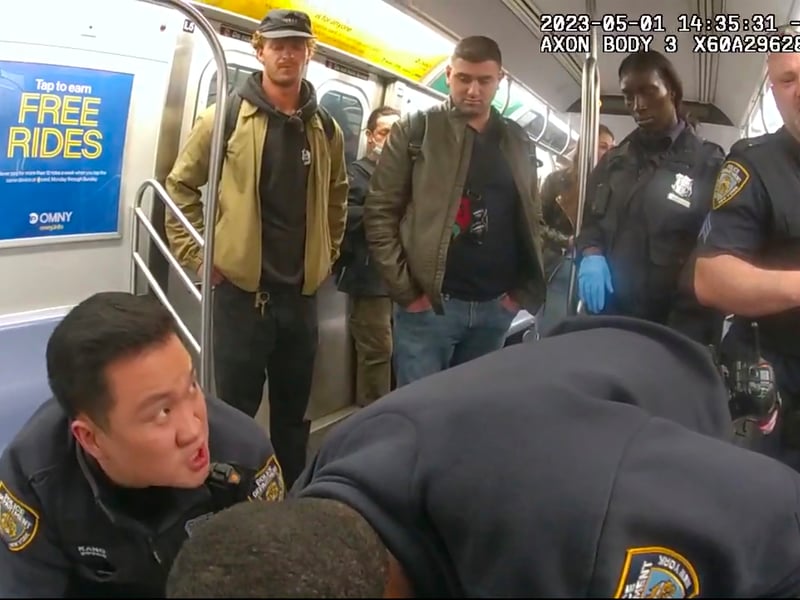
MANHATTAN (CN) — Attorneys for former U.S. Marine Daniel Penny on Tuesday showed jurors a review of six years of psychiatric records of Jordan Neely, the homeless subway performer Penny killed in a deadly chokehold on an uptown-bound F train in Manhattan last year.
Prosecutors with the Manhattan District Attorney’s Office say Penny, who is white, went “way too far” in his efforts to subdue Neely, a Black 30-year-old, in a fatal rear chokehold when he boarded Penny’s subway car on May 1, 2023.
Penny is standing on trial on counts of second-degree manslaughter and criminally negligent homicide. He pleaded not guilty.
Forensic psychiatrist Dr. Alexander Bardey testified as a defense expert witness Tuesday afternoon that Neely’s psychiatric medical historyshowed he had been hospitalized repeatedly for extremely severe symptoms of paranoid schizophrenia, which were exacerbated by chronic abuse of K2, a psychoactive synthetic cannabinoid also known as “spice.”
“The most common diagnosis that he receives is schizophrenia and K2 abuse … possibly suffering from psychoaffective schizophrenia disorder,” Bardey said.
After reviewing “probably four or five thousand” pages of Neely’s medical records, spanning 2015 to 2021, Bardey said Neely exhibited symptoms of acute paranoid schizophrenia, including hallucinations of “devil voices,” grandiose delusions of telepathic powers and a paranoid belief that “he had changed the world with Tupac Shakur and now his life is danger.”
“He also voiced extensive paranoia about how people are targeting him because they are jealous of him,” Bardey testified.
Bardey, the director of the Fifth Avenue Forensics firm, said K2 use can cause a longer-lasting state of psychosis in the user’s brain that continues for weeks or months after the substance has been ingested.
“It’s clear that his situation is complicated by the existence of both schizophrenia and a K2 abuse issue,” he testified.
Bardey said that eyewitnesses’ recollections of Neely’s erratic behavior on the subway car the day he was killed were consistent with his “acutely agitated” state during prior hospitalizations.
“That description of his appearance — that he was malodorous, disheveled, wearing soiled clothing — is consistent with how he’s appeared in various hospitals and emergency rooms.”
Prosecutors declined to cross-examine Bardey, who completed his testimony and was excused Tuesday afternoon.
Defense lawyers began calling witnesses on Monday after Manhattan prosecutors rested their case as the trial entered its fifth week.
Penny’s attorneys have argued that he acted to defend the subway car and did not intend to use lethal force against Neely, who they described in opening arguments as a “seething, psychotic” figure who had lunged toward a passenger with a small child and threatened, “I will kill.”
Witnesses say Neely intimidated other passengers when he started shouting manically about his homelessness and making threats as soon as he got on the train. That’s when Penny came up from behind Neely, placed him in a chokehold and held Neely on the ground for around six minutes.
Video played for the jury earlier in the trial shows Neely completely limp when Penny let go of the hold. Neely was later pronounced dead at a nearby hospital. The city’s medical examiner ruled his cause of death was compression of the neck.
Neely was a fixture in the Times Square transit hub, known best for his costumed impersonation of singer Michael Jackson.
Left-leaning advocates have described the killing as an act of racist vigilantism, invoking comparisons to both Kyle Rittenhouse, who was acquitted in 2021 for killing two people and injured a third with an AR-15 during a chaotic Kenosha, Wisconsin, and the infamous New York City subway shooting carried out by white gunman Bernhard Goetz against four Black teenagers in 1984.
Members of Black Lives Matter and the National Action Network civil rights group have assembled in protest most trial days across from the courthouse at Collect Pond Park.
Penny’s defense attorney, Kenniff, is a former prosecutor, judge advocate general and Iraq war veteran. In 2021, Kenniff ran against current Manhattan District Attorney Alvin Bragg as a Republican nominee on a platform largely opposed to the criminal justice reforms pushed by progressive state Democrats in 2019.
Earlier on Tuesday, Penny’s lawyers called four character witnesses who testified to his reputation as empathetic and compassionate, including his mother, two Marine platoon leaders and a Long Island surfing buddy.
Penny, 24, faces up to 15 years in prison if he is convicted on the top count of second-degree manslaughter. The second count, negligent homicide, carries a maximum sentence of four years.
 Follow @jruss_jruss
Subscribe to our free newsletters
Our weekly newsletter Closing Arguments offers the latest about ongoing trials, major litigation and rulings in courthouses around the U.S. and the world, while the monthly Under the Lights dishes the legal dirt from Hollywood, sports, Big Tech and the arts.