
 Search Articles



PARIS (CN) — “The exercise room was very small. Three machines were crammed side by side: a rowing machine, a stationary bike, and a treadmill,” Nicolas Sarkozy, the former president of France, writes in his 216-page book “The Diary of a Prisoner,” released Wednesday.
Sarkozy said he can’t go a day without exercising and was allotted an hour a day in the small prison gym alone.
“The space was so cramped that I could barely squeeze between the three pieces of equipment,” he says.
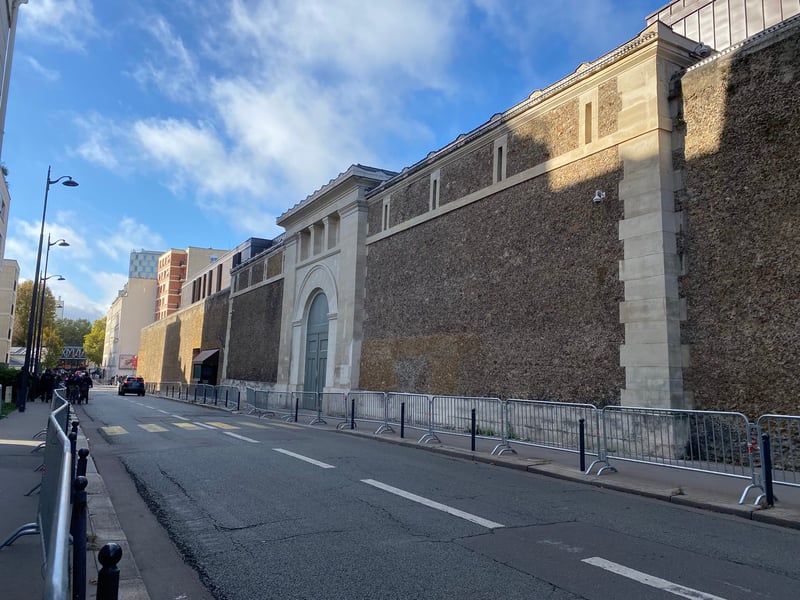
After being convicted in an illegal campaign financing scandal — the former autocratic Libyan leader Moammar Gadhafi said he contributed roughly $58 million to his 2007 presidential campaign — Sarkozy arrived at La Santé prison in Paris on Oct. 21, marking the first time a head of state was jailed.
He reveals some difficulties adjusting to the physical constraints of prison; he’s estimated to have a net worth in the millions and lives in a villa in the posh 16th arrondissement in Paris. Suddenly, he found himself in a room he compared to a “low-budget hotel.”
“A bed securely fixed to the wall with reinforced plates. A small light wood desk, a shower, a refrigerator, a hot plate, a television,” Sarkozy wrote. “All in the same room.”
Twenty days into his 5-year sentence, he was released into judicial supervision with the caveat that he cannot leave France. His appeal is scheduled to run from March 16 to June 3.
The text largely centers around Sarkozy’s inner monologue, criticisms of prison and meetings with his family. But experts argue that between the lines, the book is a serious political communications tool and foreshadows a potential merging of the moderate- and extreme-right of France’s political spectrum.
Olivier Costa, a political scientist and director at the Center for Political Research at Sciences Po, said the book fits into a strategy of political leaders openly challenging the justice system. The tactic was bolstered internationally by U.S. President Donald Trump and former Italian Prime Minister Silvio Berlusconi.
“They also exploit the public’s limited understanding of the separation of powers and the role of the judiciary, and they present themselves as victims,” Costa explained. “That’s what Sarkozy does in his book.”
In the text, Sarkozy elaborates on his daily routine and the travails of prison life.
“I was about to receive my prison number, 320535. That was how I would now be identified,” Sarkozy writes. “Four days earlier, I had been Nicolas Sarkozy, the former president of the republic, received by President Emmanuel Macron himself, at the Élysée Palace. Could one ever have imagined a more striking contrast? A more absurd situation? I had to pinch myself to accept this reality.”
His days went something like this: Every morning, he was allowed to spend an hour with his lawyers. Three or four afternoons per week, Sarkozy could meet with his family. He couldn’t stomach the food and “soggy” baguettes, so his diet largely consisted of packaged yogurts and apples. At night, other prisoners hurled insults toward his cell.
Maxime Lefebvre, a diplomat and professor of international relations at the ESCP business school, said Sarkozy has “won the battle of communication” with the judicial system by reframing a conviction as a political witch hunt.
“There is a kind of battle of powers between politics and justice … and Sarkozy is putting this battle on the political level. He doesn’t want to recognize that it’s a purely a judicial case,” he explained. “He wants to fight or to continue to fight in the battle of communications in claiming that he’s innocent, that he has been condemned wrongly.”
Such a strategy echoes the extreme-right leader Marine Le Pen, who was convicted of embezzlement charges in March and barred from running for public office for five years. The sentence, which she is appealing, would make her ineligible to run for France’s 2027 presidential elections. She criticized the ruling as undemocratic and seeking to sabotage her chances of winning.
And in the book, Sarkozy — who writes that he no longer considers Macron a friend — suggests a future alliance between the right-wing Les Républicains party and Le Pen’s extreme-right National Rally. Although Sarkozy is past his political prime, he still holds considerable influence that could draw former voters into Le Pen’s camp.

“The book lets him create a counterfire by shifting the conversation to something else, like the question of an alliance with the National Rally,” Arnaud Mercier, a political scientist and professor in communication sciences at the Panthéon-Assas University Paris II, said. “The idea is really on the one hand, to settle the negative episode by controlling the narrative, and at the same time to step over it and recapture attention with his provocative proposal of an alliance with the National Rally.”
Although Le Pen cannot run for the presidency as of now — which could change if the verdict is overturned next spring — recent polls show Jordan Bardella, her protégée, would beat every other candidate if elections were held tomorrow.
This isn’t the only corruption battle Sarkozy is fighting; in November, he lost his final appeal of a 2021 conviction for benefitting from illegal campaign financing during his unsuccessful 2012 presidential run, which has become known as the Bygmalion affair. Experts expect he will take the case to the European Court of Human Rights.
Jean-Yves Camus, a political scientist, researcher and author specializing in far-right movements in Europe, believes this ordeal could have boosted Sarkozy’s power and influence.
“Even if he managed to get out quickly, this only fuels his image as a martyr, which he is now exploiting heavily with this book, which will earn him a lot of money — and which will have political consequences,” Camus said. “If, in 2027, we see Bardella and Marine Le Pen in the second round [of presidential elections] and Sarkozy decides to tell the voters who remain loyal to him whom they should vote for — Bardella or Marine Le Pen — he will be even more legitimate and even more listened-to than before.”
 Follow @lilyradz
Subscribe to our free newsletters
Our weekly newsletter Closing Arguments offers the latest about ongoing trials, major litigation and rulings in courthouses around the U.S. and the world, while the monthly Under the Lights dishes the legal dirt from Hollywood, sports, Big Tech and the arts.