
 Search Articles


(CN) — In an bid to overturn his negligent homicide conviction, a former Aurora, Colorado police officer claimed Tuesday the judge in his trial over the death of an unarmed Black man he arrested allowed the prosecution to exclude a white woman from the jury based on her race during jury selection.
Lucas Lorenz, an attorney for Randy Roedema, argued to a state court of appeals that Adams County District Judge Mark Warner botched his decision on the defense’s challenge to the prosecution’s peremptory strikes of 10 white jurors. Warner had found that the prosecution had no race-neutral reason to strike one white woman from the panel and that there was no pattern of excluding white jurors.
“The ultimate conclusion by the trial court overruling the Batson challenge, that was error,” Lorenz told the three-judge panel at the Denver hearing. “The actual substantive finding, which was not changed, substantiates the Batson challenge.”
The hearing was narrowly focused on how the trial judge had applied the three-step test of the Batson challenge to juror No. 51. The test goes back to a landmark 1986 U.S. Supreme Court decision meant to curtail prosecutors from using their peremptory strikes of potential jurors — where they don’t need to state a reason to exclude a juror — to weed out people of a specific racial background.
Historically, prosecutors have used peremptory strikes to exclude Black jurors from criminal trials involving Black defendants. Both sides at a trial can strike an unlimited number of jurors for cause during jury selection — for instance, because they don’t understand English well — but they only get a limited number of peremptory challenges.
In a Batson challenge, a judge will first look at whether the challenger has made a case that the other side is excluding a juror based on their race or gender. If the judge decides there’s a prima facie basis for the challenge, the attorney who used their peremptory strike will have a opportunity to explain their reasons. Finally, the judge weighs the arguments to decide whether to sustain the challenge.
During jury selection for Roedema’s trial two years ago, the prosecution used their 10 peremptory strikes to cut 10 white jurors. Roedema’s attorneys raised a Batson challenge, and according to the defense’s reading of the proceeding, the judge gave the prosecution an opportunity to offer race-neutral reasons for the strikes and allowed Roedema’s lawyers to offer a rebuttal.
The judge, Lorenz told the appellate panel, went on to make “step three” factual findings and erroneously overruled the Batson challenges.
However, according to Colorado Assistant Solicitor General Joseph Michaels, this isn’t what happened.
“What happened here was nothing more than a step one inquiry,” Michaels told the panel. “And the court made it explicit that it was not going beyond step one to step two and certainly not anywhere close to step three.”
The judge, according to Michaels, told the defense that there was no prima facie case for their challenge and that he didn’t need to go through the additional steps to make a decision.
Moreover, Michaels said, of the 34 jurors who were seated before the peremptory challenges, 27 to 28 were white, and the defense used their peremptory strikes to remove 5 of the non-white jurors. This left the prosecution, who at the point could only strike jurors who had taken the place of jurors stricken by the defense, with only white jurors for their remaining strikes.
The appellate panel wasn’t quite convinced about the prosecutor’s interpretation of what occurred during the defense’s Batson challenge.
Court of Appeals Judge Sueanna Johnson noted that the trial judge gave a summary per stricken juror whether their exclusion was reasonable and race neutral that sounded like a step two or even a step three analysis under the Batson test.
But Michaels maintained this discussion was only to determine that there was no pattern of race-based exclusion of white jurors and no prima facie basis for the defense’s challenge.
The prosecution had told the judge that they used their peremptory strike on jury No. 51 because of her eagerness responding to the Roedema’s attorneys during voir dire, which suggested a bias toward law enforcement.
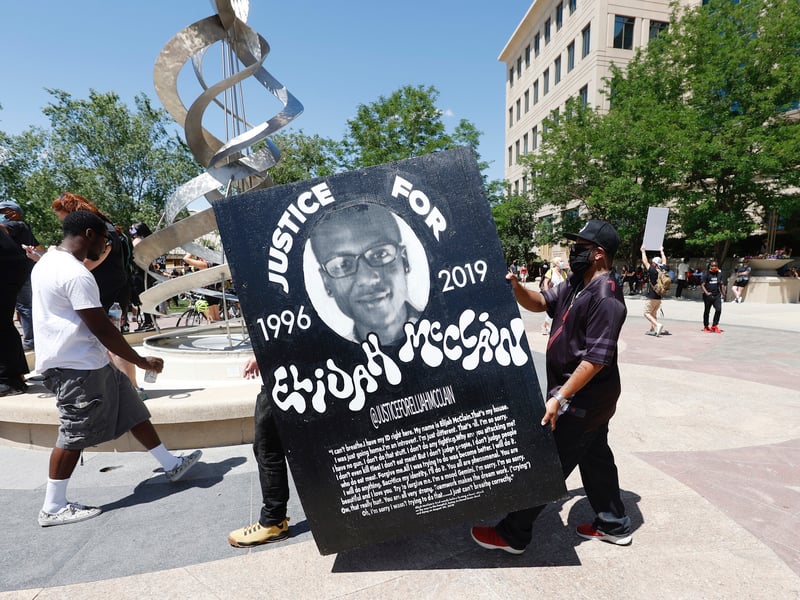
Roedema was convicted of criminally negligent homicide and third degree assault and sentenced to 14 months in county jail with work release for contributing to the death of Elijah McClain, an unarmed Black man apprehended while walking home in 2019.
McClain, 23, was walking to his home in Aurora after purchasing three cans of Arizona tea when a passerby reported him as suspicious to 911, for wearing a ski mask and dancing down the sidewalk. Three police officers arrived within minutes, including Roedema.
When McClain didn’t immediately follow orders to “stop” and “relax,” the officers handcuffed him, took him to the ground and engaged him in two constructive carotid holds. Also known as a “chokehold” or “sleeper hold,” the maneuver cuts off blood flow to the brain causing a person to black out.
As Roedema held McClain on the ground, he told police he was an introvert and a vegetarian. “Forgive me,” McClain told Roedema. “All I was trying to do was become better.”
After inhaling his own vomit, McClain passed out at the scene, and a paramedic injected him with 500 milligrams of ketamine — more than double the recommended dose for someone of his weight, 143 pounds. McClain never regained consciousness and died three days later in a hospital.
While Roedema was sentenced to jail time, juries found the other two police officers involved not guilty. Another jury found first responders Jeremy Cooper and Peter Cichuniec guilty of manslaughter charges.
 Follow @edpettersson
Subscribe to our free newsletters
Our weekly newsletter Closing Arguments offers the latest about ongoing trials, major litigation and rulings in courthouses around the U.S. and the world, while the monthly Under the Lights dishes the legal dirt from Hollywood, sports, Big Tech and the arts.