
 Search Articles


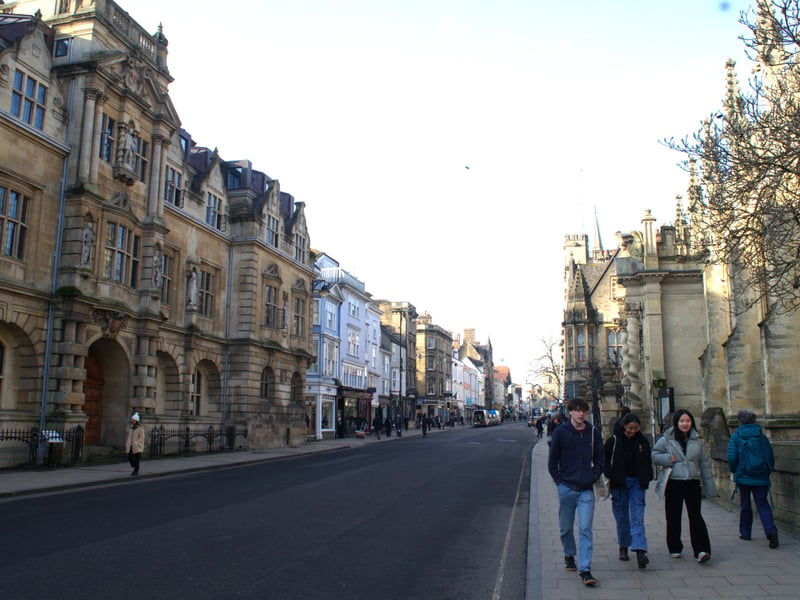
OXFORD, England (CN) — The distance between the green lawns and quiet courtyards of Oxford University to those of Cambridge University is roughly 60 miles.
It’s in this arc between two of the world’s most storied universities where British Prime Minister Keir Starmer’s Labour government is talking about bringing “Europe’s Silicon Valley” into being by connecting the cities by rail, spurring a housing boom and attracting high-tech workers and venture capitalists.
As it is, this stretch of southern England is a jarring patchwork of idyllic countryside, London urban sprawl, motorways, shopping centers, sleepy ivy-covered towns, science and technology parks, airfields and supersized warehouses for retail giants like Amazon.
The idea is to weave this patchwork into a “supercluster,” a term used to describe California’s famed “Silicon Valley” outside San Francisco.
In a January speech at a Siemens Healthineers factory outside Oxford, Chancellor Rachel Reeves, Britain’s equivalent of an American treasury secretary, laid out the vision.
“This area has the potential to be Europe’s Silicon Valley,” she said. “To make that a reality, we need a systematic approach to attract businesses to come here and to grow here.”
She said it was time to go “further and faster to unlock the potential” of the Oxford-Cambridge “growth corridor,” which she said could add over $100 billion to the U.K. economy by 2035.
The idea of turning this slice of southern England into a European version of Silicon Valley makes sense.
It was, after all, in 1897 at a laboratory on Free School Lane in Cambridge where J.J. Thomson discovered the electron, a fundamental particle behind electronics.
“You could argue the whole of the high-tech industry started in Free School Lane,” said Will Haylock, a 69-year-old electronics engineer who works for a major American microchip maker with a base in Cambridge.
“Britain’s good at inventing lots of stuff. We have lots of clever people, technology, a lot of it in Cambridge and Oxford, but for whatever reason, we don’t seem to exploit it long term,” he said, speaking with Courthouse News at his home outside Cambridge.
This is what the government hopes to turn around.
“We’ve got all the right assets to create; let’s change that from just creating to developing and growing,” said Matt Allen, the executive director of the Oxford-Cambridge Supercluster Board, a group representing major businesses backing the plan.
“Why are businesses spinning out here and going elsewhere in the world? Why?” he said. “What I’d like to see is businesses coming out of other major clusters around the world and saying, ‘You know what, I’m going to go scale up in the Oxford- Cambridge growth corridor.’”
A rail line to connect the dots
To start, the government is pushing to finish work to reconnect Oxford and Cambridge by train. An old railway between the colleges, the Varsity Line, was closed in 1967. Going between the two cities by rail now requires changing trains in London, a trip that can take three hours.
Work on the rail line has slowly progressed since 2012,**** but Starmer is seeking to accelerate the pace of construction of the last 53 miles. When completed, the new East West Rail project will cover 84.5 miles. The work is scheduled to be done by the mid-2030s at a cost of up to $9.8 billion.
The hope is for new towns and business parks to mushroom along the line.
“The East West Rail effectively creates a spine across the region and links it up,” Allen said. “You get something a bit more believable from a business or investor perspective.”

The government is also pouring money into building two new reservoirs: the Fens Reservoir near Cambridge and the South East Strategic Reservoir near Oxford.
The reservoirs are critical to the government’s vision, which includes the construction of tens of thousands of new homes and a plethora of tech companies sprouting up. The water is needed for the new houses but also for the high-tech sector, which uses huge amounts of water to cool data centers and supercomputers.
“A big issue we have in Cambridge, which I think will be very important if we want to go to this kind of supercluster project, is water scarcity,” said Giorgio Caselli, a researcher at Cambridge University’s Judge Business School. He is working with East West Rail on studies looking at how the Oxford-Cambridge corridor should be developed.
“There have been planning applications for housing turned down in Cambridge on the ground that there may not have been enough water available,” he said.
Tapping into “the Cambridge Phenomenon”
Cambridge has long been renowned as arguably Europe’s leading technology center — what’s come to be known as “the Cambridge Phenomenon.”
A Financial Times journalist coined the term in 1980 to describe a plethora of technology companies that had spun off from the university over the previous 20 years following a move in 1960 to put Cambridge’s brains at the disposal of British industry.
Cambridge’s success can also be traced to the 1970 Mott Report that promoted transferring technologies developed inside academia over to private enterprise. Shortly thereafter, Cambridge’s Trinity College constructed the Cambridge Science Park to host private businesses. By 1987, another hub, the St. John’s Innovation Centre, opened to merge academic discoveries with private business.
Cambridge’s dynamism continued to grow and by the 1990s the city with its deep pool of talent was dubbed “Silicon Fen,” a reference to the Fens, a marshy region in eastern England near Cambridge.
Today, there are over 5,000 high-tech firms in the Cambridge area employing about 60,000 people and generating more than $20 billion in annual turnover. It’s home to about two dozen “unicorn” companies — that elusive and magical stage tech firms dream of reaching by achieving the billion-dollar-market-value mark.

There’s AstraZeneca, a multinational pharmaceutical and biotechnology company that became famous during the coronavirus pandemic for its Covid-19 vaccine. Cambridge is well known for its life sciences research.
There’s also Arm Holdings, a major semiconductor and software developer; Darktrace, a leading cybersecurity firm; and AVEVA, a multinational information technology consultancy.
Oxford, too, boasts a number of tech firms, though not nearly as many as Cambridge. Among them are Sophos, a security software firm; Rebellion Developments, a video game company; Oxbotica, a robotics firm; and Mind Foundry, a company that specializes in uses for artificial intelligence.
Besides homegrown companies, several multinational corporations — including Airbus, Siemens, Moderna — have set up facilities in the region.
In a way, the corridor is already a high-tech hub.
“It’s not something that government has needed necessarily to encourage,” Allen said. “It’s something that the private sector, universities, have very much driven over the past, probably, 50 years.”
A British government eager for growth
Efforts to boost the Oxford-Cambridge corridor are part of a broader push by Starmer to fill government coffers and inject dynamism into Britain’s sluggish economy.
“Economic growth is the number one mission of this government,” Reeves said in January. “Without growth, we cannot cut hospital waiting lists or put more police on the streets.”
Labour’s emphasis reflects the dire state of Britain: There is an $18 billion budget hole, inflation has steadily risen and economic growth is meek at best.
To stimulate the economy, the Starmer government has opted for deregulation, cuts to welfare and public services, tax hikes, overseas trade deals, investment into big infrastructure projects like expanding Heathrow Airport, and pro-business financial deregulation — a strategy that’s drawn criticism from lots of corners and left Starmer with abysmal approval ratings.
On the streets of Oxford, people were unconvinced about Starmer’s talk of making the region an engine driving the U.K. into high-tech superpower status.
Nick Hagan, a 38-year-old book store owner, questioned the assumptions behind Starmer’s vision, worrying it might end up enriching the region around London, known as the “home counties,” which is already extremely wealthy and gripped by a housing crisis and income inequality.
“What they’re doing is doubling down on the kind of safe bet of an affluent, kind of home-county corridor where there is a huge amount of brain power,” he said. “If anything, it just feels like another concentration of wealth and privilege. It’s digging down into the hole further and they want to get out of it.”
He doubted whether spending lots of money on Oxford and Cambridge would make life better for the majority of Brits, many of whom he said can’t afford their rents, much less dream about buying a home.
“I’m not optimistic about it,” he said. “I don’t know what the answer is. But you know, some politics which genuinely looks at what’s going on and tries to make things fairer for everybody.”
Owen Lombard, a 21-year-old German language student at Oxford, was skeptical too.
“It’s definitely got its positives, but I worry a little bit whether or not it’s just for publicity,” he said. “More kind of something we can talk about and it sounds really good.”
Heather Murray, an 80-year-old pensioner upset with Labour’s policies, wasn’t buying the hype at all.
“I don’t think that’s going to work,” she said, sitting inside a second-hand charity shop where she volunteers.
“To be honest, I think the North needs it more than the South,” she said, reflecting a common complaint about Starmer’s emphasis on infrastructure projects in southern England. “We’re much better off in the South than the North. All the MPs [members of parliament] live this way, that’s what is behind it.”
Building on the Oxford-Cambridge brand
Still, many experts see the Oxford-Cambridge region as an ideal candidate to become Europe’s Silicon Valley, especially if collaboration and cross-pollination can be fostered between the universities.
“Once they pool their immense resources together, there is no reason why two of the leading university towns in the world couldn’t lead an AI revolution in the United Kingdom and the wider world,” said Arshin Adib-Moghaddam, the co-director of the Centre for AI Futures at the School of Oriental and African Studies in the University of London. Adib-Moghaddam, the author of a new book called “The Myth of Good AI,” said he hopes Britain becomes a leader in developing AI grounded in ethics.
“If the current government rallies European allies together and reaches out to capital beyond the EU, then the Oxford-Cambridge brand carries enough weight to attract immense investments,” Adib-Moghaddam said in an email.
Public First, a policy research firm hired by the Oxford-Cambridge Supercluster Board to model the region’s potential, estimated there could be fantastic growth over the next two decades if the right policies are put into place.
The region currently contributes about $56 billion to Britain’s economy, and that could skyrocket to more than $160 billion by 20250, Public First projected in its report.
But that kind of growth would only come about if the region can attract vast sums of venture capital ($538 billion) and see some 371,000 new houses get built for the more than 400,000 skilled workers who would be needed for all the new jobs, according to the report’s authors.
“These are two of the top five universities in the world and they produce a lot of the kind of labor that is needed to scale this up,” said Gabriel Hill, an economist at Public First who worked on the report.
He said attracting venture capital and skilled workers are critical.
“One of the key things for this is to signal intent and a vision, which I think in part the government has done by kind of stating their ambition,” Hill said, speaking by telephone.

Caselli said the Oxford-Cambridge region is already the closest thing Europe has to Silicon Valley.
“If you look at innovation clusters across the world where they’ve been successful, there’s always strong universities,” he said, speaking by telephone. “If you put all the top 10 universities in the world on a map, you’d see how spread out they are, apart from Oxford and Cambridge.”
“You’ve got real global brands and world-recognized universities here already,” he added. “We’ve got amazing R&D. What we’re not doing as well in the U.K. is scaling those businesses up.”
But he added Britain needed to make sure the region’s growth was calibrated and well-planned because Oxford and Cambridge already are among the most expensive cities in Britain, with problems of income inequality and exorbitant housing prices. Also, these growth plans could exacerbate traffic congestion and threaten the region’s beauty and charm.
“It is very important to have economic growth because an economy that grows is an economy where people can live, in theory, a better life,” he said. “So, growth, yes, is positive, but it brings a lot of challenges as well.”
He said Britain should not encourage “growth full stop” and assume “that growth is the solution to all problems.”
“We know many of the challenges that Silicon Valley is going through with spiraling house prices and very high income inequality, even more than in Cambridge,” he said. “So, yes, growth, but I think we shouldn’t forget that we are the U.K. We are not the U.S. The scale is different, and we should not be pursuing, in my view, the same trajectory that Silicon Valley has been pursuing because we’re talking about a different economy, a different scale.”
Courthouse News reporter Cain Burdeau is based in the European Union.
 Follow @cainburdeau
Subscribe to our free newsletters
Our weekly newsletter Closing Arguments offers the latest about ongoing trials, major litigation and rulings in courthouses around the U.S. and the world, while the monthly Under the Lights dishes the legal dirt from Hollywood, sports, Big Tech and the arts.