Search Articles


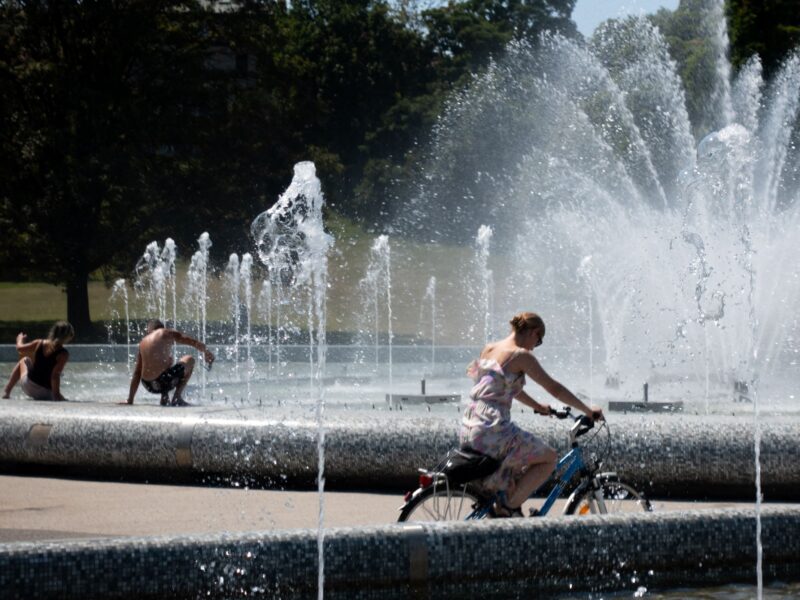
BUDAPEST, Hungary (AFP) — The most severe heat wave ever recorded in Europe roasted central and eastern parts of the continent on Monday as Ukraine’s war-ravaged power grid struggled to cope with the shock of scorching heat.
The heat wave first smothered western Europe last week, sending temperatures to record highs and straining hospitals, transport networks and power grids on a continent where infrastructure was not built to withstand punishing heat and where air conditioning is not widespread.
More than 1,300 excess deaths were recorded in Europe since June 21, according to the U.N. health agency, including several small children who died in locked cars and youths who drowned as they sought relief from the infernal temperatures in unsupervised swimming spots.
France reported at least 74 drowning deaths since June 18 and Poland said 17 drowned on Sunday alone.
“I’m doing the same thing as everyone — trying to stay in the shade and drink a lot of water,” Susanne, a Vienna resident, told AFP on a bank of a river near the Austrian capital.
“I just hope that the politicians will understand the situation and will begin to set a course in the right direction,” she said.
On Monday, the Balkans braced for temperatures of up to 104 F, with firefighters in Bosnia battling blazes sparked during the heat.
At least 130 million people in Europe were expected to swelter through temperatures of more than 95 F, down from 190 million on Sunday according to an AFP analysis.
This heat wave is the most severe ever recorded in Europe, and would have been “virtually impossible” this early in the summer without climate change, the World Weather Attribution group of scientists said.
All-time temperature records have been broken in Germany, Poland and the Czech Republic, as well as for the month of June in the U.K. and in Switzerland.
New shock for Ukraine
Ukraine’s energy network, already pummelled by Russian attacks over more than four years of war, was buckling under the high temperatures on Monday.
In the western Rivne region, authorities introduced emergency power outages to ease pressure on the grid as temperatures passed 96.8 F as 3 p.m., according to data from the state Hydrometeorological Center.
The central Khmelnytsky region also announced temporary outages, and five other regions — from Ivano-Frankivsk in the west to Zaporizhzhia on the front line in the south — warned households and businesses to be prepared for blackouts on Tuesday.
The state weather service said the country would face “intense heat,” with temperatures of 95 F to 100.4 F expected, though this is some way off the national record of 107.6 F recorded in August 2010.
“The heat is also a serious test for equipment that has been operating under wartime conditions for more than four years and has withstood numerous attacks,” Sergii Kovalenko, CEO of the Yasno energy company said over the weekend.
He said that summer was the peak period for repairing the energy network, battered through the winter by repeat Russian attacks, meaning the grid was already “operating at the limit of its capabilities.”
Record temperatures
Over the weekend, the heat scorched the Czech Republic, Germany and Poland, with the countries setting new temperature records of 107.4 F, 107.1 F and 104.9, respectively.
The Berlin police used water cannons to help residents of the capital cool off for a second day running Sunday — this time at the Olympia venue where singer Bruno Mars was performing.
With temperatures cooling in France, the national weather service said on Sunday evening it was already anticipating the possibility of another heat wave in July.
The scorching heat has sparked lively discussion in some countries about the merits of air conditioning, which is used far less in Europe than in some parts of the world.
The EU on Monday refused to be drawn into the increasingly politicised debate, with a Brussels spokeswoman saying the bloc did not have “a particular view or position” on the matter.
—
By Agence France-Presse
Subscribe to our free newsletters
Our weekly newsletter Closing Arguments offers the latest about ongoing trials, major litigation and rulings in courthouses around the U.S. and the world, while the monthly Under the Lights dishes the legal dirt from Hollywood, sports, Big Tech and the arts.
Additional Reads

 Six killed in German 'family tragedy' shooting: Police June 29, 2026