
 Search Articles



(CN) — Nearly 62,000 people died from heat-related causes last summer during record-breaking heat waves in Europe, according to a new study, one that goes on to predict deadly summers will become common as global warming intensifies.
The research was published Monday in Nature Medicine, a peer-reviewed international medical magazine. Its authors, affiliated with universities across Europe, say the comprehensive analysis of the number of heat deaths in Europe last summer it is the first of its kind.
To determine the numbers, the researchers used computer modeling to examine 45.1 million deaths across 35 European countries, narrowing in on deaths between May 30 and September 4, last year’s hottest months.
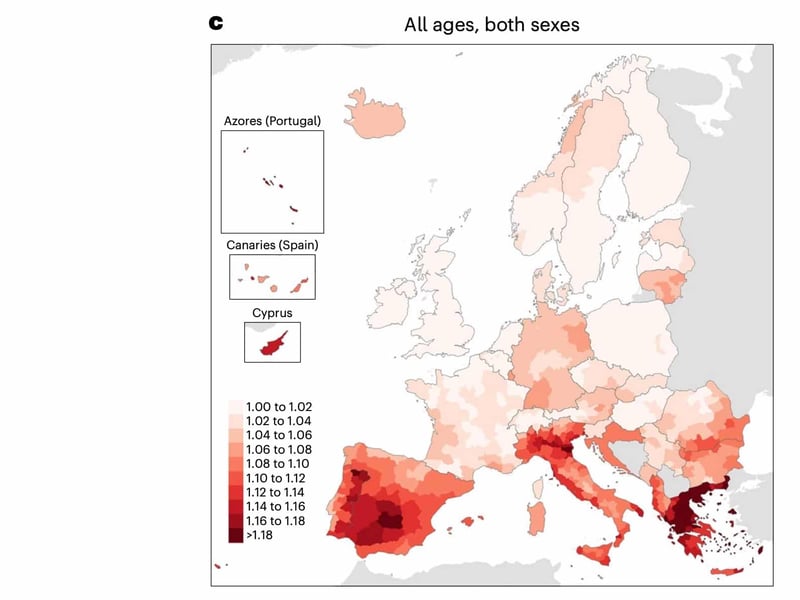
From this, they estimated that 61,672 people died during the continent’s long bouts of extreme heat last year. The most deaths took place in Italy (18,010 deaths), Spain (11,324 deaths) and Germany (8,173 deaths).
The dangers of extreme heat have become a matter of grave concern in Europe since devastating heat waves in 2003 killed more than 71,000 people. Another heat wave that hit Moscow and western Russia in the summer of 2010 led to more than 55,000 heat deaths.
After the deadly 2003 summer, European Union governments developed plans to alert people, in particular the elderly, about the dangers of heat. Meanwhile, the number of air-conditioning units in European homes and businesses has been increasing.
Extreme heat is particularly dangerous for older people with preexisting heart and respiratory diseases. Those who are poorer and more isolated are also considered more at risk. The study found more women than men died last year due to the extreme heat.
The researchers warned that European authorities, especially those in southern Europe, must do even more to protect vulnerable people from heat waves because Europe is warming so fast. Due to its geographic location, the continent is heating faster than other parts of the world as heat-trapping gases, released through human activities, continue to build up in the atmosphere.
“As a major climate change hotspot, these populations will be increasingly exposed to extreme summer conditions and would therefore be expected to experience increasingly higher heat-related mortality in the future,” the paper states. “Addressing geographical inequalities in current and future vulnerability to heat will also need to be prioritized by national and European governments and agencies.”
In the past 30 years, temperatures in Europe have increased by more than twice the global average of 1.2 degrees Celsius (2.16 degrees Fahrenheit) above preindustrial levels. Scientists attribute this warming trend in Europe to warm currents from the Sahara Desert and Africa, heat generated by the Mediterranean Sea, and the loss of sea ice in the Barents Sea and around the Norwegian archipelago of Svalbard.
If Europe continues to warm on this trajectory, the study projects summers will become ever more perilous.
More than 68,000 people could be dying due to heat every summer by 2030, the researchers calculated. In another 10 years, that number could rise to more than 94,000 deaths, or 120,610 deaths by 2050.
Worldwide, research into the dangers of heat waves is receiving a lot more attention as the number of excess heat deaths grows along with global warming and other trends, such as urbanization, demographic growth and an aging population.
With this year also setting new heat records, the urgency of reducing carbon emissions and surviving on an ever-hotter planet is becoming ever more obvious.
World average temperatures were broken last week, and Copernicus, the EU’s climate change agency, reported that the planet recorded its hottest June on record.
Last Tuesday, the U.S. National Centers for Environmental Prediction said the global average temperature hit 62.9 F, surpassing a record set the previous day.
United Nations Secretary-General António Guterres warned that “climate change is out of control.”
“If we persist in delaying key measures that are needed, I think we are moving into a catastrophic situation, as the last two records in temperature demonstrates,” he said.
Courthouse News reporter Cain Burdeau is based in the European Union.
 Follow @cainburdeau
Subscribe to our free newsletters
Our weekly newsletter Closing Arguments offers the latest about ongoing trials, major litigation and rulings in courthouses around the U.S. and the world, while the monthly Under the Lights dishes the legal dirt from Hollywood, sports, Big Tech and the arts.