
 Search Articles


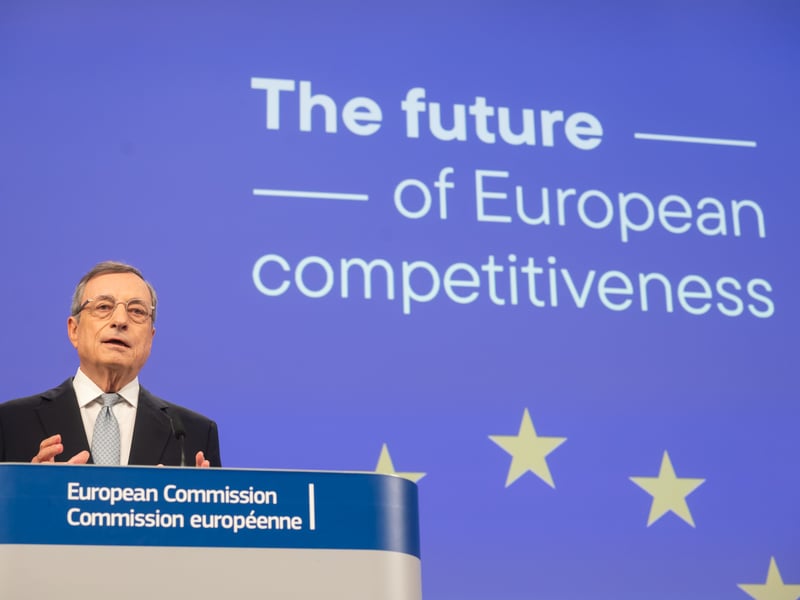
BRUSSELS (CN) — To catch up with the United States and China, Europeans need to invest around $880 billion a year to amp up productivity and create a “new industrial strategy for Europe,” according to a report former Italian Prime Minister Mario Draghi delivered to the European Commission Monday.
Commission President Ursula von der Leyen commissioned Draghi to draw up a plan for the European Union to help the bloc compete on a global scale. As a former European Central Bank chief, Draghi is credited with saving the euro currency in the aftermath of the 2008 financial crisis.
The report underscored worries that Europe’s economy has fallen behind global competitors and that the continent’s prosperity is at risk in the long term.
“For the first time since the Cold War, we must genuinely fear for our self-preservation, and the reason for a unified response has never been so compelling,” Draghi told reporters in Brussels in presenting the nearly 400-page document.
To prevent Europe’s economic decline, the bloc must invest twice as much as it did rebuilding the continent after World War II, Draghi said.
His report was driven by concerns about a “wide gap” in economic growth that has “opened up between the EU and the U.S., driven mainly by a more pronounced slowdown in productivity growth in Europe,” he said.
Draghi identified innovation and emerging technologies as one key weakness. There are only four European companies among the world’s top 50 tech firms.
“Europe must become a place where innovation flourishes,” Draghi said. He warned the bloc was “punching under our power.”
“We need to create foreign economic policy, build up stockpiles, build defense industrial capacity,” he said.
Another key part of Draghi’s proposal is greater EU funding for defense research.
In recent years, and especially since Russia’s invasion of Ukraine, European countries have significantly increased military spending. However, they largely rely on imports of military equipment from the U.S. or other non-EU countries.
“Security is a precondition for sustainable growth,” Draghi said, calling for more strategic autonomy to allow a preference for developing and buying more European-made products.
According to the International Monetary Fund, the EU’s 27 national economies account for 14% of global purchasing power based on gross domestic product, down from more than 20% in 2000, before the United Kingdom left the bloc.
Draghi proposed the bloc massively step up spending through joint borrowing to fund investments, which he said should amount to between at least 750-800 billion euros ($829-885 billion). That is almost 5% of the EU’s GDP.
“The private sector is unlikely to be able to finance the lion’s share of this investment without public sector support,” Draghi wrote, adding that “some joint funding for investment in key European public goods, such as breakthrough innovation, will be necessary.”
The report’s release comes as the European Commission, the bloc’s executive arm, gears up for its next five-year term and a new set of commissioners following EU-wide elections this summer.
Many of the much-awaited report’s nearly 170 proposals are expected to influence Europe’s decision-making over the next five years.
Referring to the EU’s landmark Covid-19 pandemic recovery fund, Draghi proposed issuing fresh “common debt instruments (…) to fund collaborative investment initiatives aimed at enhancing the EU’s competitiveness and security.”
However, he admitted that common loans would only be possible if “the political and institutional conditions are met.”
More frugal EU member states, such as Germany and the Netherlands, have been against moving toward common debt because they fear being forced to pay for poorer countries in southern Europe.
Key recommendations in the report include relaxed competition rules to enable market consolidation in sectors such as telecommunications, integration of capital markets by centralizing market supervision, greater use of joint procurement in the defense sector, and a new trade agenda to increase the EU’s economic independence.
“A joint plan for decarbonization and competitiveness could entail, in specific circumstances, defensive trade measures to level the playing field globally and offset state-sponsored competition abroad,” Draghi wrote. “Never in the past has the scale of our countries appeared so small and inadequate relative to the size of the challenges.”
Despite the ambitious push, many of Draghi’s proposals would need the consent of all of the bloc’s 27 member states to become reality.
“We could do much more if all these things were done as if we acted as a community — but we lack focus on key priorities. We don’t combine our resources to generate scale. And we do not coordinate the policies that matter,” Draghi said.
The initial response from European industry organizations to the proposals has been largely positive.
“The report accurately diagnoses key obstacles to competitiveness, such as regulatory burdens on businesses, fragmentation of the single market, high energy costs and skills shortages," said Vladimír Dlouhý, president of Eurochambres, an association of European chambers of commerce and industry.
“It is also right to point out the need for better coordination at EU level if the disjointed approach to sustainability and competitiveness during the previous five years is to be corrected in the new term,” he added.
Tanja Gönner, the chief of the Federation of German Industries, one of the most influential European industry unions, said the “EU needs just as big a boost in industrial and economic policy in the legislative period that is now beginning as it did in climate policy in the last period, including a “Clean Industrial Deal.”
“Only through fundamental reforms and integration steps can the goals of economic security, growth, environmental protection and social balance be achieved — all this must be done with little bureaucracy and without constant small-scale regulation,” she added.
Others, while they largely agreed with Draghi’s push, were skeptical about how to finance the initiatives.
“It remains to be seen which measures are the right ones to finance the necessary investments. We doubt that joint debts for public funds is the right way,” Mechanical Engineering Industry Association chief Thilo Brodtmann said.
Subscribe to our free newsletters
Our weekly newsletter Closing Arguments offers the latest about ongoing trials, major litigation and rulings in courthouses around the U.S. and the world, while the monthly Under the Lights dishes the legal dirt from Hollywood, sports, Big Tech and the arts.