
 Search Articles


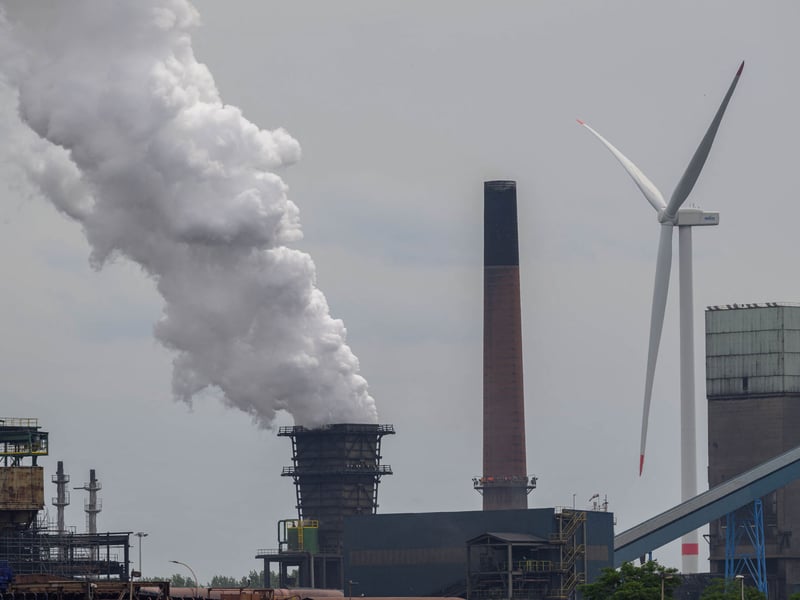
BRUSSELS (CN) — The European Union committed to cutting emissions 90% by 2040 in a climate deal environment ministers reached early Wednesday, but only after weakening the target to allow countries to buy international carbon credits rather than making all reductions at home.
Ministers had gathered Tuesday morning facing pressure to finalize both the binding 2040 climate law and a 2035 target for U.N. submission ahead of Thursday’s COP30 climate summit in Belem, Brazil. The negotiations stretched through the day and into the early morning hours Wednesday.
“We have agreed on the 2040 targets, on all the content of the climate law,” Danish Environment Minister Lars Løkke Rasmussen, whose country holds the EU’s rotating presidency, told reporters Wednesday morning. “We agreed on a nationally determined contribution. So we have now what we were aiming for before we jump the plane to Belem.”
The EU’s 2035 nationally determined contribution commits the bloc under international law to cuts of 66.25% to 72.5% compared with 1990 levels — still a range rather than a single number. Rasmussen had hoped to pin down a specific figure based on the 2040 target but said legal procedures in the European Parliament prevented finalizing that detail.
“Personally, I think there is a very good chance that the EU will overdeliver on the low [end] of the range,” Rasmussen said.
Both deals keep the EU from joining the rogues’ gallery of countries arriving in Brazil with nothing to offer.
Nearly 135 countries missed the Sept. 30 deadline to submit their 2035 targets, according to a U.N. report released Tuesday. The U.N. found that pledges from the 60 countries that did submit “barely moved the needle” on reducing global temperature rise.
The United States will sit out the conference after President Donald Trump pulled out of the Paris Agreement for a second time. EU Climate Commissioner Wopke Hoekstra told reporters Sunday that Washington’s withdrawal leaves a massive void.
“So if a player of that magnitude basically says, ‘Well, I’m going to leave and have it all sorted out by the rest of you,’ clearly that does damage,” Hoekstra said, referring to the U.S. as the world’s No. 2 carbon polluter.
China, the top emitter, submitted a 2035 target last week that falls well short of what climate experts expected. “Most experts were hoping for a nationally determined contribution north of 30%,” Hoekstra said. “And then an NDC that is in all likelihood below 10%? I mean, even with all the diplomatic language I would love to wrap around that, it’s hard to see how that is enough.”
The EU is the world’s third-largest carbon emitter after China and the U.S., and its climate regulations often set global standards that ripple through international supply chains. The bloc’s rules on everything from car emissions to plastic packaging have forced companies worldwide to adapt their practices.
Path to 2040
At the heart of Wednesday’s deal was the 2040 climate law. But the 90% headline target masks a significant concession: The EU will only be required to cut 85% of emissions domestically, with the remaining 5% covered by purchasing carbon credits from other countries. Environmental groups have long criticized such credits as a loophole that lets wealthy nations avoid the hardest pollution cuts at home.
Hoekstra defended the approach Wednesday, arguing that “the planet doesn’t care where we reduce emissions.” He insisted the deal was “absolutely science-based” and compatible with limiting global warming to 1.5 degrees Celsius, or 2.7 F.
But when pressed by reporters on whether the compromise met scientific standards — the EU’s climate advisory board recommended 90% to 95% domestic reductions — Hoekstra pivoted to comparing the bloc’s ambition with other wealthy nations. “Let’s make a comparison between our NDC and that of our friends from Japan, Korea, New Zealand, Australia, Canada, the U.S.,” he said. “I think you will find that these numbers are truly very ambitious.”
The European Commission’s original July proposal would have required countries to make all emissions cuts domestically, with international carbon credits covering only 3% of targets and not kicking in until 2036. That plan drew fire from environmental groups as a loophole. The final deal went further, raising the cap to 5% with details on timing and implementation still to be worked out.
On the eve of the meeting, Teresa Ribera, the commission’s executive vice president for the green transition, had warned ministers against further weakening the plan. “Delaying climate action or lowering our ambition below the required trajectory is an invitation to waste money and miss investment opportunities,” she said.
But ministers added concessions throughout the negotiations. The compromise text lets governments revisit the 90% target every two years.
France secured an emergency brake that could lower the target by 3 percentage points if natural carbon sinks — like forests — fail to absorb expected amounts of pollution. Italy won similar brakes to pause climate rules if industries face severe pressure, along with specific language about “considering the role of zero and low carbon or renewable fuels in the decarbonization of transport,” according to Hoekstra.
The commission also agreed to delay by one year the ETS2 carbon pricing system that would impose costs on fuels and home heating — a measure that had already been agreed but proved politically toxic.
The climate backpedaling fits a broader pattern. EU leaders have scaled back green policies in recent months, putting growth ahead of environmental goals. In October, Brussels gutted its deforestation law — exempting nearly all European producers while foreign exporters still face the rules.
The bloc also pushed through trade deals with Indonesia and South American countries despite warnings they could speed up deforestation and undercut European farmers with cheaper imports.
The EU now has 44 trade deals covering 76 countries — including Indonesia, Mexico and the Mercosur bloc wrapped up or advanced this past year — and is negotiating with India and four others. The push reflects a years-long drive to cut dependence on the United States and China that’s grown more urgent since Trump’s return strained ties across the Atlantic.
The 2040 climate law still requires approval from the European Parliament before becoming binding legislation. With EU leaders set to depart for Brazil on Thursday, both Hoekstra and Rasmussen emphasized that securing any deal was better than arriving at COP30 without commitments.
“Failure here is not an option,” Rasmussen said. “We have a union that has the ability through hard times, but also through difficult decisions to come together.”
Courthouse News correspondent Yuval Molina is based in Brussels, Belgium.
Subscribe to our free newsletters
Our weekly newsletter Closing Arguments offers the latest about ongoing trials, major litigation and rulings in courthouses around the U.S. and the world, while the monthly Under the Lights dishes the legal dirt from Hollywood, sports, Big Tech and the arts.