
 Search Articles


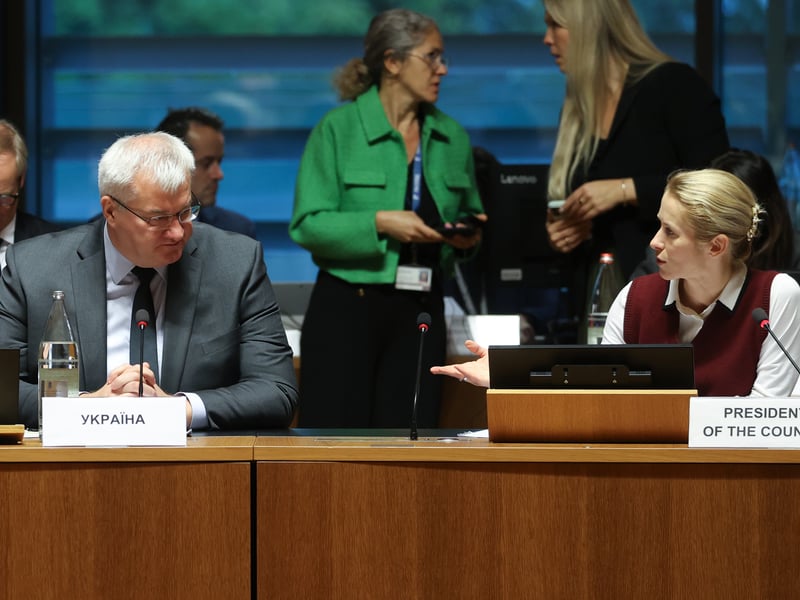
(CN) — European Union foreign ministers scrambled Monday in Luxembourg to respond to Donald Trump’s rejection of Ukraine’s weapons requests, splitting sharply over his planned meeting with Putin as they jockeyed for position ahead of a critical EU summit Thursday where Volodymyr Zelenskyy will appeal directly for support.
The fight exposed a fundamental rift over the U.S. president’s approach, coming days after his tense White House meeting with the Ukrainian leader. Trump denied Ukraine’s request for Tomahawk missiles Friday, telling Zelenskyy to accept Russia keeping occupied territory. The long-range weapons would wreck his planned peace talks with Putin in Budapest, Trump said — talks with no set date that won’t include Ukraine.
Trump doubled down Sunday on Air Force One, telling reporters Russia and Ukraine should “stop at the lines where they are” — with roughly 78% of the Donbas region already under Russian control. “They can negotiate something later on down the line,” he said.
Monday’s debate amounted to a dress rehearsal for Thursday, when EU leaders will have to decide how far they’re willing to go to back Ukraine if Washington won’t. Baltic and Eastern European ministers staked out the most aggressive position, rejecting any deal that excludes Ukraine.
“My wish would have been that it’s President Zelenskyy who meets President Putin, because it’s actually them who have to agree on this,” EU foreign policy chief Kaja Kallas told reporters Monday. “Russia is the aggressor and Ukraine is the victim here, so putting the pressure on Ukraine as the victim is not the right approach.”
If aggression pays off, it “serves as an invitation to use it elsewhere as well,” warned Kallas, a former Estonian prime minister. Finnish Foreign Minister Elina Valtonen said nobody can make decisions “over the head of Europe” about matters affecting the continent.
But Western European ministers signaled more flexibility. Germany’s Europe Minister Gunther Krichbaum said “it’s good that such a meeting is happening.” French Foreign Minister Jean-Noël Barrot called it “useful” for Americans to talk to Russians, though he added Putin’s presence “on European Union soil only makes sense if it allows for an immediate and unconditional ceasefire.”
Denmark’s Foreign Minister Lars Løkke Rasmussen went furthest, calling Trump’s proposal for a ceasefire at current battle lines “an important step forward.”
Divisions complicate sanctions, Ukraine aid
The positioning ahead of Thursday also highlighted Europe’s fundamental problem: Ministers can disagree about Trump’s approach all they want, but the bloc still struggles to deliver what Ukraine actually needs.
Ukrainian Foreign Minister Andrii Sybiha came to Luxembourg seeking air defense systems and ammunition as Russia pounds Ukraine’s power grid ahead of what could be the war’s worst winter. He got promises to keep trying. The EU’s ammunition initiative is still 300,000 rounds short of its 2 million target, Kallas said. A million rounds are available under a Czech-led initiative, but countries need to fund the purchases or transfer weapons from their own arsenals — neither of which they’re rushing to do.
Ukraine is negotiating with Washington for 25 Patriot air defense batteries, but those won’t arrive for years unless European countries speed up their own orders or hand over existing systems. Russian strikes have already destroyed much of Ukraine’s natural gas infrastructure, forcing Kyiv to scramble for liquefied natural gas imports and financing before winter.
The disagreements also complicated efforts to finalize a 19th sanctions package targeting Russian banks and crypto platforms. Austria has held the package up for weeks over concerns about its banks still operating in Russia. Kallas said it won’t pass Monday but could get approved Thursday when leaders meet. The package would restrict Russian diplomats’ travel in Europe for the first time, blacklist another 118 ships and lower the oil price cap to $47.60 per barrel.
Kallas pushed back against pressuring Ukraine to give up territory. “Russia is the aggressor and Ukraine is the victim here, so putting the pressure on Ukraine as the victim is not the right approach,” she said. If aggression pays off, she warned, it “serves as an invitation to use it elsewhere as well.”
But the toughest talk came from Lithuania’s Foreign Minister Kęstutis Budrys, who said the only place for Putin in Europe should be The Hague, where the International Criminal Court has issued an arrest warrant over war crimes in Ukraine. Hungary, which is planning to withdraw from the ICC, said it won’t arrest Putin — a preview of the obstacles any unified EU stance faces.
The EU is also expanding its power to board tankers suspected of smuggling Russian oil. Kallas warned that Moscow’s so-called shadow fleet — aging tankers used to dodge oil sanctions — doesn’t just fund Russia’s war but acts as a launch pad for hybrid attacks. French forces boarded one in early October.
Separately Monday, EU energy ministers agreed to phase out Russian gas imports by January 2028, with most banned starting in 2026.
EU moves on India, stalls on Israel
Ministers also grappled with Trump’s Middle East peace plan that produced last week’s Israel-Hamas ceasefire. Europe wants a role in Gaza reconstruction but can’t agree on how to proceed.
Kallas said proposed sanctions on Israeli ministers are on standby. “We don’t move with the measures now, but we don’t take them off the table either because the situation is fragile,” she said. Ministers remained deeply split — Spain and Belgium want tough action, while Germany and several Eastern European countries say the ceasefire makes sanctions pointless.
Ministers also endorsed a new strategic EU-India agenda following Trump’s claim last week that Indian Prime Minister Narendra Modi promised to stop buying Russian oil. India hasn’t confirmed that — and New Delhi has consistently defended its Russian energy purchases as economically necessary. But if true, the move would cut off one of Moscow’s biggest remaining oil customers and could finally unlock the EU-India trade deal that’s been stalled for years over those purchases.
Thursday will show whether Monday’s splits were posturing or real disagreements over how far Europe goes to back Ukraine without Washington. That’s when EU leaders gather for their regular summit and Zelenskyy addresses them directly — his chance to secure commitments the foreign ministers wouldn’t make. Trump’s meeting with Putin in Budapest could follow soon after, though no date has been set.
Courthouse News correspondent Yuval Molina is based in Brussels, Belgium.
Subscribe to our free newsletters
Our weekly newsletter Closing Arguments offers the latest about ongoing trials, major litigation and rulings in courthouses around the U.S. and the world, while the monthly Under the Lights dishes the legal dirt from Hollywood, sports, Big Tech and the arts.