
 Search Articles


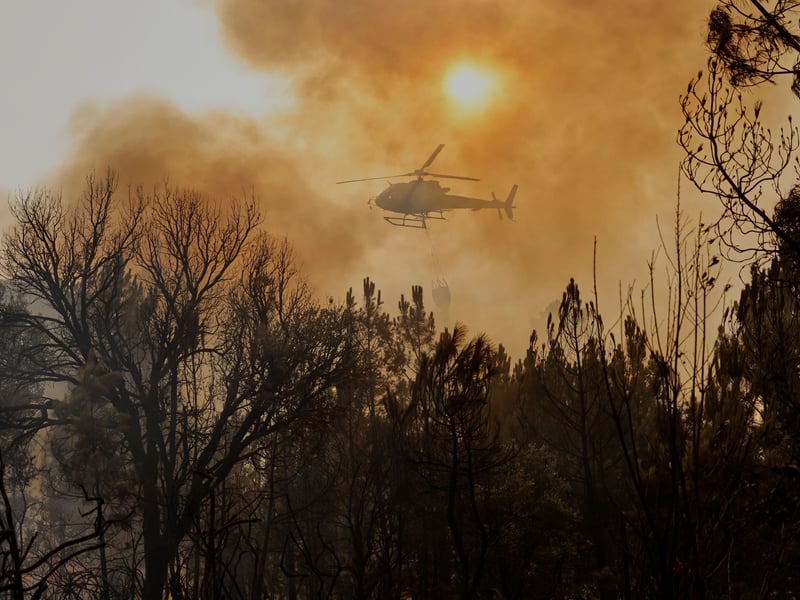
BRUSSELS (CN) — Thousands of Europeans remained displaced Thursday as wildfires continued burning across southern Europe, with Greek authorities warning of “very high” fire danger for Friday amid one of the most severe mid-season tallies in recent years.
The ongoing crisis has killed at least six people and consumed nearly 1.1 million acres according to the European Forest Fire Information System — more than double the 19-year average of about 540,000 acres for this time of year.
Greek officials issued fire risk warnings for Friday across multiple regions including Attica, parts of the Peloponnese, Central Greece and several Aegean islands, as active blazes burn near the country’s third-largest city of Patras and on the island of Chios.
Outside Patras, emergency crews struggled to save homes and agricultural areas from fires that spread through forested hills and olive plantations.
Thirteen firefighters received medical treatment for burns and other injuries, fire brigade spokesman Vassilis Vathrakoyiannis said in a televised briefing.
“Today is another very difficult day with the level of fire risk remaining very high across many parts of the country,” Vathrakoyiannis said.
In France, approximately 2,000 evacuees were barred from returning to their homes last week in the fire-ravaged Aude region, in what officials called the country’s largest wildfire since 1949. The blaze killed one person and injured 18 others —including 16 firefighters — while destroying nearly 40,000 acres.
In Spain, authorities confirmed evacuating approximately 2,000 people — including tourists — from the resort town of Tarifa as fires burned near beaches. Spanish officials reported three fatalities — an equestrian center worker who died from burns while attempting to rescue horses in Tres Cantos, a suburb north of Madrid, and two volunteer firefighters in the northwestern Castile and Leon region.
“All the government’s resources are working to address the difficult situation our country is facing. The threat remains extreme,” said Spanish President Pedro Sánchez on Thursday, after the death of the second volunteer.
Portugal’s emergency remains critical, with more than 900 firefighters battling “very unfavorable” conditions in the town of Arganil. Portuguese authorities reported fires have consumed nearly 104,000 acres this year — eight times more than the same period last year.
European countries activated a continent-wide emergency response system — essentially Europe’s version of mutual aid for disasters — with Spain activating the EU Civil Protection Mechanism for forest fires on Wednesday for the first time, according to EU officials.
In total, the system has been activated 16 times during the current fire season, matching the total for all of 2024.
The European Commission — the EU’s executive branch — deployed 22 firefighting airplanes and four helicopters through shared emergency reserve program rescEU — funded by Brussels and established in 2019.
Between July and September, nearly 650 firefighters from 14 European countries were strategically prepositioned in high-risk areas of France, Greece, Portugal and Spain.
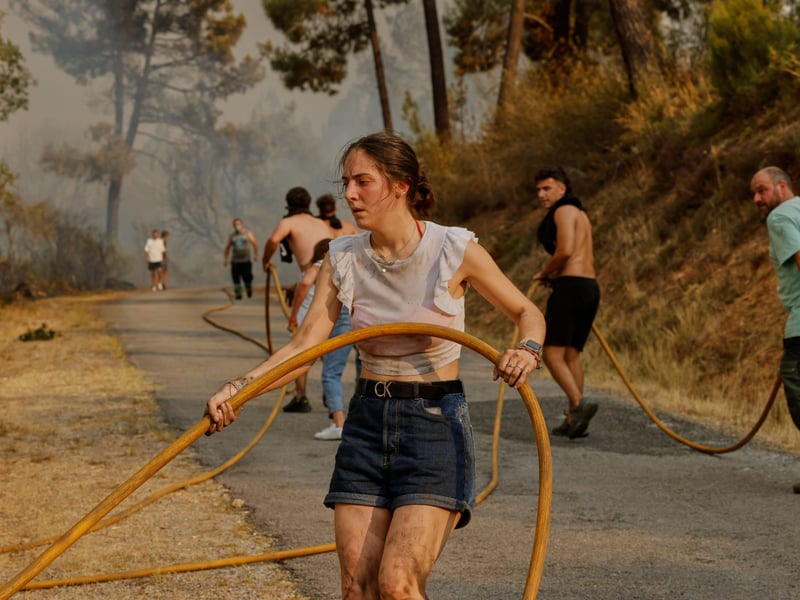
Current wildfires are generating massive carbon emissions, with 2023 European fires releasing over 22 million tons of CO2 according to the latest official data — equivalent to roughly one-third of all emissions from international aviation in the EU annually. During the comparable period last year, European wildfires produced 10.6 million tons of CO2 emissions.
Temperatures soared above 100 degrees Fahrenheit across the continent this week, with the EU’s Copernicus Climate Change Service — a program that tracks global weather patterns — reporting July 2025 was the third-warmest July ever recorded, with a global average surface air temperature of 16.68 °C (62.02 degrees Fahrenheit), which is 0.45 °C above the 1991–2020 July average.
Turkey’s national weather service recorded a new national temperature record of 50.5°C (122.9° Fahrenheit) in July.
The crisis has highlighted Europe’s vulnerability to extreme weather events, with climate disasters causing economic losses of 738 billion euros ($804 billion) in the EU between 1980-2023, according to the European Environment Agency, with over 162 billion euros ($177 billion) occurring just between 2021-2023.
Scientists attribute the intensifying fire season to climate change, with hotter, drier weather creating conditions for fiercer blazes. The U.N. World Meteorological Organization reports that extreme temperatures caused approximately 489,000 heat-related deaths annually between 2000 and 2019, with 36% occurring in Europe.
The wildfire risk has expanded beyond the traditional Mediterranean region to affect countries such as Czech Republic, Germany and Sweden. Between 2007 and 2024, nearly 20% of all requests for assistance through the EU Civil Protection Mechanism were in response to wildfires.
European Commission spokesperson Eva Hrncirova said Thursday that in 2024 “the majority of the wildfires around Europe were man-made, which is quite alarming news.”
Looking ahead, the European Commission has allocated resources to expand firefighting capabilities, with plans to acquire 12 new firefighting planes to be based in Portugal, Spain, France, Italy, Croatia and Greece, plus three helicopters for Slovakia, Czech Republic and Romania. The first helicopters are expected by 2026, with planes available during the 2028 wildfire season.
French authorities also warned residents this week to avoid fire-damaged areas due to hazardous conditions — including fallen power lines — while Spanish officials maintained evacuation orders and emergency shelters. Greek authorities urged citizens to avoid activities that could spark new fires, including outdoor burning, using spark-producing machinery and smoking in rural areas.
The EU’s Copernicus Climate Change Service confirmed 2024 as the warmest year on record globally, with average temperatures exceeding 1.5°C (2.7° Fahrenheit) above pre-industrial levels for the first time.
Officials warn that such conditions will become increasingly common without accelerated climate action, as wildfire seasons become longer and more intense across Europe.
Courthouse News correspondent Yuval Molina Obedman is based in Brussels, Belgium.
Subscribe to our free newsletters
Our weekly newsletter Closing Arguments offers the latest about ongoing trials, major litigation and rulings in courthouses around the U.S. and the world, while the monthly Under the Lights dishes the legal dirt from Hollywood, sports, Big Tech and the arts.